






Dragonfly

Image by Rezwan

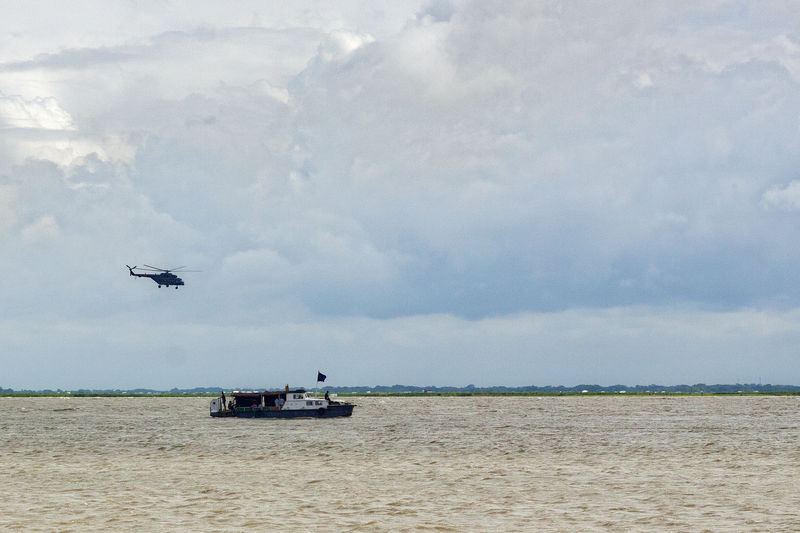
Overcrowded passenger ferry capsized in the Padma River in Munshiganj, Bangladesh

The World Cup Goal-E Project

This street in Bangladesh has a colorful world cup celebration

New Chum Hill Ruins

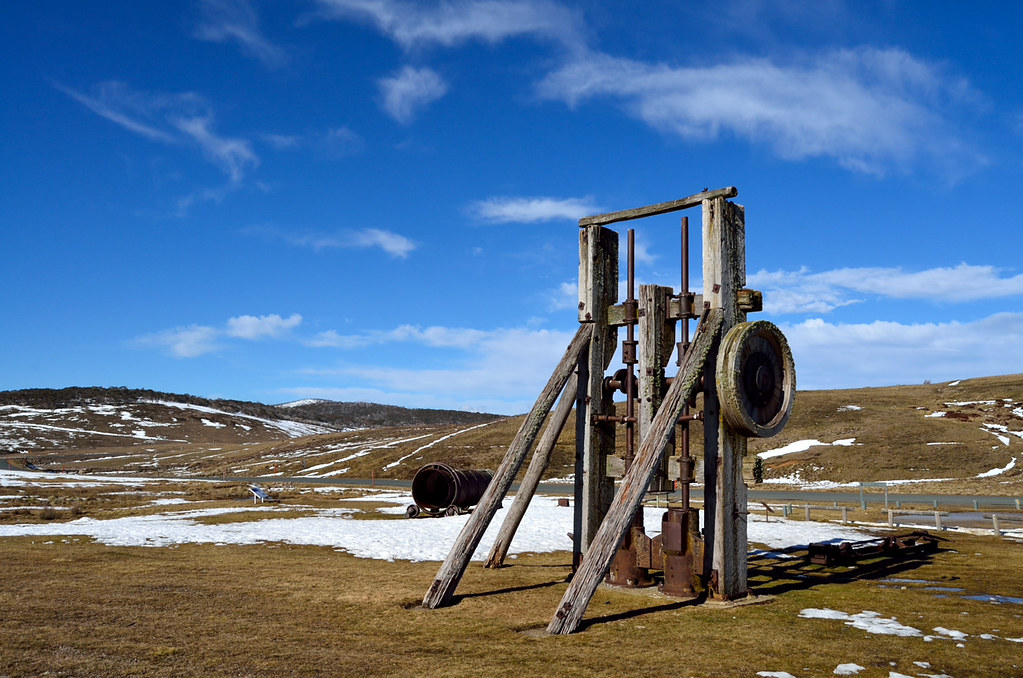
Remnants of Kiandra gold mine at New Chum Hill, #nsw #australia

Showing posts with label Microcredit. Show all posts

December 05, 2010

Bangladesh: Grameengate And Beyond


Bangladeshi Nobel Laurate Dr. Muhammad Yunus. Image from Flickr by World Economic Forum. CC BY-SA

The hottest topic in Bangladesh now is the allegation against Nobel laureate Dr. Muhammad Yunus of diverting foreign aid from Grameen Bank to another sister company called Grameen Kalyan. The objective of Grameen Kalyan is to provide financial support in the form of loans and grants to the staff and members of Grameen Bank and their families. An investigative documentary by Danish filmmaker Tom Heinemann titled "Fanget i Mikrogjeld" or "Caught in Micro debt" was aired last Tuesday on the National Norwegian Television (NRK).

Heinemann took a critical look at Microcredit operations in Bangladesh saying that many loan receivers "had multiple loans in various micro credit banks and organizations and had a hard time trying to pay back their loans." In addition he stumbled into some documents from the archives of the Norwegian aid agency Norad which tells that Grameen Bank shuffled donor money to Grameen Kalyan without prior permission of the donors to avoid potential government tax @40%. In an exclusive report the secret documents were published by BDNews24.com, the largest online news agency in Bangladesh. The local media jumped on this story and the bloggers are divided on this issue.

The Grameen Bank response denied any wrong doings.

Asif at Unheard Voice provides the outline of the arrangement of Grameen Bank and discusses about the impact of the documentary:

1. Donors (Norad et al) gave a large cash grant to Grameen Bank (GB)
2. Instead of paying back interest or principal, GB was to put aside 2% of those funds for employee welfare projects (SAF)
3. GB was afraid of a regulatory change levying 40% tax on that outflow and wanted to give SAF the “attention it deserves”
4. So GB created Grameen Kalyan (GK), gave them a large amount of cash and borrowed it back at 2%

Norad‘s problem was that:

1. GB never told them about this particular piece of legerdemain they happened to find out almost by accident (the bdnews24 story has a few PDF files of those communications)
2. Their memorandum of understanding was with GB and the Bangladesh Government about the use of the 2% for SAF, not with GK, so this left things in the kind of vacuum they wouldn’t be comfortable with

The documentary claimed as much as USD 100 million had been siphoned away and — notwithstanding Norwegian claims that Yunus is not corrupt — led to lurid claims in Bangladesh media like Yunus ‘siphoned Tk 7bn aid for poor’. GB’s detailed riposte notwithstanding, the damage has been done.

Journalist and blogger Maskawaith Ahsan defended [bn] Dr. Yunus in a post titled "In a media coup by Norway Dr. Yunus killed in Dhaka":

অধ্যাপক ইউনুসের বিরুদ্ধে ইউরোপের অর্থ গ্রামীণের বোন সংস্থায় ট্রান্সফারের যে অভিযোগ উঠেছে, তা উনার অর্থ বিষয়ক স্পর্শ কাতরতার ফলাফল। ওই অর্থ দিয়ে ইউনুস ভূমধ্যসাগরের তীরে প্রাসাদ তৈরী করেন নি, সেটি গ্রামীণের বোন সংস্থায় বিনিয়োগ করা হয়েছে। তবুও এটি দাতাদের সঙ্গে চুক্তির বরখেলাপ।

The accusations against Dr. Yunus of transferring European money to a sister concern is the result of his sensitiveness with finance. He did not build a palace in the Mediterranean, it was invested instead. Still it was against the agreement with the donors.

Baki Billah writes:

এটা একটা পদ্ধতিগত সংকট হতে পারে কিন্তু তার সাথে চৌর্যবৃত্তির সূত্র আবিস্কার করার মৌলিক কোন বিষয় আছে কি ? প্রামাণ্যচিত্র নির্মাতা টম খুব সরলে এ প্রশ্নের উত্তর দিয়েছেন, তিনি বলেছেন, অনেক চেষ্টা করেও তিনি ইউনুস সাহেবের সাথে যোগাযোগ করতে পারেন নি। তিনি কিভাবে চেষ্টা করেছেন?

This could be a procedural fault, but is there any reason to malign him with theft of money? The documentary maker Tom answered the question simply by saying that he could not contact Mr. Yunus for his response after repeated attempts (editors note: for 6 months). How did he try?

In another post of Maskawaith Ahsan, a commenter named Netpoka comments:

দাতাদের দেওয়া টাকা সরিয়ে নেওয়ার যে অভিযোগ উঠেছে, তাতে কেবল ডঃ ইউনুসকেই দায়ী করা হচ্ছে। অথচ গ্রামীণ ব্যাঙ্কের একটি বড়সড় পরিচালনা পর্ষদ আছে, যাতে প্রতিনিধিত্ব করেছেন রেহমান সোবহানের মত ব্যক্তিগণও। অর্থ সরানোর দায় তো তাদের সকলেরই হওয়ার কথা!

আর দাতাদের দেওয়া টাকা থেকে এক টাকাও তিনি নিজের ব্যক্তিগত কাজে ব্যয় করেছেন কি? শুনেছি আজ পর্যন্ত তাঁর নিজের একটি মাথা গোঁজার জায়গও নেই - থাকেন গ্রামীণ ব্যাঙ্ক ভবনের একটি ফ্ল্যাটে। অথচ তাঁকে এখন বলা হচ্ছে দুর্নীতিবাজ।

নরওয়ে এবং টেলিনর কেন ডঃ ইউনুসের পেছনে লেগেছে, তা সবাই জানে। তারপরও আমরা তাঁকেই ভিলেন বানাই।

The accusation of transferring donor money is being directed to Yunus only. But Grameen Bank is run by a big management committee where reputed people like Rehman Sobhan are also there. The accountability should be demanded from each one of them.

And did he ever spent a Taka for his own self? I heard that he even do not own a house - he stays in a flat provided by Grameen Bank. And now they accuse him of corruption.

Everybody knows why Norway and Telenor are after him. Then why are we making him the villain?

It may be noted here that a few years ago Yunus had a fight with Norwegian Telecoms giant Telenor (majority owned by Norwegian government) over management control of Grameenphone, Grameen Bank's joint venture. Yunus wanted to convert Grameenphone, the leading and profitable Telecommunication company in Bangladesh, to a social business enterprise [where profits are reinvested in the company rather than taken out], but Telenor did not accept. The Norwegian Telenor was later caught in a labor scandal.

Shuvashish Das posts a detailed analysis [bn] on this issue trying to explain why after 12 years the issue has been exposed to media:

২০১০ সালের মাঝামাঝি থেকে গ্রামীণ কল্যাণের অর্থ গ্রামীণ ব্যাংকে স্থানান্তরের জন্য সিডা, নোরাড আবার চাপ দেয়। ৬০৮ মিলিয়ন ক্রোনার (এর মধ্যে ৩০০ মিলিয়ন দেয় নোরাড, বাকিটা অন্যরা) গ্রামীণ ব্যাংক থেকে চলে গেছে গ্রামীণ কল্যাণে। অথচ ফেরত এসেছে মাত্র ১৭০ মিলিয়ন। বাকিটা এখনো গ্রামীণ কল্যাণে থেকে গেছে।

২২ আগস্ট ২০১০
গ্রামীণ ব্যাংক একটা ইমেইল দুটি ব্যাখ্যা জানায়-
গ্রামীণ ব্যাঙ্কের কর্মী আর সদস্যদের উন্নয়নের জন্য এই অর্থ স্থানান্তর।
গ্রামীণ ব্যাংক গ্রামীণ কল্যাণে কর ফাঁকি দেয়ার জন্য অর্থ স্থানান্তর করেনি। কারণ ১৯৮৩ সাল থেকে গ্রামীণ ব্যাংককে কোনো কর দিতে হয় না।

CIDA and NORAD started again in mid 2010 to pressure Grameen Bank to transfer the donor loan from Grameen Kalyan. 608 million Kroner (300 mill by NORAD) was moved from Grameen Bank but only 170 million Kroner was refunded till to date. The rest of it still lies with Grameen Kalyan.

22nd August 2010
Grameen Bank explained in an email -
The money was transferred to provide support to the staff and members of Grameen Bank and their families.
Grameen Bank did so not to avoid taxes because Grameen Bank operations are exempted from tax since 1983.
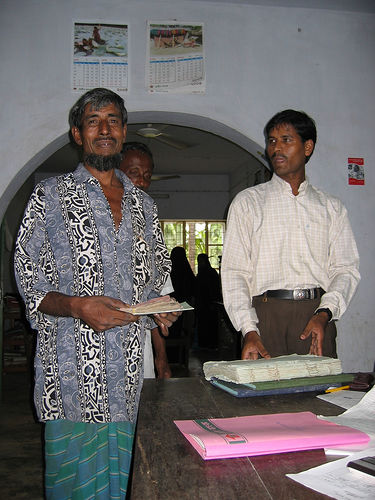


Poor bangladeshi receiving loan (w/o collateral) from the Grameen Bank. Image from Flickr by Jeevs Sinclair. CC BY-NC-SA

In the end Shuvashish asks some valid questions:

বাংলাদেশের ক্ষুদ্রঋণ সংস্থাগুলো ২০ থেকে শুরু করে ১০০% বা তারও বেশি সুদ নেয় গরিব মানুষের কাছ থেকে। ক্ষুদ্রঋণ দারিদ্র্যকে হালকার ওপর ঝাপসা প্রশমিত করে দীর্ঘমেয়াদি করে। উচ্চসুদের কারণে গরিব গরিবিমুক্ত হওয়ার সুযোগ পায় না। কিছু কামেল লোক হয়তো বেরিয়ে আসতে পারে। ঋণের যাঁতাকলে দীর্ঘমেয়াদে আটকে গেছে এমন লোকের পরিসংখ্যান জানা জরুরি। ক্ষুদ্রঋণ কেবল ভালো ভালো জিনিসগুলো পাবলিককে দেখায়, পেছনের বাজে দিকগুলো লুকিয়ে রাখে। এসব সমালোচকের দৃষ্টিতে দেখা প্রয়োজন। গ্রামের মানুষের টাকা নাই, তাদেরকে ঋণ দেয়া একটা ভালো ব্যবস্থা; কিন্তু ঋণের চক্রে ঢুকিয়ে দেয়া অমানবিক। [..] সরকারকে কর দিতে হয় না বলে দেশে প্রায় চার হাজারের মতো ক্ষুদ্রঋণ ব্যবসা। ২৫ থেকে ৩০ হাজার কোটি টাকার মতো ঋণ বিতরণ হচ্ছে প্রতি বছর। সহজে মুনাফা অর্জনের জন্য এর চেয়ে ভালো ব্যবসা আর নেই। সরকারের উচিত এদের উপরসর্বস্ব ভালো কথাগুলো খতিয়ে দেখা। আর নরওয়ে উদ্দেশ্যমূলকভাবে এই আচরণ করলে সেটারও বিহিত হওয়া দরকার।

Many Microcredit organizations (Editors note: not only Grameen) claim interest from 20% to 100% from the poor loan clients. Microcredit minimizes poverty upfront, but prolongs it. The poor cannot get out of poverty because they have to pay high interest. In reality only a small portion may get out of poverty. We need to learn about the statistics of those people who are stuck in the cycle of debt. Microcredit only focuses on successes but tries to hide the failures. One has to look at it with a critical viewpoint. The rural poor do not have money, so providing them with loan finance is a good thing. But letting them into the cycle of debt is inhuman. There are more than 4000 Microcredit organizations running in the country because they don't have to pay tax. Every year 250 - 300 billion Taka ($3.5-$4.2 billion) are being disbursed to the poor. There is no other business than this to make easy money. The government should investigate these operations. And if Norway is deliberately doing this (to Yunus), this should also be investigated.

(Also published in Global Voices Online)

February 19, 2010

Quote Of The Day

After 30 years in Bangladesh, BRAC has more or less perfected its way of doing things and is spreading its wings round the developing world. It is already the biggest NGO in Afghanistan, Tanzania and Uganda, overtaking British charities which have been in the latter countries for decades. Coming from a poor country—and a Muslim one, to boot—means it is less likely to be resented or called condescending. Its costs are lower, too: it does not buy large white SUVs or employ large white men. - The Economist

June 29, 2009

SMS Services in Uganda from Grameen, Google & MTN

From The White African:
Grameen Foundation’s AppLab has released a new suite of mobile phone applications developed in Uganda, using Google SMS Search and in partnership with MTN Uganda as the mobile operator. The services include:
  • Farmer’s Friend: a searchable database with both agricultural advice and targeted weather forecasts
  • Health Tips: provides sexual and reproductive health information
  • Clinic Finder: helps locate nearby health clinics and their services
  • Google Trader: matches buyers and sellers of agricultural produce and commodities as well as other products. Local buyers and sellers, such as small-holder farmers, are able to broaden their trading networks and reduce their transaction costs. (known locally as “Akatale SMS”)
This has been developed with a partnership between MTN Uganda, the Grameen Foundation and Google.

Here is a promo video from Uganda:


My question is why we are not seeing these kinds of sms based activism in Bangladesh?

An Idea That Works Worldwide

Check out the interview with Dr. Muhammad Yunus at Knowledge@Wharton.


"… it has worked all over the country, all over the world. In many countries, they said, “Well, our country is not like Bangladesh. We don’t have such a huge density of population and not as much poverty concentrated in our population. So in our country it won’t work.” We said, “Well, you debate about your country and Bangladesh. Give the task to us. We will go and do it for you.” Many countries accepted that, so we started doing it. We did it in Turkey. We did it in Kosovo. We did it in Costa Rica, Guatemala, China, India and many other places to demonstrate those kinds of things."

September 29, 2008

Quote of the day

"Today, if we are prepared, we could buy some of those falling banks in the United States, no problem, it's possible. Don't ignore them (the poor) ... we lend over a billion dollars a year....We have to get out of the mindset that the rich will do the business and the poor will have the charity."

- Dr. Muhammad Yunus at former U.S. President Bill Clinton's philanthropic summit, the Clinton Global Initiative.
Reuters: Unlike Wall Street, which is reeling from a flood of loans that may never be paid back, Grameen bank has a recovery rate of more than 98 percent.

June 21, 2008

Girl Effect

January 18, 2008

The Green Children

The Green Children is a young band of musicians inspired by Professor Muhammad Yunus. After visiting Bangladesh and India to learn more about microcredit, The Green Children were incredibly inspired by the borrowers they met with. From its website:
Milla Sunde and Tom Bevan established The Green Children Foundation to support microcredit, education and healthcare. Last year, The Green Children shot a music video in Bangladesh to celebrate the work of Professor Muhammad Yunus, the father of microcredit and founder of The Grameen Bank.

The Green Children have reached the target of $500,000 which will go towards the first dedicated eye hospital in rural Bangladesh.

They told Professor Yunus the good news during his recent visit to California. The hospital is due to be completed in March next year and will serve 50,000 people a year, 10,000 of which will receive the vital cataracts operation and escape from a life of blindness!
Please support them.

Via The Scientific Indian

August 16, 2007

Dr. Yunus in Singapore

Singapore’s foreign affairs minister George Yeo writes in Beyond SG blog. He recalls his recent meeting with Dr. Muhammad Yunus, the Nobel laureate banker from Bangladesh. He says:
"By doing something simple with passion and conviction, Mohammad Yunus has done good for millions of people. I find him a great inspiration".
I am just wondering when we will see a minister from Bangladesh blogging?

July 24, 2007

A podcast about Bangladesh

David Sasaki, the director of the Global Voices Outreach project has produced a podcast on Bangladesh and the Nari Jibon project, which received a micro-grant.

David worked a lot to learn about Bangladesh and incorporated many aspects in his podcast (the link is given below).

icon for podpress Intro to Nari Jibon Project

July 07, 2007

A review of Banker to the Poor

Chandrahas did a great review in The Middle Stage and in The Mint on Dr. Muhammad Yunus's autobiography "Banker to the Poor". Don't forget to check it out.

July 03, 2007

The greatest entrepreneurs of all time

Businessweek compiled the top 30 greatest entrepreneurs by a panel of professors, authors and journalists. No surprise, Bangladesh's Dr. Muhammad Yunus is on the list.

On a side note it was entertaining to read a comment by an Indian in the Businessweek post. He vented his frustration on the selection of Wipro's Azim Premji (his countryman) saying that "it is amazing that among 31 people there is not a single Hindu from India mentioned. The Ambanis, InfoSys.....". He went further to claim that The New York Times has a infestation of "syndicated writers" on the Wahabi payroll. Classic case of religious racism.

May 21, 2007

Dr. Yunus in Berlin

I met Dr. Muhammad Yunus today in Berlin. He was here in the SPD office Willy-Brandt House at Wilhelmstrasse for a reception of the local Bangladeshis (Photo: Yunus with an organizer).

This is his second visit to Germany in this month. He is here to attend the preparatory meetings of the G8 summit to be held next month. Chancellor Angela Merkel, leading the German presidency of this summit is trying to do something for the women of Africa. She has invited Dr. Yunus to share his experience of working with the economic development of women.

Dr. Yunus delivered his speech in his trademark fashion. He spoke about his work, Grameen bank and nobel prize. I have read or heard a lot on these issues. The new thing I had learnt that the beggar loan scheme was an experiment to prove that every human being is an entrepreneur at heart, many of them do not get the chance to explore it.

I was waiting for the question and answer session. The current issues with him came up. He avoided the answer why he had retracted himself from politics. He said that he had discussed about it to the press, he has nothing more to add. Answering a question he said that he initially supported the 22nd January Election because he thought not having election in time would create more chaos in the country.

He refuted the claims about high interest rates of Grameen Bank by saying that the figures of 30% or 50% are only rumors. There are four types of loan programs in Grameen Bank. Capital for making these loans are collected from the deposits of these loan takers. These people also have separate accounts where they deposit their savings. They earn interest @ 8-12% depending on schemes. On an average the cost of capital for Grameen Bank is 10%. The loan programs are as follows:

1) Housing loan - 7% interest per annum (less than cost of capital)
2) Education loan - no interest while a student - after that 5% interest (less than the cost of capital)
3) Loan for beggars - no interest
4) Other loan schemes - maximum 20% interest pa.

Dr. Yunus said that the 10% interest in addition to the cost of capital is mainly to cover the loss in other loan programs. He said that in contrary to public belief he is not the owner of Grameen Bank. Rather the loan taker women own and run the band through a board where he is an adviser. When he proposed that whether he should cut the high interest rate (Govt. sector average 15%, private sector average 18%) and lower the interest on their deposits as well they refused. They said that they will be able to bear this much interest rate.

Around 100 Bangladeshis were among the crowd. It was again proved that he can enthrall the audience with his charismatic speech.

May 10, 2007

Microlending - the 2.0 concept of Microcredit

Most of us know about Microcredit and how it operates. An institute offers small loans to a group of individuals without collateral and peer pressure and observation secures the proper utilization and return of the money. But what if this becomes more interactive like Web 2.0?

What if a group of individuals finance a small loan to one or more individuals instead of the institute? Prosper, a 15-month-old venture is doing just that in USA combining social networking with online auctions.

Wired News has details:
"Prosper's marketplace is a blend of eBay-like bidding auctions and social networking, and is conceptually related to the emerging world of microcredit.

Wannabe borrowers give Prosper permission to verify their identity and allow the company to access their financial data as collected by Experian, one of the three big credit-scoring agencies.

Prosper then gives the borrower a credit rating and helps match his or her loan request with a number of lenders. A $5,000 loan, for instance, might be funded by 50 people who each lend $100.

Lenders use borrowers' credit scores and other financial data to set interest rates that balance risk and return, while borrowers assemble their loans piecemeal from lenders' offers, giving preference to the lowest interest rates offered to them."
Just look at this instance:- A wife and mom is raising a loan for her daughters wedding. She needs $8000 and got 66% funded by 55 bids (persons) at promised 28.5% per annum return (figures when written).

The only question is what is the security offered by Prosper.
"To keep bad loans from poisoning the well, Prosper blocks borrowers who have defaulted on their loans. Over half the company's engineers work on antifraud measures, according to Witchel, and Prosper insures lenders against money lost due to identity theft.

Borrowers who miss payments on Prosper face the same consequences as they would if they miss a payment with any form of bank credit including the reporting of late payments to the credit bureaus. Borrowers also incur late fees, which are collected by Prosper and passed onto the people that loaned the money."
Prosper says that its the borrowers and lenders who are taking decisions, they are just providing the platform. There give no guarantee that the loan will be repaid. Their suggestion:
The way to ensure a good return on your investment is to diversify your lending—create a standing order to place bids on many listings, and spread your risk across many borrowers. Even if one of your borrowers defaults, the return from your other borrowers will more than make up for the loss.
And how Prosper is financed?
Prosper charges a 1% or 2% loan closing fee each time a loan is funded. In addition, Prosper charges lenders an annual loan servicing fee of 0.5%-1%.
Microcredit is really a revolutionary idea which is prompting these kind of extra-ordinary innovations. The conventional banking will certainly evolve as more consumer friendly in future especially targeting those who have less.

January 19, 2004

Grameen Bank Model helping people in Rhode Island, USA

Thrive, based on the international Grameen Bank from Bangladesh, brings tools from the village for Western women to gain financial independence. The goal of this program is to create economic self-sufficiency among predominantly struggling women in Woonsocket city and surrounding communities. Read here for more.

Bangladesh is proud of Dr. M. Yunus and his Grameen Bank which has become a micro credit icon in the world. The Grameen Bank was started in Bangladesh in 1976 as an action-research project that attempted to provide tiny loans to very poor people to allow them to start "micro-businesses." Now Grameen Bank has 2.4 million borrowers, 94% of whom are women, and has loaned more than $3.7 billion in amounts averaging less than $200. Grameen Bank models are replicated in many countries of the world.

Mr. Yunus's views:

We can remove poverty from the surface of the earth only if we can redesign our institutions - like the banking institutions, and other institutions; if we redesign our policies, if we look back on our concepts, so that we have a different idea of poor people.

To learn more about Grameen Bank click here.