Screenshot of Google Bus from the Intro Video on YouTube (click to watch the video)
A team from tech giant Google is driving across Bangladesh to teach half a million college and university students throughout Bangladesh how to make the most of the Internet. The specially retrofitted Google Bus powered with 3G mobile Internet will visit 500 campuses in 35 locations across the South Asian country.
More and more people in Bangladesh are going online, thanks to 3G mobile Internet. In last two years, Internet penetration jumped to 20 percent from just 5 percent in 2012. These new users, especially young people, do not have adequate training to harness the potential of Internet and new media.
The Google Bus initiative seeks to change that, not only allowing students to connect to the Internet but also learn about new tools that aid their education and development and attend instructor-led training sessions. Students involved in the project will also be able to use a number of Internet-connected Android devices.
The bus has already visited several colleges and universities in the capital Dhaka. In the coming months, it will start its journey towards academic institutions in and around Chittagong, Khulna, Sylhet, Rajshahi, Rangpur, Barisal and other major cities.
Netizens have expressed their enthusiasm for Google's initiative:
The Google bus team came to our #ACC college Campus..It's just great :) Though it's new to me but feeling excited. Hope in Bangladesh it will spread soon and gain popularity...
Hi, I'm bristy from tejgaon college. I like Google Bus. It is very essential for our daily life. So I like it very much.
On Bangladeshi blog Jhalmoori, Ahmed Rabib Towsif explained the significance of the Google Bus:
Google as we all know by their search engine is a multinational company with a mission to organize the world’s information and make it universally accessible and useful. With the Google Bus Bangladesh initiative it would not only benefit the youth from today, but benefit the whole country tomorrow.
Activists kissed in front of TV camera, and a fracas ensued with conservative participants in a TV talk show of Malayalam language channel Mathrubhumi (click to watch video)
Dozens of people were arrested at a Facebook-organized protest in the Indian state of Kerala to challenge conservative scorn of public hugging and kissing.
The "Kiss of Love" campaign, which says it was taking a stand against "moral policing" by right-wing groups, gathered hundreds of protesters on November 2, 2014 Sunday along the shore of the city Kochi, In the Indian state of Kerala, defying a police ban. They faced off with conservative members of student wings of political parties, who prevented them from reaching their intended location. Around 50 of the protesters including the organisers were soon arrested by police, who cited intent to disrupt the peace.
A group of protesters broke away from the police cordon and kissed each other publicly. A large crowd was waiting there to see the protest.
Public displays of affection have long been seen as vulgar in Indian societies. Even in Bollywood cinema, kissing scenes have been treated as revolutionary, although the trend is changing.
But hugging and kissing in public is still not universally accepted in India. On October 23, a Malayalam news channel owned by Indian National Congress political party carried a report with visuals of young couples kissing and embracing in several coffee shops and restaurants in north Kerala’s Kozhikode city, terming them “immoral activities.” This prompted several people, alleged to be members of the Bharatiya Janata Yuva Morcha, a youth-wing affiliated with the ruling Bharatiya Janata Party, to vandalise a coffee shop in Kozhikode. They first criticised the public display of affection by some couples there and then went on a rampage.
In response, a group of young people calling themselves "free thinkers," launched a Facebook page for “Kiss of Love.” It has so far gathered more than 69,000 likes. It describes itself on the page (at the time of writing the report):
Moral policing is a criminal activity. Most political parties and religious organisations try to do that. A group of young bloods join their hands together to prove to the society that kiss is the symbol of love.
More than 7,000 users accepted the Facebook event invitation for the November 2 "Kiss of Love" protest at Marine Drive in Kochi. The organisers stressed that it wasn't "a kiss fest" but a gathering of people of all ages to raise awareness against moral policing.
The event received pushback before it even began. Volunteers were attacked by two men while promoting the "Kiss of Love" protest. Police also denied permission for the event, although two petitions to the high court to stop the event were rejected.
The following Tweet mentions a TV talk show recorded a few days earlier bringing the activists and the conservatives including political party members for a discussion. At one point two activists started kissing in front of camera and a heated fracas ensued between the participants.
The moral policing issue has become a problem in Kerala, especially for women who are often the targets of such efforts. Shahina KK analysed the psyche of these men who are judging others in Open magazine three years ago. The writer pegged the problem in Kerala as having to do with "a crisis of gender relations all of Kerala’s own," pointing out that men who moral police aren't always from right-wing groups, but can span the political spectrum:
Men in Kerala appear over-concerned about what women do, how they turn up in public—with whom, how, and when. To fall in love is almost seen as a crime in the state now. Public spaces are being fumigated, so to speak, to protect society from such dangers as public displays of affection. A couple sitting together in a park or on a beach can expect to be roughed up by strangers, some of them in police uniform. Meanwhile, cases of sexual harassment, molestation and rape have reached levels never seen before.
The "Kiss of Love" campaign is reminiscent of the Pink Chaddi Campaign in Mangalore, in the neighbouring state of Karnataka, where on Valentine's Day 2009 hundreds of people sent pink underwear to the office of right-wing group Sree Ram Sena, which had harassed some women at a pub in an attempt to moral police.
It remains to be seen when the Indian culture will start accepting kissing in public.
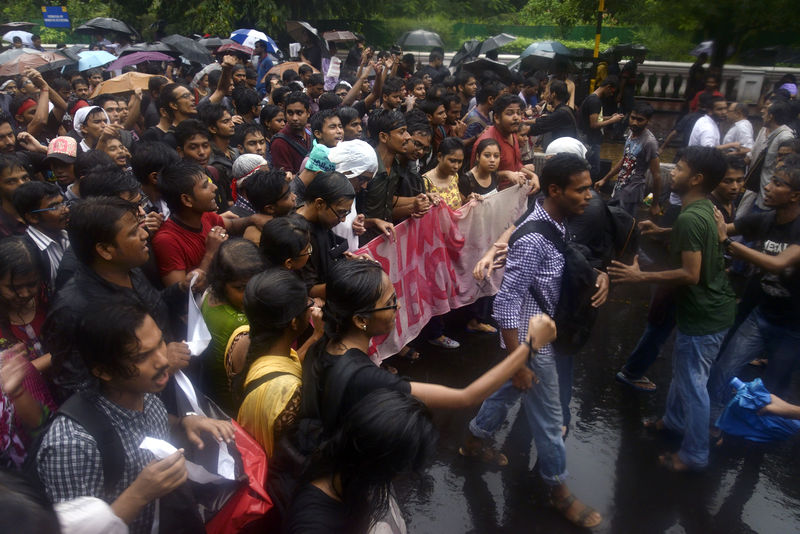
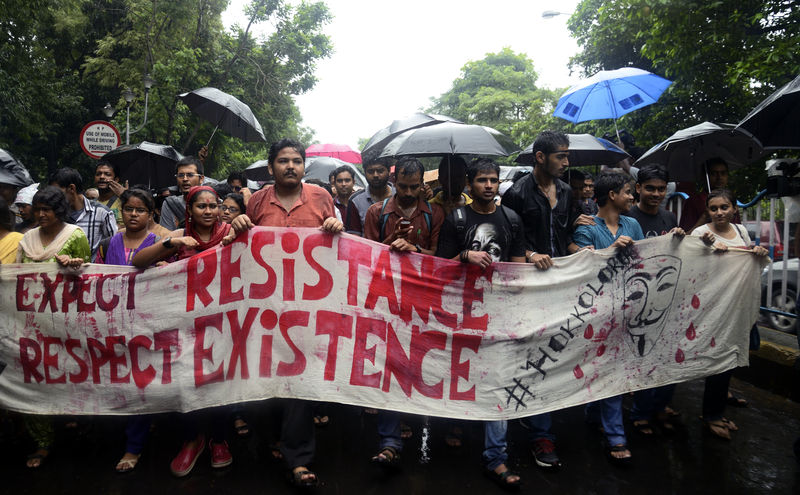
Jadavpur students protesting against police action at campus and demanding resignation of the vice chancellor. Image by Reporter#47468. Copyright Demotix (20/9/2014)
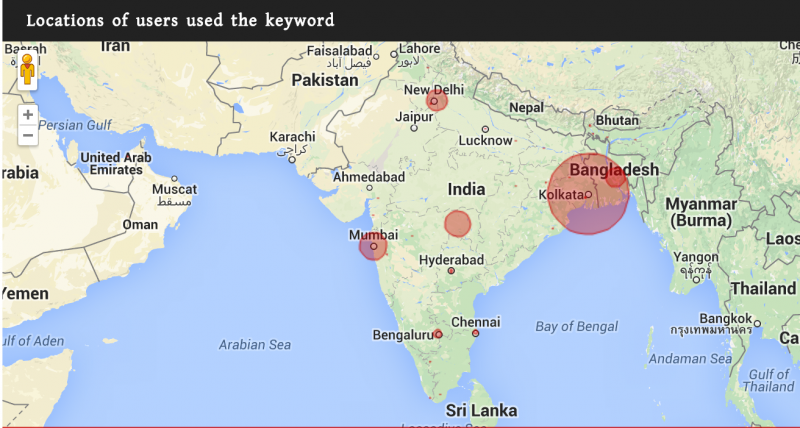
The Indian state of West Bengal it witnessing a revolution of sorts in #Hokkolorob, the "Let There Be Noise" movement, which started in Jadavpur University last month and is spread like wildfire across the country. Individuals started using term "Hok Kolorob", originally the title of a 2006 song by Bangladeshi singer Shayan Chowdhury (also known as Arnob), as a hashtag on Facebook, Twitter, and other social media.
Screenshot of locations from where Twitter users mentioned the hashtag #hokkolorob via tweetchup.com
On August 28, several residents of the Old Boy's hostel molested a female second-year student at Jadavpur University and beat up her male friend. The girl's father lodged a police complaint on September 2 and sent a letter to university authorities on September 3, launching an internal inquiry.
Suspicions about the University's investigation have arisen, however, following a September 5 visit to the victim's home in Bidhannagar by two members of the university's probe, who refused to give their names. The anonymous investigators asked questions about the girl's sobriety and dress on the night of the attack, leading her family to file a complaint with police, calling it "mental harassment".
That's when students started protesting, demanding that the university replace the probe members who visited the victim's home and asked such questions, and that the school form a new, external committee to investigate what happened on August 28.
On the evening of September 16, students blockaded some university buildings, confining several officials to their offices, including Vice-Chancellor Abhijit Chakrabarti. When talks failed between students and administrators, the Vice-Chancellor summoned the police. In the early hours of September 17, police moved in on the student demonstrators, severely injuring several and arresting thirty-six. Many were hospitalized. There are now allegations that some activists from the Trinamool Chhatra Parishad (the ruling party’s student wing) also aided the police.
Jadavpur University students organise a rally from Nandan to Raj Bhavan, protesting against police in a midnight action on Jadavpur's campus. They also demand the resignation of Vice Chancellor Abijit Chakraborty. Image by Reporter #47468. Copyright Demotix (20/9/2014)
Videos of the attack on students were leaked on the Internet, and the broadcast media has also amplified the story. The incident sparked a nationwide reaction, as the #HokKolorob hashtag has taken local social media by storm.
The viral spread of these protests and demonstrators' success with social media have mobilised Jadavpur University alumni across the region. Students from other educational institutions, as well as members of the general public, have mounted a sudden and effective campaign to express their outrage with the way authorities have handled the molestation case.
On September 20, students organised a rally in the heart of Kolkata city, attracting an estimated 100,000 participants. Prasun posted pictures of the protest on his blog.
Rupam Islam, a rock star in Kolkata, sang in support of the demonstrators, providing the movement with what has become its anthem. The song extols the movement's determination with the words, "Andoloner Shuru Aacchey, Shesh Nei" (This movement has a beginning, it has no end).
Protesters in Delhi (at JNU, Banga Bhavan and Jantar Mantar), at IIT Chennai, IIT Mumbai and IIT Kharagpur, Pondicherry, Hyderabad, and in Bangalore have also gathered for demonstrations of solidarity with the #hokkolorob movement.
The movement got an interesting turn as on September 22, a rally was arranged by the ruling Trinamool Congress party against the protesting students where they were mocked through slogans and posters.
I write this as a fellow student of Jadavpur who has experienced her friends go through things unspeakable, who cannot unsee what she saw, where people she loves and cares for went through hell in a place that she loves with her being, her college, her university.
Why are the students in Jadavpur, and their friends elsewhere, so angry? [..]
Had the vice chancellor and the university authorities wanted, they could have dealt with the matter with promptness, sensitivity and intelligence. Instead, to please their political masters in the Trinamool Congress Party, they tried to shield the actual reign of thuggery that they preside over in the campus of Jadavpur University. It is the Vice Chancellor, not the students, who need to understand what ‘decorum’ and ‘discipline’ in a university mean.
Agnivo Niyogi, a blogger, however thinks the #hokkolorob campaign amounts to little more than "hashtag activism":
What amused me the most is the fact that these “rebellious” students were relaying the “state sponsored brutality “live” through FB and Twitter. Delhi-based media, which these days treats FB posts as Gospel truth jumped into the fray and launched into an attack on the WB Govt.
The Facebook page dedicated to the #hokkolorob cause, which has played a major organisational role in the movement, has more than 54,000 followers today. The group's popularity, however, has also attracted the scrutiny of police, as well as the Jadavpur molestation victim herself. According to reports, the girl lodged a complaint with police in Lalbazar last month against efforts on Facebook to "malign her image". Her father, moreover, no longer calls for Vice-Chancellor Chakrabarti's resignation, and even urges students "to return to class".
Is #hokkolorob becoming a lost cause? Avishek writes:
There is a lot to overcome, it seems. Exactly why police get away with brutal assaults on students and manhandling girls while #HokKolorob-ers get arrested for painting banners remains unknown.
Kolkata probably cares. She probably does not, despite having witnessed 1905, 1946, and 1971. She goes on nevertheless in sensuous meanders from Laboni to Maddox Square and beyond. She had cried her heart out the day #HokKolorob took centrestage on September 20.
Some day she will join in the march to overcome as well. Some day she will respond to #HokKolorob.
The recent events at the Viqarunnisa Noon School and College (VNC), a prestigious girls educational institution in the Bangladesh capital Dhaka, has stirred much buzz in the Bangladeshi blogosphere. Porimol Joydhor, a teacher of Bangla department of the school's Bashundhara campus, was accused of raping a female student of class ten at VNC while giving her private tuition in his premises.
According to reports Porimol recorded the incident in his mobile and threatened the victim that he would post it on internet if she divulged the matter. As the investigations began more shocking information were revealed. The incident took place in late May and the school headmaster at Basundhara branch did not take any action against the teacher after the victim reported it in a letter. Guardians alleged that because Porimol was a student leader of the ruling party the authorities ignored these allegations. When the news broke out in the media [bn] in early July the school governing body was put under a lot of pressure. Porimol was sacked and went into hiding. The committee also suspended two other teachers for their alleged misconduct with girl students.
The events and the student protests caused much uproar in the country and more drama unfolded as the students continued their protest which led to the replacement of the school principal. The mainstream media was accused of using sensationalism and politicizing the events. But some students continued to share their sides of the story via blogs and Facebook.
Bloggers like Bengal Masud posted pictures of the protests and provided regular updates. He posted [bn] on the 6th of July:
অবশেষে ব্লগ-ফেসবুক এবং রাজপথ এই ত্রিমুখী আন্দোলনে পরিমলকে গ্রেফতার করতে বাধ্য হয়েছে পুলিশ। বুধবার দুপুর ১২টার দিকে কেরাণীগঞ্জে এক আত্মীয়ের বাসা থেকে পরিমল জয়ধরকে গ্রেপ্তার করা হয়।
At last after the three-fold campaign via Blog, Facebook and street protests the police was forced to arrest Porimol. Wednesday (6th of July) at around noon he was arrested from a relatives house in Keraniganj (near Dhaka).
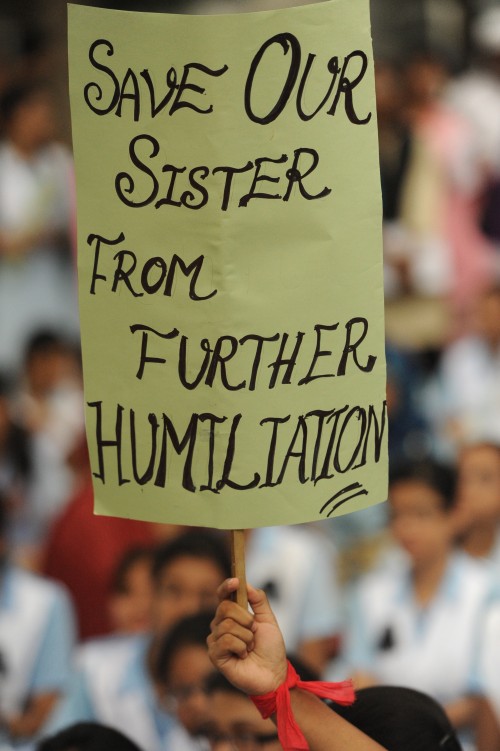
Students hold placards denouncing sexual abuse at their school, as they gather at the Central Shaheed Minar.Image by Safin Ahmed. Copyright Demotix.
The students were still in doubt whether the victim would get justice and continued with their protests. Their demands included:
All the accused should be brought to justice
The school principal and the school management should clarify why they did not do anything against the accused
Demanding resignation of the school principal for protecting Porimol.
Many people became furious as the school principal was accused of saying that it was mutual sex.Xabirvents his anger [bn] at Amra Bondhu Blog:
আপনার কি জানা আছে মিউচুয়াল সেক্স হওয়ার জন্যে “কনসেন্ট” নামে একটা জিনিস লাগে। কিন্তু মহামান্যা মাথামোটা অধ্যক্ষা সাহেবা, ১৮ এর নিচে (ক্ষেত্র বিশেষে ১৬) একজন নাবালিকা কখনোই সম্মতি দিতে পারে না।
Do you know that “consent” is required for mutual sex? But dear **** principal, a minor girl below 18 (in some cases 16) can never give consent on her own.
Moreover, the blogger reveals that the section 5 of Sexual Offences Act (2003) says “a person commits an offense if he intentionally penetrates the vagina, anus or mouth of another person with his penis and the person is under aged.”
An anonymous ex-student of VNC recalls [bn] in her blog that her Alma mater was not like this. She posted [bn] on the 8th of July about the student protests online and offline:
আমাদেরকে স্বীকার করতেই হবে যে, যে সব ছোট বোনেরা ফেসবুক এ ইভেন্ট খুলেছে তাদের উপর যথেষ্ট চাপ থাকবে কালকে।এতক্ষনে হয়তো আমাদের গায়ে মানে না আপনি মোড়ল; হোস্নে আরা বানু তোমাদেরকে টিসির ভয় দেখিয়েছেন। পুলিশ প্রশাসনও হয়তো কালকে ভাড়াটে গুন্ডার মতই ব্যাবহার করবে। তারা হয়তো আত্মরক্ষার জন্যই চাইলেও অনেক কিছু করতে পারবেনা। আমাদের সেই সব বোনদেরকে বলছি - আপুরা তোমরা একটুও ভয় পেয় না। আপুরা আছি, আপুরা তোমাদের সবার পাশে আছি।
We have to admit, those younger sisters who opened this Facebook event will be under much pressure tomorrow. It might happen that the principal Hosne Ara Banu had already threatened them to expel from the school. The police may act like hired goons tomorrow. Those sisters may not be able to do much to be safe. But I am telling to those sisters, please don't be afraid. We ex-students are with you together on this.
Students hold placards denouncing sexual abuse at their school. Image by Safin Ahmed, Copyright Demotix
On the 9th of July the students of VNC along-with Parents and ex-students formed a human chaindemanding resignation of the Principal. Bengal Masudposted [bn] videos and pictures of the event.
Soon the protests gathered more support from other members of the civil society. Also many teachers from VNC joined [bn] in the protests.
Blogger Alim Al Rajeeis posting [bn] regular updates on this. This Facebook page is also providing updates. Some students are providing updates [bn] on how the interim principal is being accused of belonging to a political party and how the girls are being threatened by different quarters.
Shimul Kibria at Choturmatrik Blogwrites [bn] about the trend of blaming the victim in a rape incident as some are blaming the student of VNC rather than Porimol:
কিছু মানুষ তাদের পারিপার্শ্বিকতার নারীদের চিনেছে নিছক একটি ভোগ্যপণ্য হিসেবে। তাদের চিন্তামতে/বিবেচনায় নারী মাত্রই ক্ষুদ্র মননের, স্বল্প ক্ষমতার একটি প্রাণী যা আসলে পুরোপুরি পুরুষের অধীন!
Some people have learnt that women are only consumables. In their perspective women cannot think big, they have relatively less power and are completely submissive to men!
He continues:
প্রতিবাদ এখানেই শেষ নয়; পরিমল ও তার মদদ দাতাদের কঠোর বিচারকার্য নিশ্চিতকরণ, নারী ও শিশু নির্যাতন আইনের যথোপযুক্ত প্রয়োগ নিশ্চিতকরণের জন্যে এই মঞ্চ আরো এগিয়ে যাবে; এটা আমার মতো আরো লক্ষাধীক মানুষের প্রাণের চাওয়া।
The protests have not ended; we have to ensure justice for Porimol and his cohorts and ensure proper implementation of the women and children's act. To achieve these goals this platform should march forward, this is the demand of many thousands of people like me.
The World Bank’s infoDev program has conducted a 2010 Survey of ICT for Education in India and South Asia, exploring the ways in which technology is used in both formal and informal education. Based on survey results, infoDev has isolated several themes of ICT for Education (ICT4E) that will continue to play a strong role in the development of ICT4E programs in South Asia. While educational programs tend to be thought of as addressing students, ICT in the training of teachers is an important concept, especially within the area of building capacity through basic computer literacy. If teachers don’t understand technology and how to use it, they can’t teach students about it, so future ICT4E initiatives should include this aspect of teacher training. Another essential ICT4E theme observed by infoDev was that of public-private partnerships aimed at providing and sustaining ICT infrastructures in schools. Perhaps the most important components of ICT4E are Distance Education (DE) and open universities, which allow students challenged by geographic or financial barriers to access the education they need.
ICT4E in Bangladesh
Bangladesh has made great strides in the area of mobile phone use and accessibility, with coverage reaching over 90% of the population, but ICT in education remains an area of focus that demands more progress. A significant challenge for any ICT4E initiative would be the high cost of Internet access, which cripples Internet use for a majority of the population in Bangladesh. There is also a significant disparity across gender literacy, with males at 54% and females at 32%, which would present some difficulty in educating students and teachers on how to use ICT. However, among the younger population, there are more literate females than males, so if there has ever been a time to equalize gender literacy for ease of education, it is quickly approaching. Bangladesh has had some success with ICT in non-formal education, with programs dedicated to the spread of libraries and village computing and Internet centers. Within the realm of formal education, Bangladesh is focusing on teaching ICT courses in higher education to promote the industry, but using ICT to guarantee an education to all students is an idea that merits more attention. Because Bangladesh does not currently have an ICT in education policy, that is the first step to be taken toward incorporating ICT into the nature of teaching and learning.
Important Components of ICT in South Asian Education
In countries like India and Sri Lanka, ICT in education has taken the form of traditional media such as television and radio. Stations provide 24-hour educational material to viewers and listeners, taking advantage of existing technology to promote teaching and learning. Innovations like the Simputer and corDECT have also been instrumental in the ICT4E development of these countries. The Simputer addresses the educational and communication needs of the illiterate by including functions that read handwritten text and provide audio translations, among other capabilities. corDECT is a wireless local loop that provides Internet access within a 10-km radius, which can be easily expanded to a 25-km radius. By taking advantage of these technologies in distance teaching and learning, South Asian countries have made significant progress toward using ICT in education.
Bio: Alexis Bonari is a freelance writer and blog junkie. She is currently a resident blogger at First in Education, researching accredited online degree programs. In her spare time, she enjoys square-foot gardening, swimming, and avoiding her laptop.
Steve Jobs of Apple is considered a great presenter. Here are some excellent advices and tricks [video + slides] for delivering an effective presentation from Businessweek columnist Carmine Gallo, who is also the author of the book - The Presentation Secrets of Steve Jobs (via Digital Inspirations).
"Your time is limited so don't waste it living someone else's life. Don't be trapped by dogma - which is living with the result of other people's thinking. Don't let the noise of others' opinion drown out your inner voice. Stay Hungry, stay foolish." - Steve Jobs
The Education minister of Bangladesh Nurul Islam Nahid has kept his promise to provide millions of Bangladeshi school students with new textbooks from the first day of the new academic year. A staggering number of 186,826,950 textbooks were printed for 27,662,529 students of this academic year.
The minister said:
“A huge number of students from the poor families discontinue their studies due to lack of books. So we decided to provide all with new books to prevent drop out."
There were quarters who wanted him not to succeed. A mysterious fire at the National Curriculum and Textbook Board (NCTB) warehouse in Tejgaon industrial blazed hundreds of tones of textbooks and printing materials on October 1. Fire service officials hinted that it was an act of sabotage. This daily star report hints that a supplier of papers, who was accused with supply of poor quality papers may be behind (as most of the papers burnt were supplied by them).
However, the minister should be lauded for his efforts to publish and distribute those books in time. I wish other ministers could show effectiveness like Nahid.
There is a saying that "when your only tool is a hammer all your problems look like nails." It seems the only tool of some of the Islamists is bringing death to somebody.
The salient features of this new education policy which is set to be enacted this December:
Increase primary education from 5th to 8th class.
It will integrate Madras education and vocational education into the general education
It will establish mandatory core subjects for primary-level education: Bangla, English, mathematics, Bangladesh Studies, social environment and climate change, and information technology and science.
Every School will have a mandatory library equipped with necessary books
More scholarships for the poor
No physical punishments
Arrangement of lunch for the students
Education for indigenous students in their mothet tongues
Facilities for the disabled
Standardization of teachers qualifications
More training for the teachers and promotion will be connected with experience and training and many more
In a nutshell the national education policy will make changes at the grassroots levels of the education system.
Nirmal Gomes, a specialist in Educational Administration & Policy Studies, wrote in E-Bangladesh about this new education policy. He discussed the importance of a complete education system and this policy is close to that:
A holistic education policy implementation is most essential in the reality of Bangladesh. Every students need to be developed their emotional, physical, social, and intellectual growth. The education policy must acknowledge and emphasize the spiritual, intellectual, social, physical, and psychological needs of young children from the beginning of its establishment and this will continue to foster growth in each child. Besides promoting skill-based education, the policy must encourage children to learn and nurture the social and cultural values, integrity, tolerate, respect and love others, service to others, and to be a responsible person. The students can learn all these good values from schools.
Now it seems a quarter is not liking the idea of a unified education system. The idea of introducing Science and mathematics to Madrassa students seem to be detrimental for some people's agenda. They think this policy is not emphasizing on religious education. It seems this idea is fed by the Islamist political parties as if they lose control on Madrassas then their politics will be difficult.
I think this education policy is not the ultimate solution for Bangladesh, but its a start. Lets not derail this road of change paying heed to threats of some religious fanatics. The policy needs your support.
Trailer of the documentary "Two Million Minutes". Two million minutes is how much time a student has after completing this eighth grade to prepare for college.
"How students spends the time during their high school effects their entire economic future. And by extension a country's economic future depends on how its students collectively spends those valuable minutes."
'Life in Eskaton'describes the experience as a substitute teacher of seventh grade in an international school in Dhaka, Bangladesh.
"To enhance quality, the administration has aped the syllabus followed at more successful schools, where standards are higher. The children here lack the grammar and reading skills to respond and are bamboozled into memorizing answers.
The only way to make it easier for them is to set factual questions, which seems more like a weak history lesson to me. My students are privileged to receive an English education but they’re being thrown into the sea without knowing how to swim. Still, they’re under a constant pressure to perform. One can’t blame them for looking for an easy way out.
I saw it during my A levels and here I was seeing it again - a corporate approach to education. After school ends, the children attend private tutors to help with ‘getting ahead’. Weekends are time for extracurricular activities which is a fancy name for more lessons.
The product of this system is an immensely skilled individual who does everything necessary to succeed, but without passion for any of it. From an economic point of view, we’re churning out people who may one day end up with zero job satisfaction and it amazes me that few seem concerned about the effect this will have on overall productivity in our society."
Too bad most parents nor the educationists appreciate the extracurricular education needs of the adolescents.
Believe it or not the above are from text books for higher secondary level (HSC) and these are authorized by the education board of Bangladesh. (Via Sakib)
I am stunned reading all these. They could not think beyond the old style of memorizing tables of differences between computer and Internet. And how could they do this to the students making them learn these craps like:
"Computer cannot understand people's command: Internet can understand people's command" or "Computers have memory: Internet does not have memory".
Unbelievable!
And from the second picture:
8. Dos-based operating system is keyboard dependent so if dirt or insects enter inside the keyboard then the computer does not respond properly. 9. Keyboard takes much space in the computer table.
Give me a break. I don't know I should laugh or cry? Where are the voices of the IT industry in Bangladesh? Why aren't they protesting?
Sakib tells that HSC students choose this subject to get some easy marks which are on the hands of the teacher. He went the labs once in his total HSC study period and the teacher taught how to save files on MS word. He reports that the teacher took Tk 2000 (about 30 USDs) for 80 practical marks. Pathetic.
The Bangladeshi education system is divided into three different branches. These branches are: a) The English Medium, b) The Bengali Medium, and c) The Religious Branch. Many of the school and colleges are Government or semi Government. Tution fees are heavily subsidized in full Government institutions but they lack sufficient infrastructures. Students are free to choose between government or private institutions provided that they have the means.
The detailed structure of the mainstream education system in Bangladesh can be found here:
But the problems of this system are:
1. Almost all of the funding of Govt. mainly contribute to the salaries of the teachers of the Govt. & semi Govt. educational institutions. There are very nominal budget for sports facilities or other developments of school. Good quality private schools do not have that problem because they impose much higher fee to students to cover up these costs. But many of these private schools are out of reach of lower middle class or poors.
2. Enrolment at primary schools is only 77%. That means, 23 percent of all children of Bangladesh aged 6-10 do not have access to primary education. Many of them drop out of school as they progress.
3. Govt. educational Institutes have limited seats for students at secondary level. Private Institutes are there to fill the gap but are costly and only wealthy families can afford.
4. There is no mechanism for assessing quality of the primary students. SSC or HSC examinations are standardized, but no such assessment before 10th class.
5. There are controversies regarding the curriculum and the authorities of the religious educational institutions.
6. Education imparted at Govt. funded universities have little relevance to the needs of the economy and job market (absence of adequate technical or professional faculties).
7. Many university graduates, produced at considerable cost to the society, (public universities being almost entirely state financed with little sharing of costs by the beneficiaries), have to remain unemployed for a considerable period of time before they find employment often in areas outside their fields of study.
In the view to overcome such problems, I think Bangladesh can contemplate on changing its education system. One model can be the German education system, which is stated elaborately here:
In brief the German system features:
1. Pre-school and primary education up to class 4.
2. After Class 4 they phase out to four categories of schools according to the merit, class 5 being the orientation phase irrespective of school type.
3. Hauptschule and Realschule are for pre-vocational or technical students. Gymnasium is for students willing to go to tertiary level of education (i.e. Universities). After the 10th grade the four schooling systems have the exam "Abitur".
4. In the second tier of education there is technical school and on the job training phase. After 12th class they end education and go for a job. For the students willing to go to Universities go to Gymnasium.
5. In the third tier there are Universities and other technical higher educational institutes.
In this system students are classified into different kinds of schooling according to their merit well in advance (in 5th grade). So a student does not have to study higher math in 9th or tenth grade if he does not want to study science in higher classes or go to University.
For a poor country like Bangladesh, the Govt. cannot simply afford to ascertain higher education for everybody through subsidized Govt. Institutes, which is also not required. Instead Govt. can establish more vocational institutes where students passing SSC or say HSC can study for two years plus one year on the job training, which will qualify them for a market oriented job. More efforts are needed to keep adequate budget to ensure primary education for maximum number of children eligible for school. There should be one central examination after 5th grade to classify the students for different categories of school according to their merit.
There is scope for many discussions and contemplation on this subject. But it is disheartened for the Bangladeshi People that the ruling governments spend their time and energy in the unnecessary affairs like changing political history in the curriculum according to their liking.
As the literacy rate is rising in Bangladesh, there is an ever-growing demand for institutions for higher education. Each year more and more students are passing SSC (10th class) & HSC (12th Class). But there are not enough Colleges, Universities or other vocational institutes to accommodate all of them. The conventional education system up to mid nineties has been supported by massively subsidized education through a very small number of state-run institutions to a very narrow spectrum of students chosen out of fierce competition. The Govt. Institutions are supposed to be of high quality but lack of management, increasing cost and fixed budget are hindrances to maintain their quality. After the mid nineties many private universities have been established and the number is increasing each year (+ 50 as per last count).
There are controversies about the quality and motto of these private Universities. M. Omar Rahman, an ex-Harvard Professor working now in one leading private University has written an article claiming 'Private universities are springing up like tea stalls'.
He points out to the demerits of the private universities: "rampant consumerism, narrow spectrum of course offerings, and low quality of instruction". but he is also optimistic about the fact that as the public deciding factor is quality & choice of subjects and eventually only the higher quality institutions will survive.
I also think that there is nothing wrong in having more educational institutions. However we can argue that there should be proper control over them to ensure quality and other ethical obligations. As far as I know, the govt. has imposed some requirements for opening a private University like they have to have their own campus; a huge sum of money (100 million Taka) has to be shown as collateral/deposit etc. But I am in doubt whether there is proper control over curriculum. However as many such private Universities claim that they are affiliated with leading Universities in USA, Australia or UK, the curriculum is not supposed to be of a lesser quality.
As per Mr. Omars point of view: these are the advantages of Private Universities:
(i) increased choice and or access to those students who either are unable (due to increased competition) or unwilling (due to the characteristics of the institutions), to enter the public system; (ii) timely completion of degrees unhindered by session jams as in the public system; (iii) a safe and secure environment free of student violence -- a particularly attractive feature to parents; (iv) a semester system of education where one is evaluated continuously and multiple times in circumscribed courses, rather than in one anxiety provoking end of course final exam which can make or break one's career; (v) coursework in English, competence in which is increasingly recognized as the passport to jobs in the global economy; (vi) linkages or the promise of such to universities in North America, Europe, Australia and New Zealand which then provide an avenue for students to pursue higher studies and possibly future employment in the global market place; (vii) the promise of potentially higher quality faculty who are paid substantially more than their public peers and presumably hired on merit rather than through nepotism; (viii) better physical facilities (classrooms, laboratories, libraries, computer centers, cafeterias etc) due to the higher resource mobilization from tuition fees; and (ix) the promise of expanded research and scholarly activities funded partially through higher tuition fees.
So we should welcome such private ventures to ensure good quality education in the country, which should stop many students from wealthy families going abroad for education.
As far as the quality of the Universities is concerned, I know that in job market you cannot progress only with your degrees. Quality and your performance count everywhere. If a private University render poor quality education, then its alumni will not get good job and thus would not attract new students.






















![Reblog this post [with Zemanta]](http://img.zemanta.com/reblog_e.png?x-id=55039aea-b2cf-41b3-8984-d5f30b5bed61)