





Dragonfly

Image by Rezwan

Overcrowded passenger ferry capsized in the Padma River in Munshiganj, Bangladesh

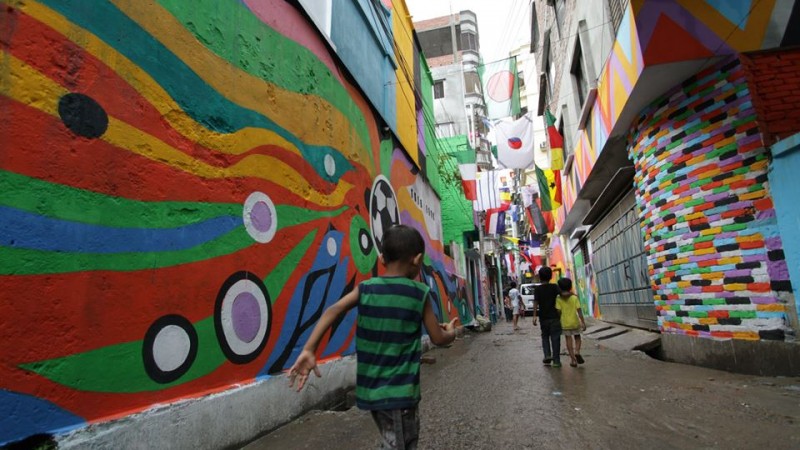
The World Cup Goal-E Project

This street in Bangladesh has a colorful world cup celebration

New Chum Hill Ruins

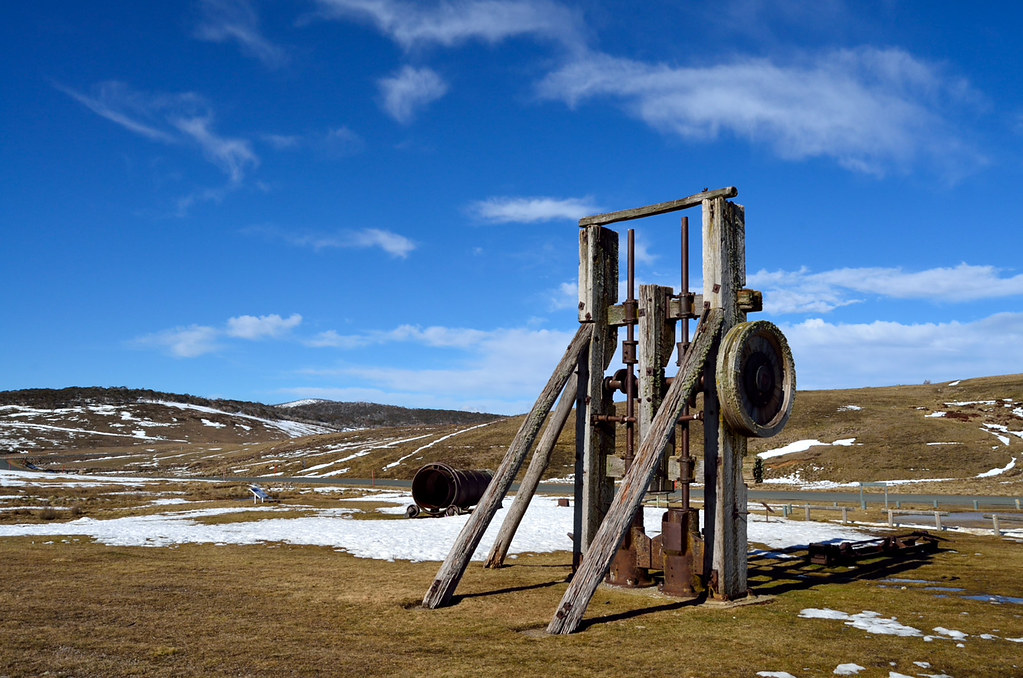
Remnants of Kiandra gold mine at New Chum Hill, #nsw #australia

Showing posts with label Culture. Show all posts

May 11, 2015

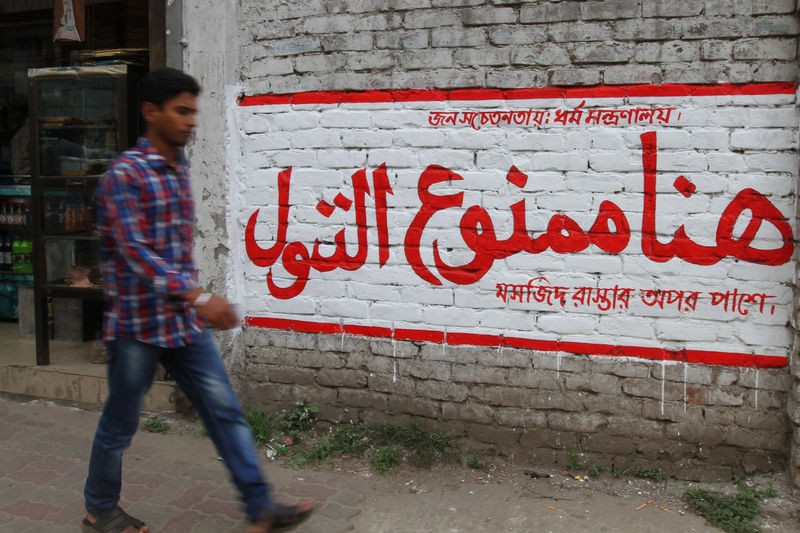
Why Arabic Script on the Walls Might Not Stop Public Urination in Dhaka

The photo shows  Arabic sign on the sidewall of Panthakunja Park at the Karwan Bazar in Dhaka. Image by Sk. Hasan Ali. Copyright Demotix (7/5/2015)
The photo shows Arabic sign on the sidewall of Panthakunja Park at the Karwan Bazar in Dhaka. Image by Sk. Hasan Ali. Copyright Demotix (7/5/2015)
Public urination is a problem in Bangladesh due largely to a lack of public toilets. Municipal officials in the capital Dhaka have battled in vain to stop men urinating in public, with signs in the local Bengali language and warnings of punishment and fines yielding no notable results.

Now the government is hoping that an innovative idea can put a stop to the habit. Recently the Ministry of Religious Affairs released a video highlighting their campaign "Language Matters" wherein Bengali signs warning against urination are now being replaced by Arabic signs, a holy language for Bangladeshis.

Perhaps they have taken a cue from neighbouring India -- battling with the same problem -- where pictures of Hindu gods and godesses on the walls are intended to have the same effect.


Although some are lauding the state's effort to solve a perennial problem, others are skeptical, claiming the campaign supports blind faith and promotes misconceptions.

Sufi Faruq comments on YouTube:
ধর্ম মন্ত্রণালয়ের দারুণ একটা ক্যাম্পেইন !!! (..)

বাংলাদেশের বেশিরভাগ মুসলিম আরবি ভাষা না বুঝলেও এই ধরনের অক্ষরকে পবিত্র মনে করে। তাই ওই স্ক্রিপ্টে লেখা যে কোনকিছু অপবিত্র করতে ভয় পায়। এই ভয়টার বেশিরভাগ সময় ধর্ম ব্যবসায়ীরা অপব্যবহার করতো। এবার একটা দারুণ কাজে ব্যাবহার হল।
A great campaign by the Ministry of Religious Affairs!!!

Most of the Muslim majority Bangladeshis cannot understand Arabic but they deem it as a holy language. So they fear to desecrate anything written in that language. Most of the time it was used by religious opportunists as it is the language of the Koran and the prayers. Now it has been used for a good cause.
Despite the Ministry of Religious Affairs' claim in the video about toilets being present in most of Dhaka's 10,000 mosques, the general lack of public toilets in the city of approximately 15 million is a genuine challenge. The city's large homeless population is particularly affected by the shortage.

Adnan R. Amin at Alal O Dulal Blog thinks that the video does not get to the root of the problem and instead aims to create false impressions:
The using of a religious misconception (“Arabic is a holy language”), to prevent a social evil, is clever. But it also reinforces and lends credence to that misconception, instead of dispelling it. One would think that for a ministry for religious affairs, dispelling religious misconceptions would outweigh protecting city-walls. If there were funds available to the government, Dhaka’s City Corporations could’ve used them to create better facilities for women. While it is difficult to discern from boardrooms, the 36 public toilets with facilities for women are now being used by men. Judging from the tactic and tone of  this video, a reexamining of both government bodies’ priorities seems to be in order.
Moreover, Fariduddin Masud, an influential cleric criticised the Ministry for Religious Affairs.

While most mosques do have sanitary facilities, mosques themselves are "not public toilets", he said, adding that "nobody has the right to use the language of the Koran for such a campaign."

Blogger Irene Sultana doubted the campaign via a blog post on Women Chapter titled 'Not Arabic, but Public Toilets, Matter":
ঢাকা শহরের প্রতি দেড় লাখ নাগরিকের জন্য শৌচাগার রয়েছে মাত্র একটি। [..] অধিকাংশ পাবলিক টয়লেটই ব্যবহার অনুপযোগী। [..] পাবলিক টয়লেটহীন নগরীতে পথচারীদের অধিকাংশই তাই ফুটপাতকেই বেছে নিচ্ছেন ’হালকা’ হতে।

না বুঝে কেবল আরবি লেখা থাকলে সালাম করা হলো এ দেশের মানুষের ধর্মীয় অন্ধত্ব। ধর্ম মন্ত্রণালয়ের দায়িত্ব ছিল মানুষকে এসব অশিক্ষা থেকে বের করে শিক্ষিত, সচেতন করা, তার বদলে মানুষের সেই অজ্ঞতাকে ব্যবহার করে ’সমাধানের’ নামে মূলত একটি মশকরা করলো!
There is only one toilet in the capital Dhaka for every 150,000 people, out of which many are not usable. So in the absence of enough public toilets the pedestrians use walls to relieve themselves.

Many Bangladeshis respect the Arabic language because they don't know the language. The duty of the Ministry of Religious Affairs was to educate them and make them aware that this is a language only, not everything in its writing is sacred. But instead they used this ignorance to eke out a "solution" which is actually a farce.
Sultana also cites the recent efforts of Indian Prime Minister Narendra Modi, who built toilets in front of temples and achieved 5.2 million lavatories in the first 100 days of his tenure.

Bangladesh lags far behind on this issue.

While state religious officials are already trumpeting its successes, the campaign does not appear to have been well thought-through. If implemented to the fullest extent, Dhaka's walls will be covered by Arabic but people will still have nowhere to urinate.

Moreover, in India, before Modi went on his toilet-building spree, the gods on walls campaign unravelled: people simply began urinating on the faces of the deities. Innovative campaigns incorporating public shaming such as "The Pissing Tanker" also lacked impact.

For this reason Adnan R Amin's comment that the money spent on the campaign -- "a proxy solution that treats the Symptom and not the Cause" -- would be better spent on new public toilets in Dhaka seems to be well-founded.

The post was also published in Global Voices Online.
April 15, 2015

Bengali New Year Takes a Colorful Stand Against Religious Extremism in Bangladesh

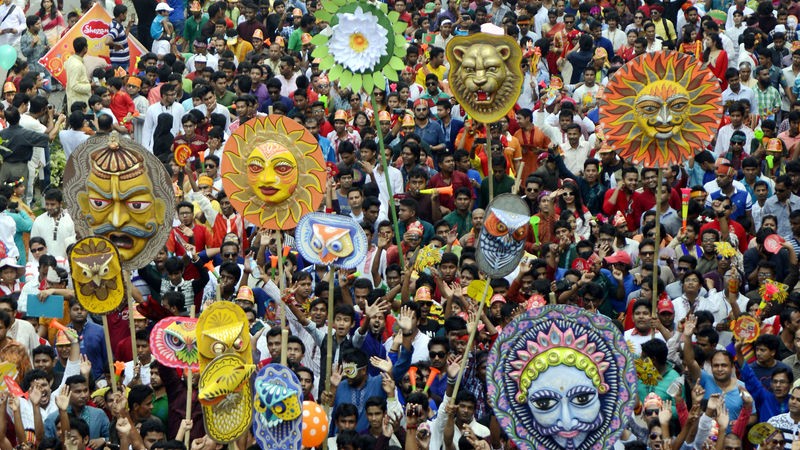
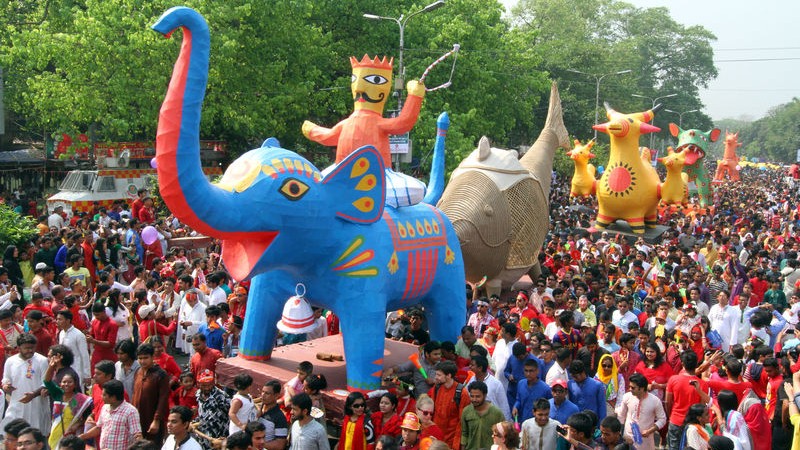
People celebrating Pahela Baishakh at Mangal Shobhajatra (Rally), a procession organised by Dhaka University’s Faculty of Fine Arts to welcome the Bengali new year. Image by  Sourav Lasker. Copyright Demotix (14/4/2015)
People celebrating Pahela Baishakh at Mangal Shobhajatra (Rally), a procession organised by Dhaka University’s Faculty of Fine Arts to welcome the Bengali new year. Image by Sourav Lasker. Copyright Demotix (14/4/2015)
The past few months have been particularly tough for Bangladesh as continuous political turmoil and violence left over 120 people dead. The recent killings of two free-thinking blog activists and the emergence of a new militant wing that seeks to murder atheists have worried many.

Whenever the country has found itself in trouble, Bangladeshis have embraced their roots, taking solace in art and culture to unite against any challenges they face.

On Tuesday, April 14, 2015, people did just that in Bangladesh, welcoming the Bengali New Year 1422 with the resolve to continue the fight against communalism and religious fanaticism.

Bengalis, who are overwhelmingly the largest (98%) ethnic group in Bangladesh, customarily celebrate the New Year (Pohela Baishakh) with colourful procession and festivities. This year's festivities had a special theme: "Onek Alo Jaalte Hobe Moner Ondhokare" (Burn many lights in the darkness of hearts). It was chosen to commemorate the recent assassination of blogger and writer Avijit Roy and online activist Oyasiqur Rahman. A 20-foot-tall statue symbolising the rise of communal forces was at the procession, reminding everyone to reject such strife.

People carried colourful costumes in the Mangal Shovajatra.
People carried colourful costumes in the Mangal Shobhajatra (Rally). Image by Sourav Lasker. Copyright Demotix (14/4/2015)
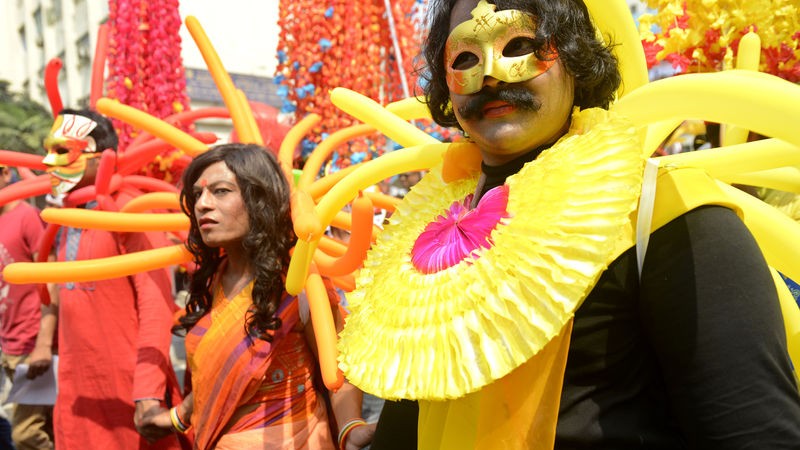
Pohela Boishakh is the first day of the Bengali calendar, celebrated on 14 April in Bangladesh and 15 April in the Indian state of West Bengal by Bengalis. Hundreds of fairs and events welcoming the New Year takes place in many parts of Bangladesh and in West Bengal in India. The largest festivities happens in Dhaka, the capital of Bangladesh, where tens of thousands of people wearing multicoloured masks and traditional dress march in the Mangal Shobhajatra procession marking the New Year.

Tanvir Haider Chaudhury wrote on Facebook:
আপনি যেখানে থাকুন, পারলে ঢাকা চলে আসুন। পৃথিবীর সবচেয়ে আনন্দময়, উৎসবমুখর জায়গা এই মুহূর্তে ঢাকা।
শুভ নববর্ষ।
Wherever you are, please come to Dhaka if you can. Right now Dhaka is the happiest place on earth full of festivities. Shuvo Noboborsho (Happy new year).
While Twitter user Bappy tweeted a photo:
Crowds celebrated Pahela Baishakh at Mangal Shobhajatra, a procession organised by Dhaka University’s Faculty of Fine Arts to welcome the Bengali New Year 1422. Image by Sk. Hasan Ali. Copyright Demotix (14/4/2015)
Anila Haque thanked Google for creating a doodle for the occasion:
Gargie Ahmad hoped that the New Year would bring an opportunity to start anew:
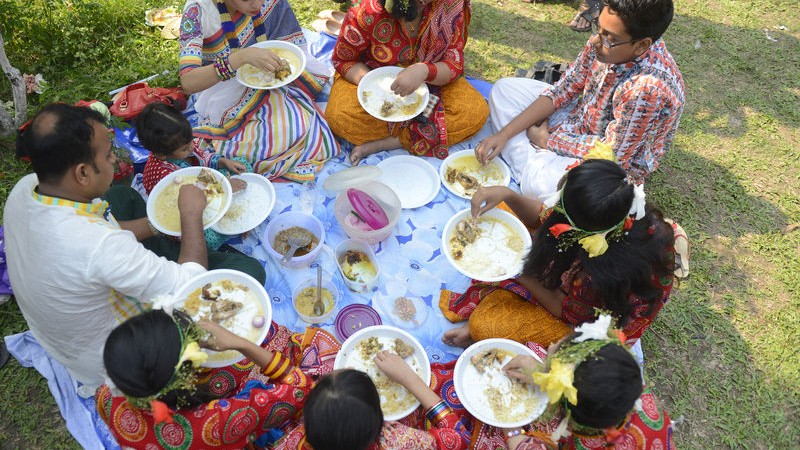
To the Bengalis, hilsa isn't just a fish. It's an integral part of the culture and heritage. Be it fried or cooked with mustard, hilsa is a must in Pahela Baishakh celebrations. Image by Sourav Lasker. Copyright Demotix (14/4/2015)
Indian Prime Minister Narendra Modi tweeted in Bengali:
My good wishes to all the Bengali friends on Pahela Boishakh. Hope the following year will be great for everyone. Shuvo Noboborsho (Happy New Year).
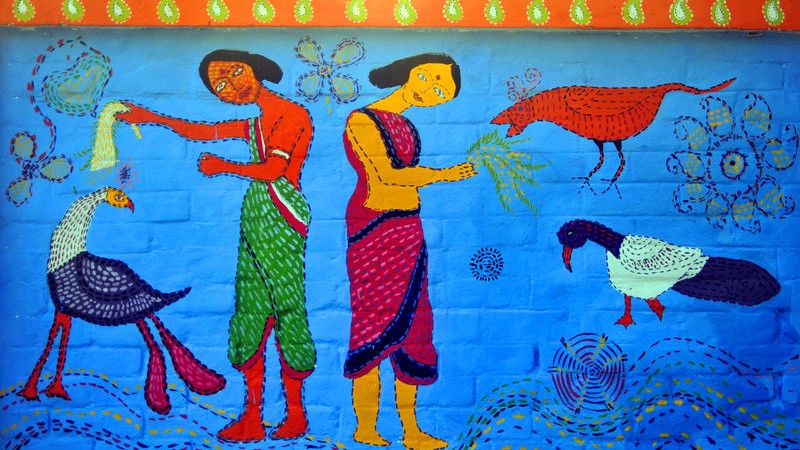
'Nokhsikatha' graffiti by the Students of Fine Arts Institute on the walls of Dhaka University Fine Arts Institute where the rally begins. Image by Firiz Ahmed. Copyright Demotix (14/4/2015)
'Nokhsikatha' graffiti by the Students of Fine Arts Institute on the walls of Dhaka University Fine Arts Institute where the rally begins. Image by Firoz Ahmed. Copyright Demotix (14/4/2015)
And other netizens tweeted out images of the holiday:
'Nokhsikatha' graffiti by the Students of Fine Arts Institute on the walls of Dhaka University Fine Arts Institute where the rally begins. Image by Firiz Ahmed. Copyright Demotix (14/4/2015)
'Nokhsikatha' graffiti by the Students of Fine Arts Institute on the walls of Dhaka University Fine Arts Institute where the rally begins. Image by Firoz Ahmed. Copyright Demotix (14/4/2015)
The post was also published in Global Voices Online.
March 11, 2015

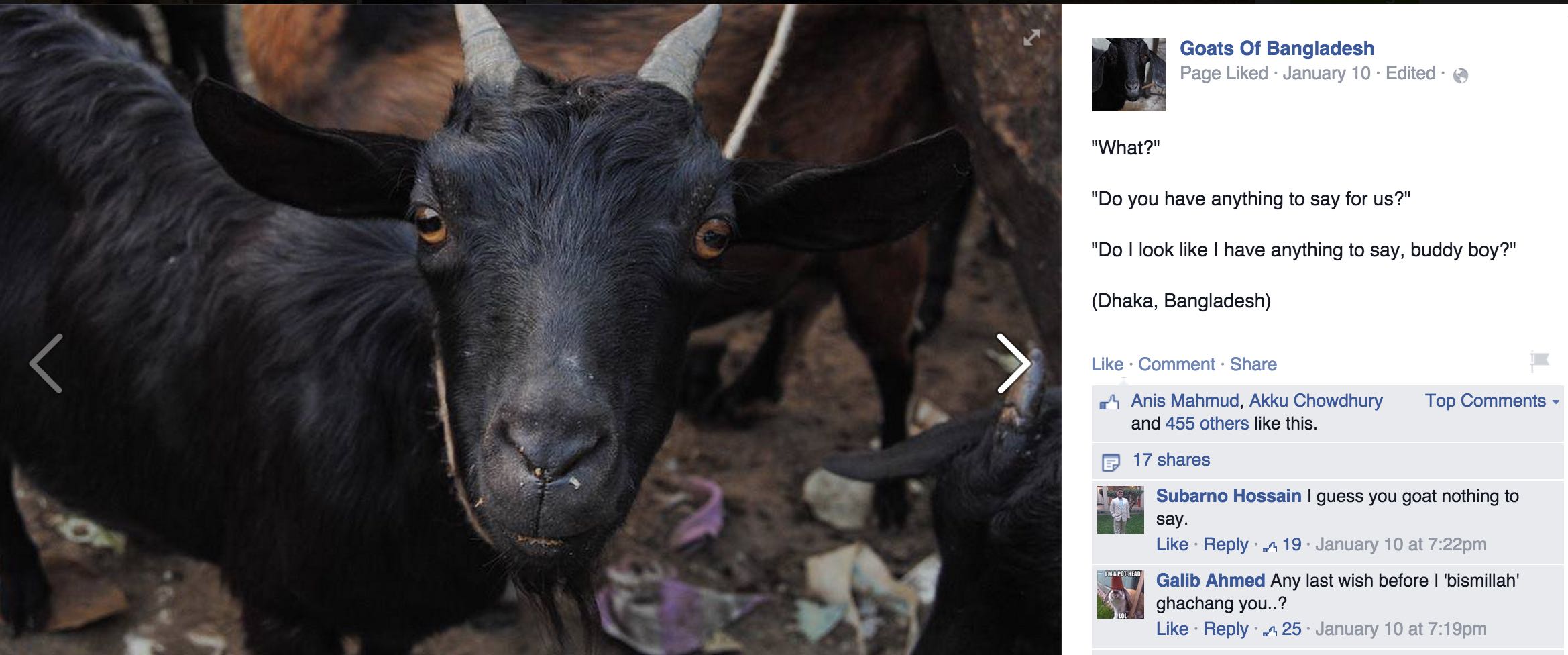
Real Goats. Real Stories. Bangladesh Delivers.

Screenshot from The Goats of Bangladesh Facebook page.
Screenshot from "The Goats of Bangladesh" Facebook page.
Read the full interview here at Scroll.in.

Bangladesh has now a satirical Facebook page much like Pigeons of New York, which is itself a parody site of the famous Humans of New York project. Goats of Bangladesh is only about six months old, but it boasts of almost 10,000 followers. Sahil Bhalla of Scroll.in interviewed one of the page's administrators, who preferred to remain anonymous.
[What is] the idea behind the page?

We were bored one day during Eid and decided to take pictures of goats with a DSLR camera. After seeing the outcome of the pictures, one of us decided we would open a parody page called "Goats of Bangladesh" where we would mimic the style of posts made by Humans of New York in a mocking way.
Screenshot from the Goats of Bangladesh Facebook Page
Screenshot from the "Goats of Bangladesh" Facebook Page
Read the full interview here at Scroll.in.

The post was also published in Global Voices Online.
February 04, 2015

Mumbai Newspaper Editor Fired, Arrested for Republishing Charlie Hebdo Cartoon

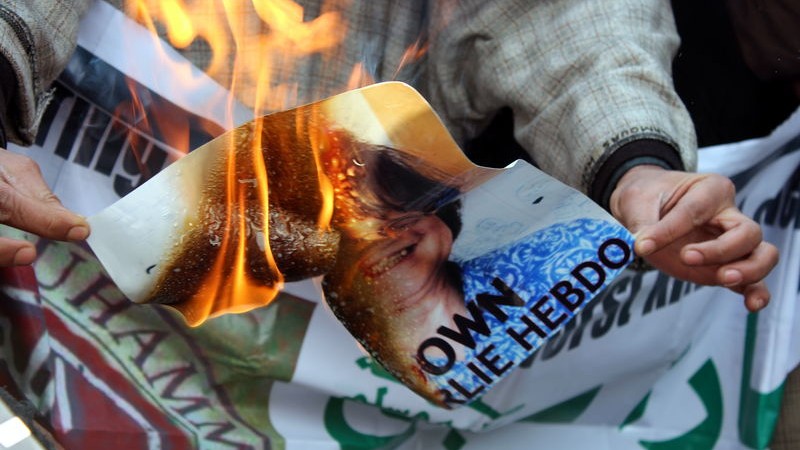
A protest rally against French satirical magazine Charlie-Hebdo was held in Kashmir's Old City. Protestors effigy and Charlie Hebdo posters were set on fire by angry protesters . Image by Adil Hussain. Copyright Demotix (23/1/2015)
A protest rally against French satirical magazine Charlie-Hebdo was held in Kashmir's Old City. Protestors effigy and Charlie Hebdo posters were set on fire by angry protesters. Image by Adil Hussain. Copyright Demotix (23/1/2015)
A newspaper in India was shut down and its editor arrested after republishing one of French satirical magazine Charlie Hebdo's cartoons featuring the Prophet Muhammad on its front page.

Shirin Dalvi, who was later released on bail, is accused of violating section 295A of the Indian Penal Code, which bans malicious and deliberate acts intended to outrage religious feelings. She faces as many as six lawsuits filed against her across the state, and has taken to hiding her face behind a burqa while in public.

Her troubles began on January 17, 2015, when she printed the February 9, 2006 cover of Charlie Hebdo titled "Mahomet débordé par les intégristes" ("Muhammad overwhelmed by fundamentalists"), with a bearded man in tears saying "C'est dur d'être aimé par des cons" ("It's hard being loved by jerks"), on the front page of the Mumbai edition of Urdu daily Avadhnama. The editorial accompanying the republished cartoon argued that since no image exists of the Prophet Muhammad, the Charlie Hebdo caricatures should not be taken as a representation of him:
There exists no image of him, so how can we infer that this picture is a caricature of him?
Ten days earlier, two gunmen had attacked the Charlie Hebdo's office in Paris, killing 12 people, including eight journalists and injuring 11 others. The dead included the magazine's editor and a policeman. The magazine outraged many Muslims across the world as it published a number of controversial Muhammad cartoons over the years.

Facing backlash, Dalvi apologised, writing a detailed editorial explaining her position on the next morning. But the outrage continued. She began receiving threats on her phone. Lawsuits have been filed against her in different police stations in Mumbai, Thane and Malegaon.

On January 19, Avadhnama’s Mumbai edition was shut down and all its 15 employees sacked. Taqdees Fatima, owner of the Avadhnama title, defended herself, saying she had no links with the Mumbai edition, which was run by a separate entity.
The editor, publisher and printers are totally different and… (are) responsible for the contents.
Avadhnama's other city editions did not publish the cartoon and were not affected. For Dalvi, more misery was waiting. Members of the Rashtriya Ulema Council (State Cleric Council) threatened to protest outside the police station if Dalvi was not arrested.

On January 28, she was arrested and got bail on the next day. But she has not gone back to her home in Mumbra since the protests began; her house remains locked and her children are staying with the relatives. Dalvi, along with the newspaper’s publisher Yunus Siddiqui, proprietor Taquadees Fatema and managing director Deepak Mhatre obtained anticipatory bail in another case filed against them on the same charge.

Dalvi told the Mumbai Mirror in an interview that she meant to reproduce Charlie Hebdo's latest cover purely as an illustration to go along with a report, but printed the 2006 cover by mistake. She admitted that she didn't know what the cartoon said since she doesn't speak French, and had only intended for the cartoon to illustrate a report about the controversial magazine's increased circulation following the attacks.

In a different interview with media watchdog website The Hoot, Dalvi, who has been working in Urdu media for the last 25 years, accused some papers of running false reports about her, such as one saying she had shot down a junior colleague's objection to the cartoon's publication by saying it would boost the newspaper's circulation. The website reported that sources in the Urdu media industry suggested business rivalries may have something to do with the case against Dalvi.

Online, some users criticised the lack of support for Dalvi following the Charlie Hebdo attacks. Satire Twitter account ChopdaSaab tweeted:
Blogger Suvie Kaul wrote:
Nikhil Mehra, a lawyer from New Delhi, tweeted:
The hashtag #IStandWithShireenDalvi has taken off:
Sadanand Bhat, a commenter on an article in Indian Express, questioned the state of freedom of expression in India:
This is Outrageous. Here in western Countries they published the picture of the cartoon. Where is the freedom of Expression in India? WHy should she apologise? Where are all the Seculare [sic] peaceniks? This silence is deafening even in the news reviews. Feel sorry for her and wonder how I can help her.
Raghvendra Upadhyay commented on an article in the India Times to say:
There is a thin line between "freedom of press" and "outraging religious feeling". Important thing is, what is the duty of a press. To put in news what people what to hear ? or what press want people to know ?

Choice is yours !!

Based on your choice, you will build yours and your societies future.
The post was also published in Global Voices Online.
November 15, 2014

Hijras, Bangladesh's ‘Third Gender’, Celebrate First Ever Pride Parade

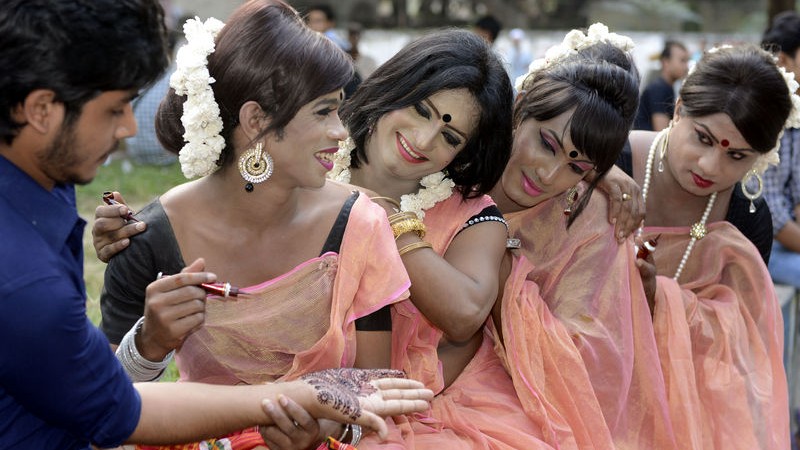
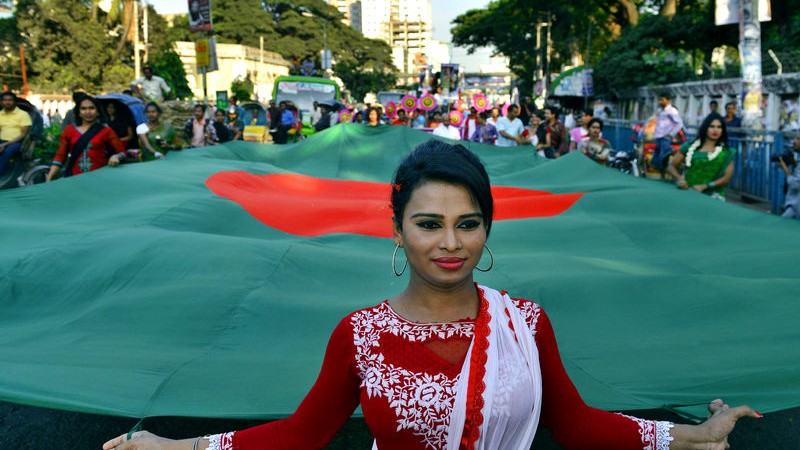
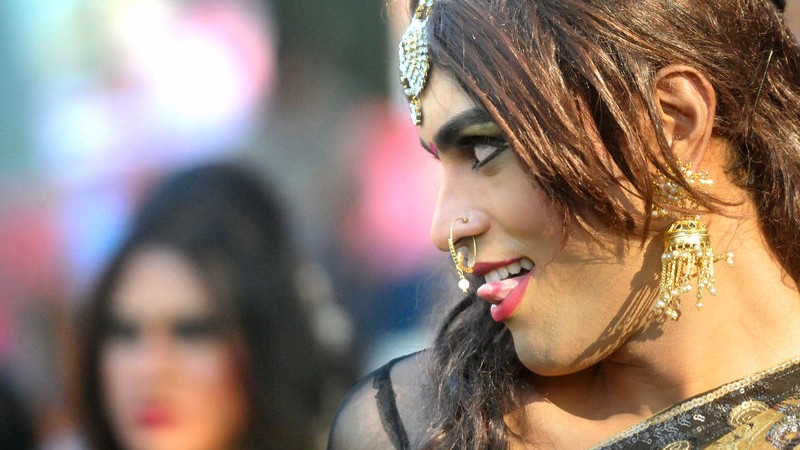
Hijra pride 2014 festival began in Bangladesh on Sunday. The photo was taken from the Sahabgh Raju Circle in Dhaka. Image by Anwar Hossain Joy. Copyright Demotix (9/11/2014)
The 2014 Hijra Pride festival began in Bangladesh on Sunday. The photo was taken from the Sahabgh Raju Circle in Dhaka. Image by Anwar Hossain Joy. Copyright Demotix (9/11/2014)
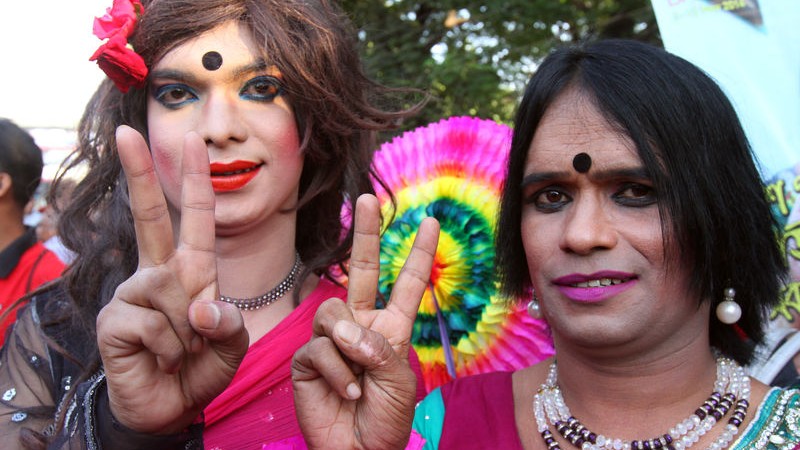
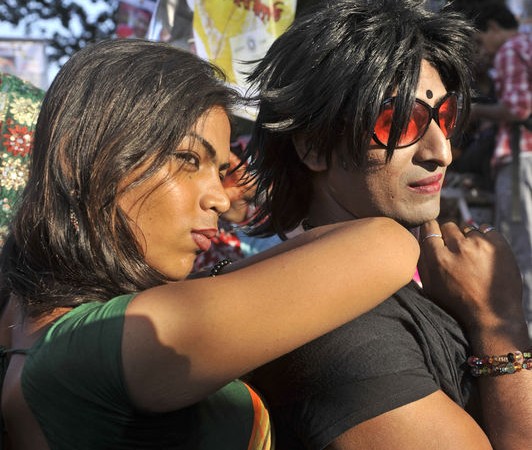
About a thousand Hijras took part in Bangladesh's first ever "Hijra Pride" in the capital Dhaka last week to celebrate the first anniversary of their recognition as a separate gender by the government. Hijra is a feminine gender identity that some people who are born male or intersex adopt, often labeled as transgender by the West.

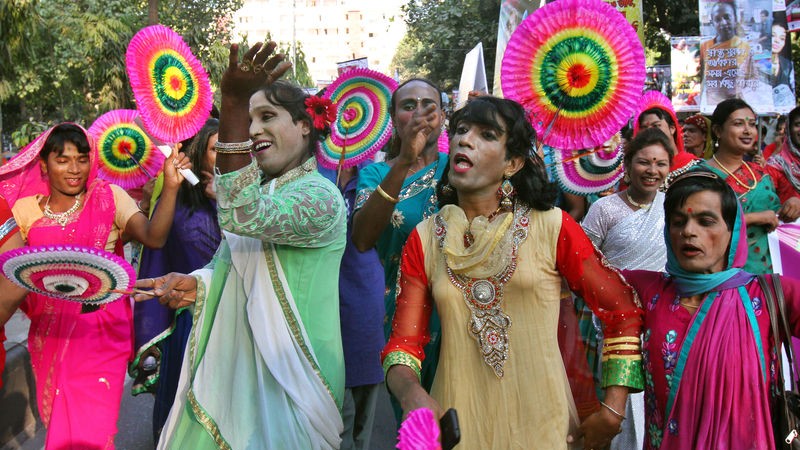
Bangaldesh's about 10,000 Hijras have long suffered discrimination. At this first pride parade, participants with colourful dresses sang and danced in the streets carrying Bangladesh flags and banners, one of which read: "The days of stigma, discrimination and fear are over."

Take a look at some snapshots of the event:

Transgender people parade with the national flag in Dhaka to mark 'Hijra Pride'. Image by Sony Ramany. Copyright Demotix (10/11/2014)
People parade with the national flag in Dhaka to mark 'Hijra Pride'. Image by Sony Ramany. Copyright Demotix (10/11/2014)
The colourful rally organised by the Bandhu Social Welfare Society  took lace near the press club, Dhaka. Image by SK Hasan Ali. Copyright Demotix (10/11/2014)
The colourful rally organised by the Bandhu Social Welfare Society took place near the press club, Dhaka. Image by SK Hasan Ali. Copyright Demotix (10/11/2014)
Celebrating ' Third gender (Hijra) Pride 2014' in Bangladesh. Image by Sk. Hasan Ali. Copyright Demotix (10/11/2014)
Celebrating Hijra Pride Parade. Image by Mohammad Asad. Copyright Demotix (10/11/2014)


Bangladeshi hijras - transgenders - dance in the street during a pride parade. Image by  Indrajit Ghosh. Copyright Demotix (10/11/2014)
Bangladeshi Hijras dance in the street during a pride parade. Image by Indrajit Ghosh. Copyright Demotix (10/11/2014) 
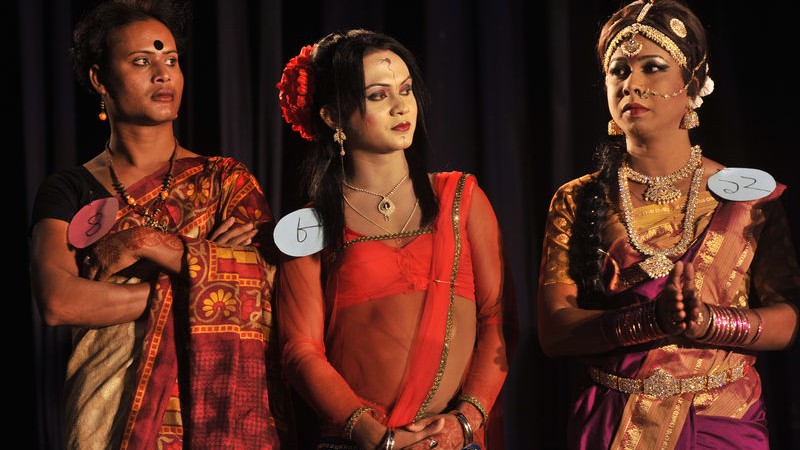
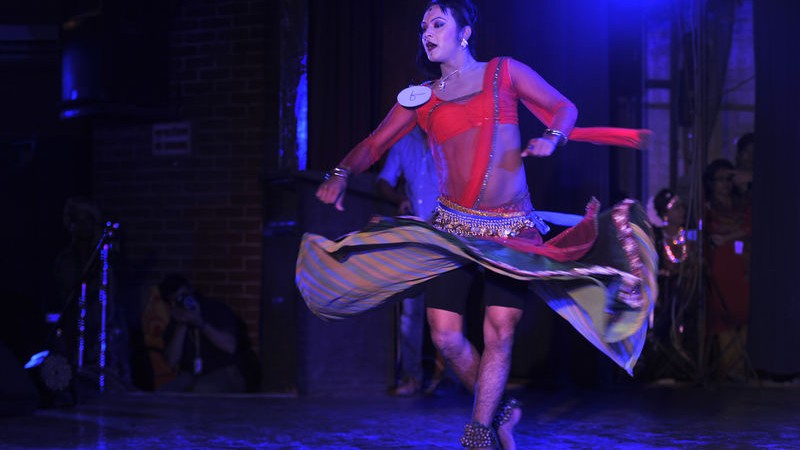
Hijra celebrate with a beauty talent show during the evening. Image by Mohammad Asad. Copyright Demotix (10/11/2014)

‘Hijra pride 2014’ ended with a talent hunt competition. Image by Mohammad Asad. Copyright Demotix (10/11/2014)
People also celebrated with them and shared support via Twitter:
The post was also published in Global Voices Online.
November 04, 2008

Halloween in Germany

You might wonder what is the connection of a pre-Christian Celtic festival of the dead with Germany?

This Spiegel article reveals:
In the mid-1990s, few in Germany had ever heard of Halloween, and even fewer celebrated it. Now, it's a €150 million a year industry.
Dieter Tschorn, a German businessman started promoting the event in 1994 and it took off.


In 2007, 4,600 tons of pumpkins were sold in Germany, says Tschorn. One can buy Halloween bread at the baker's, Halloween sausage at the butcher's, Halloween cocktails at the bar and, of course, Halloween candy in the nation's supermarkets. Tens of thousands of German children now go door-to-door, holding out their bags and saying "sweet or sour," the German version of trick-or-treat.

The Halloween promoter says that the holiday has become an industry worth around €160 million in Germany, in third place behind Christmas and Easter. In 1994, that number was close to zero.


I recently went to the The Erlebnisshof Klaistow about 50km away from Berlin where a pumpkin festival was held. You can see all the innovative sculptures people can do with pumpkins here. The best pumpkin of the region weighs 260 kilos:

June 21, 2008

The Google Sari


NewLaunches.com writes:
Satya Paul a leading fashion designer showed a Saree with Google on it in one of his recent shows.

May 01, 2008

Bangabandhu in Bollywood

Renowned Bangladeshi columnist Abdul Gaffar Chowdhury is producing a film on Bangabandhu Sheikh Mujibur Rahman. Guess who will be playing the role.

Its Amitabh Bachchan, the legendary actor of Bollywood.

Reuters India also reports:
His son Abhishek Bachchan will act in the role of a young Mujib. Amitabh's daughter-in-law and former Miss Universe, Aishwarya Rai, and renowned actress Shabana Azmi will also act in two key roles.

Shyam Benegal, the only director to won India's National Film Award for Best Feature Film in Hindi five times, will direct the movie.
Amitabh is a powerful actor and I don't have anything against the choice. But I wonder why we had to turn to Bollywood to produce a cinema on Bangabandhu. It remains to be seen whether the real history is altered through Bollywood style dramatization or not.

Sad but true that politicization of Bangabandhu's deeds (both by Awami League and anti Awami League forces) have alienated the true Sheikh Mujib from the hearts of many Bangladeshis. And we have to rediscover them through Bolloywood.

Update: Bachchan denies plan to play Mujibur Rahman

December 31, 2007

New year's eve in a police state

Once again the Bangladesh Government will be trying to subdue the new year celebrations that occur in the Gulshan-Banani area and the Dhaka University area. From the Daily Star:
Around 6,000 law enforcers will be deployed in the city including the diplomatic zone and the posh areas of Gulshan, Banani, Baridhara, Dhanmondi, Uttara and on the Dhaka University Campus.

Dhaka Metropolitan Police (DMP) authorities made a number of city roads off limits to traffic for 10 hours from 8:00pm on New Year's Eve.
A Bangladeshi Blogger responds:
Why do I suddenly feel like I live in a military state? Maybe its got something to do with the six thousand policemen stationed around the capitol to maintain safety as New Years celebrations go ahead. It’s sad that the first few hours of a fresh year have to be a nerve racking time for the people ensuring our safety. The government seems to frown on parties tonight. Lol. With reason, I’m sure. Still, there’s no stopping the young - and there shouldn’t be.

Facts

* People who complain about New Year celebrations are just jealous no one invites them. They would go if someone did.
* The rioters are not really people who are celebrating. They’re criminals using the event as an excuse to burn cars or rape (harass)women. Problems like these are not caused by our decision to make something of this night but because of the 364 other days of the year when crime goes unpunished.
* If you’re looking for a party, you’ll find it ;)
* A lot of losers are out on the streets tonight.
* As a nation with people of different religions, backgrounds, etc some have a right to party tonight.
* You can party and get high without drugs, drinks or a smoke.
* Some people who are well within the law get harassed tonight.
* People need to chill.
The truth is that if your only tool is hammer all your problem looks like nails. Lack of common sense are the roots of these problems.

December 14, 2007

The art of Kite-flying

Ulysses's article about Maanja brought me back sweet memories from the past when I used to fly kites.

Maanja involves in pasting the tread of kites with glass and sand to make it tough and sharp to aid in the battle of kites. Soon children would scream "Bho-kattaaa" as soon as the lost kite was beheaded from the thread by the sharp thread of the winning kite. And some would run after it for miles to retrieve from a distant roof or treetop.

Those were the days and Ulysses reveals the sad news:
Kites have been driven out from the center of congested, claustrophobic Dhaka.

October 19, 2007

S M Sultan, Brick Lane, Female Bloggers and Bangla E-Books

(First published in Global Voices Online)

Sid of Serious Golmal writes a well informative article on the life of S M Sultan, the master painter of Bangladesh commemorating his 13th death anniversary. Sultan was born in Norail (in Kushtia in the southwest of Bangladesh) in 1923. Born to a mason, he was a natural talent and did not complete his study in the Calcutta College of Arts and Crafts. Later on he created a wave in the West when he visited USA and UK under a cultural exchange program and displayed his paintings. From 1953 to 1976 Sultan lived in virtual obscurity, living the life of a Vaishnava Sanyasi.

Sultan's Adam
(The First Tree Planting: Sultan 1976: courtesy Serious Golmal)
"Sultan’s paintings may be sold at Sotheby’s in London today but for the people of rural Norail, the guru entered folk legend more than half a century ago. They tell us that animals were drawn to him, that he could converse with them, that hundreds of his works are scattered all over the world in all manner of places, given away as gifts, that he cared not for fame or material wealth, choosing to travel from village to village, country to country, returning at last to his source.

He lived in three continents but never had a fixed abode, never attached prices to his work, never married. He wore his hair long, chose to live out his days in rural Bengal with his dogs, cats, rabbits, birds and snakes rather than the big international cities that beckoned when recognition of his genius came early in his life."
Kotha Chilo (Stories to tell) blog reviews the movie based on Monica Ali's award winning novel Brick Lane. The filming of Brick Lane caught much media attention because of protests of some members of Bangladeshi communities in UK and the unit had to change location of filming to avoid threats. But Monica Ali maintains that "the 'controversy' was whipped up in the media".
"Monica Ali's 2003 novel Brick Lane was feted for its ability to blend the personal and the political as it recounted the experiences of a young Bangladeshi woman's journey of self-discovery. It was illuminating about the hidden lives of Britain's Bangladeshi community and the growing racism abroad in the wake of the 9/11 attacks. The respectable film version heavily compresses the novel into a less complex but still touching, small-scale tale of female empowerment that almost feels like a variation of Shirley Valentine."
Bangla Blogging platform Sachalayatan [bn] boasts of being more of an online writers community rather than collection of some conventional blogs. It has been promoting budding as well as established writers to post their literary works there. And adding more to the task it has already published a few literary E-books in PDF versions and more collaborative projects [bn] at hand. Now users can download their copy of the literature free, print it and read it at ease.

The first publications is a collection of poems of Sunil Saifullah, a notable young poet who prematurely ended his life in 1981. Some of his poems were only once published by the students union of his University (Jahangirnagar University) in 1982. But these few books went into oblivion in course of time and now he is barely known to people of Bangladesh. Bloggers of Sachalayatan first discussed about his works went to the University library to collect a copy of the book and recreate the Book. You can download the book from here [bn].

Some comments on the feat:
সৌরভ: জয় হোক এ উদ্যোগের। এ চেষ্টার মাধ্যমেই জন্ম জন্মান্তরে সজীব থাকুন আমাদের মাঝে কবি সুনীল সাইফুল্লাহ।
Sourav: Bravo to this initiative. With this work let poet Sunil Saifullah live among us for eternity.

সুমন রহমান: বাংলা সাহিত্যে এরকম সারপ্রাইজ আরো কিছু আছে। আমার মনে সচলায়তনের ই-বুক প্রকল্প দিয়ে সেসবের সুরাহা আমরা করতে পারবো।
Suman Rahman: There are more such surprises in the Bangla literature. I think we will able to sort them out with the Sachalayatan E-Book project.

Fele Asha Chelebela
Another recent Bangla E-Book publication “Fele Asha Chelebela” is a 109 page collection of childhood memoirs of twenty one bloggers which portrays the true picture of the lives of Bangladeshi youths, society, their upbringings etc. Its popularity prompted the bloggers to decide to publish it in future as a printed book with more collections of writings. You can download it from here [bn].

You never know some day these collaborative Bangla E-books with the help of New Media will be able to really change the scenario of literature of the country.

And last but not the least please do read the recent writings of the female bloggers of the Nari Joibon project to know about Bangladesh from their view. Nari Jibon is a not-for-profit organization in Bangladesh who is providing education to poor and under-privileged women making them self reliant through different short term education and skill development programs. It has brought these female voices to Blogging with the help of a Rising Voices micro-grant.

August 04, 2007

Resilience, faith and the survivors of the delta

"One thing Bangladeshis cannot be accused of is making a drama out of a crisis."
writes John Sudworth of BBC after visiting the flood effected SirajGanj in Bangladesh. He tells about the way Bangladeshis are tackling this year's flood being more devastating than an average year. They are remaining calm and resilient, trying to carry on with their normal life in waist-deep water.

(Picture courtesy the Daily Star)

The relief efforts are not as exhaustive as previous years however the people seem to be slow on accusing that. Instead they are seen with these kinds of faith:
"Allah has given us mouths, so He will give us food."
Floods in Bangladesh are a recurring phenomenon. Over thousands of years, people living in Bengal Delta learned how to live with rivers and adjusted their lives to the deltaic conditions of the land. The settle in higher land on flood plains, their cropping pattern is adjusted to the deluges and during floods they use makeshift boats to travel.

The people of Bangladesh, therefore, found ways to live with rivers. They respect rivers. They know that rivers gave birth to this land, and rivers would come periodically to nurture it with silts.

Probably thats why they have been the survivors of the Delta. A Malaysian Blog Alis Aquilae recognizes this character in one of the thousands of Bangladeshi labors working in Malaysia. The blogger observes:
What i admire is their will to live and work despite the punishment every year. Knowing monsoon would come releasing its wrath and breaks the river banks each year…these people continue in believing that nothing can stop them from surviving. They have never gave up. The yearly monsoon seems destructive but it is also because of that the land is fertile. They may have to start everything from scratch after the flood receded but the thought of a good harvest probably lighten up their day. They are the true survivors.

July 07, 2007

Burqa debates

Arafat slams the remarks of Michael Savage, host of The Savage Nation, the "the third most-listened-to talk radio show" in America. Savage said:
You know, when I see a woman walking around with a burqa, I see a Nazi. That's what I see -- how do you like that? -- a hateful Nazi who would like to cut your throat and kill your children. Don't give me this crap that they're doing it out of a sacred ritual or rite. It's not required by the Quran that a woman walk around in a seventh-century drape.
Arafat argues:
...is public tolerance reserved only for matters of religious or cultural 'obligation'? Whatever happened to choice? I mean, society allows tattoos and piercings not because people get them out of some kind of compulsion, but because it's a matter of choice.
Commenter Achelois argues
Hijab/niqaab is not a clothing item of choice. They may wear a blue ‘shuttlecock’ burqa out of choice and not the black – that is choice.

I don’t like the burqa and it makes me very uncomfortable to talk to a masked ‘human’; a human who has made herself believe that veil is her religious obligation and then claims that she should be given personal choice to wear what ‘she’ wants!
Update: Lets make this debate interesting. A Bahraini girl tells her story about her colleague wearing Hijab (via Global Voices Online):
Several days ago in one of the malls a girl stopped me, and her features seemed familiar…For a moment I thought it might be a colleague from work, but there was a big difference in the appearance of the two. My colleague, ever since I have known her, wears hijab (headscarf), and I have never seen her wearing short or tight clothes, just as she doesn’t wear any makeup on her face.

When she put out her hand to greet me I knew for certain my suspicion was correct, and she was the same colleague that I know. I asked her about the reason for the big transformation in her appearance which had surprised me. She said she didn’t always wear hijab, and only wore it during official work hours, and this was her normal way of dressing. Why this double life? Aren’t men the same wherever they are?

She answered, ‘Yes, with one small difference. I deal with those men for eight continuous hours during the working day, but outside, wherever I am, I am away from this closed circle of daily monitoring, from the annoying looks that follow me. I wear hijab during office hours because men usually talk more daringly to women without the hijab. This covering that I put on my head puts a clear boundary between me and those who do not respect women and do not behave well towards them unless they are wearing hijab.’
There we go we have Hijab as a makeshift tool to tackle men in a patriarch society.

Update II: The clerics in Kenya are outraged because prostitutes and criminals are using Buibuis or Burqas to hide their faces and avoid authority's crackdowns (BBC). The organising secretary of the Council of Imams of Kenya, Sheikh Muhammad Khalifa says:
"For God's sake, if one has decided to join this profession, the uniform of prostitutes is well known. "They should stick to their disgraceful attire."

February 19, 2004

Same-sex marriage

Judging from the pros and cons (?) of same-sex marriage can you hear a revolution coming up in the western society?

I doubt whether it will make an impact like living-together or cohabitation. Although these experiments are not trouble free they follow the procreation rules of nature.

To sum up, my opinion is that homosexuality is not natural. The accumulation of wealth in the western society and no children of homosexuals to inherit them will cause an unbalance someday. And threats like Aids will increase among the gay-lesbian societies. Nature has its own revenge on the malpractice of the society.

Update: In reply to some of the comments I am clarifying one issue here. I said "threats like AIDS" not AIDS in particular. Who knows what could be nature's next revenge.

Its surprising though that homosexuality is prevalent in affluent and open societies rather than conservative and developing societies. For conservative societies, sex before marriage is a taboo and craving for opposite sex remains alive for many years since childhood. But in societies where you can have sex easily (ofcourse with consent) anytime you like since puberty, the attraction towards opposite sex diminishes as the the years progress. Human beings' nature is to discover new things and ideas. So sexual attraction to same sex is the hottest meme so to speak. I am not arguing that there should be laws preventing this. But I think let the behavior progress at its own merit. And you can imagine how it will be dealt in conservative societies, whereas it has aroused many controversy in the open society itself. E.g. Shanti & Jivha had some angry
comments to deal with after ranting on the same subject. Its unlikely that same-sex marriage would be a burning issue in Bangladesh in the near future.

February 18, 2004

Valentine the infidel

The times of Oman reports:

Saudi Arabia's religious police arrested more than 200 workers from Bangladesh and Myanmar as they celebrated St Valentine's Day outside the holy city of Makkah, where the traditional event for lovers is banned by fatwa.

The kingdom's grand mufti and highest religious authority, Sheikh Abdulaziz Al Sheikh, condemned the party-goers.

"What these workers did in a holy place by celebrating and singing and drinking alcohol is a very grave sin," he told the daily. "Committing a sin in a holy place is doubly sinful. Valentine's is an infidel tradition that has no place in Islam, " he said.


In my view, those who drunk alcohol, committed commited a crime under local law. But for singing and Partying? My gosh! Is that a place to live? And I have heard that the wealthy Arabs like to drink and partying and they do them discretely. I guess there is a different law for them. Those poor workers, who are only exploited and have nothing to cheer about in life get the axe.

If Valentine's tradition is infidel, then how do Saudis express love? Keeping their loved one's in Harem?

February 14, 2004

ON VALENTINE'S DAY

We love ourselves more than anybody else. Those who like what we like, are our friends. They can participate in a prolonged discussion with us. Then we have a consensus. We love them too. Because they are like us not like the others. We do not want to listen to other thoughts, other religions, other views. They may dilute us, make us leftist, soft. We believe in nationalism. We want to make this world a civil place. We need to ensure everybody's freedom whether they want it or not. We want to make sure that our precious lives would be secure from all threats at any cost. We want every country to destroy WMD but we would keep some just in case.

I love that beautiful girl because she thinks I am the strongest guy in the block. And if I win her love then I can show everybody that I am the hero in the block worthy enough for a girl like her.

Now, do I hate those "we"s and "I"s? Narcissism rules everywhere. Where are the compassion and real love for others? Love means understanding and caring for others without "I" in it. Greatest loves involve greatest sacrifices.

When love can be free of the selfish us?

February 12, 2004

WHAT CAUSES RAPE?

Alas a blog! posts an anotomy of rape culture. Although it is in the context of US, the problem is universal. The findings are:

* The overwhelming majority of rapists are male.

* The Myth of Masculinity - Masculinity is defined by power-over. The man who is overpowered by others is less then a man; the man who has power over others is a man among men. Once boys become teens, masculinity is additionally defined by the absolutely crucial task of getting laid.

* Low regard for women- women aren't respected as equals, by and large. Many rapists don't rape because they hate and want to hurt women; it's not that personal. Rapists rape because they want sex; they don't consider the woman's feelings at all, because a woman's feelings aren't worth considering. They're just women, after all.

* Sexuality is something possessed by women, which is given to (or taken by) men -it's pretty obvious why men's magazines, wanting to sell copies with a sexy cover, usually use photos of mostly-undressed women. But why do women's magazines do the exact same thing? Because to do a sexy magazine cover, you generally have to show a photo of a woman. Sexuality equals women in our culture; it is something possessed by women, not by men.

That's also why women are taught to wait to be asked for a dance (or for a date), while men are taught to do the asking. Women have it; men ask for it.

The reasons for rape cases prevailing in Bangladesh are:

*All of the above and
*Women and children are soft targets as many of them are less educated and ignorant of precautions.
*Its easy to get away with rapes in this country. Lack of witness does not make a firm case against rapist. Rape victims must produce proof of evidence to doctors within 24 hours, which is not possible allways.
* Rape victims are socially abhorred. So rape is used to take revenge or disgrace somebody.

So whats your view on this? Are there more reasons? What do you recommend to prevent this universal threat?

February 01, 2004

SACRIFICE OR WASTE?

Tomorrow is Eid-ul-Azha, one of the two biggest religious festivals of Muslims. For Muslims all over the world, the celebration is mainly slaughtering sacrificial animals on this day after the Eid Prayer.

Some 3800 years ago, on this day, Prophet Ibrahim (A) offered to sacrifice his beloved son Prophet Ismail for the satisfaction of Almighty Allah. But in spite of his willingness, Ismail was spared by Allah and a ram was sacrificed instead. That's how the ritual began.

The sacrifice of animals is symbolic. Hazrat Ibrahim's sacrifice conveys something noble and something ideal. That is the Muslims who sacrifice animals every year on the occasion of Eid-ul-Azha in consonance with Lord Creator's commandment should sacrifice atleast a small portion of their wealth keeping in view the symbolism in order to bridge the wide gap between the haves and havenots. As it is stated in Quran:

"It is not your meat nor their blood that reaches Allah: it is piety that reaches Him:"

But it will be a sorry state of Dhaka city tomorrow as mostly the goats and cows would be sacrificed openly in the streets. For lack of sufficient slaughter houses in the city and ample space inside own house compounds most people have no option than to choose the streets. There are also competitions among the riches for purchasing the costliest and the largest animal. Many slaughters more than one animal in one family. They do not think that the cattle and goat population in our country cannot meet their demand. Every year during Eid-ul-Azha many cattles are brought from India through legal and illegal channels. For Hindus these cattles are a symbol of God. They do not eat beef. And we, the Muslims in Dhaka are not well mannered enough to keep the sacrifices away from a public place like the street. For children and weak hearted also cattles lying in a pool of blood is not a good sight. It is said that slaughtering your own animal is advisable. How savage! I would never endorse it. And what happens to all the flesh? One-third of it has to be given to the poors. One-third for the relatives and one-third for own consumption. I see everytime many families are really in dire straits not being able to manage storing all the meat given by the relatives. And you would not find real poor persons to give away. There are some professional meat collectors disguised as poors who will sell away the meat to some others (or even to some restaurants!). What an waste!

I thought we are living in the twenty first century not 1700 years BC. We always forget that the sacrifice is symbolic. There has to be some other way to sacrifice a portion of our wealth. Considering the growing population and increased purchasing power, there will be more demand for sacrifice animals. Will they face extinction or will the agriculture or dairy industry will have problems because of this; only time will tell.

I wish I could spend these holidays in some other place. I hate to see blood.

December 25, 2003

X-MAS IN BANGLADESH

To start with, it is a holiday in Bangladesh. It has been in Bengal for 225 years ever since the British East India Company started to rule the region. Whereas X-Mas (December 25th) was declared a federal Holiday in America on June 26, 1870.

There is a small Christian population here. There is roughly one Christian in every 324 Bangladeshis. However the Christian community is well bonded and are widely known as an amiable community.

There is a comprehensive article by Jerome D'Costa about Christianity in Bangladesh

Some excerpts:

Arab traders and aulias (holy men) brought Islam to Bangladesh through Chittagong and Sylhet in the 9th century AD. The Portuguese traders also brought Christianity to this country through the port of Chittagong, called the Porto Grande or the great port, in the 16th century, but the first church in Bangladesh was built in 1599 at Chandecan (also called Iswaripur or old Jessore) near Kaliganj in the Sunderbans of present Satkhira district.

The usual programs of the X-Mas day, commemorating the birth of Jesus Christ, include special prayers at churches, decoration of Christmas tress, distribution of gifts by Santa Claus to the children, family reunion and feast.

One notable thing here; the Christmas carols and the church hymns are mostly Bengali songs written by the poet Rabindranath Tagore. I like Tagore songs and I was overwhelmed when I found out that they are sang in church in holy spirit. And the decoration of Christmas trees is not visible as there is a small Christian population. But in City's luxurious hotels, including the five-star ones, X-Mas trees are decorated and they have arranged special programs for all offering foods and gift packages for families and children. 'Santa Claus' is also there with gifts. The foods at houses include rice cakes and other delicious items including wine.

But mass scale consumption is not evident here. I have seen that many of the Christians are true believers. The reason for that I guess being a minority helps them to be unite and keep them closer to god as:

"His place is with those who do not belong, who are rejected by power because they are regarded as weak, those who are discredited, who are denied the status of persons, tortured, excommunicated. With those for whom there is no room, Christ is present in this world." (via Laura)

Wishing everyone merry X-Mas and may God bless us all.

December 21, 2003

FEAR & RESPECT

People say respect must be earned. But many of us try to gain respect of others by imposing fear or threatening others. This all starts when we think that we are superior to others and fail to respect them. I believe that to earn respect you must respect others first. When interacting with persons of apparent inequality we should give them respect. Otherwise a relationship of domination and submission would occur based on fear and the world will remain divided in many worlds (1st world, 3rd world etc). For example, there is a lot to learn from tribal people when apparently they seem to be uneducated and savage. I have another experience with an old beggar. When I greeted him with respect and asked of his well being he responded, chatted and in the end refused to take alms from me when I offered.

Lets not fear others and not impose fear on to others. Peaceful coexistence is only possible when we eliminate fear among ourselves and respect each other.