Dragonfly

Image by Rezwan

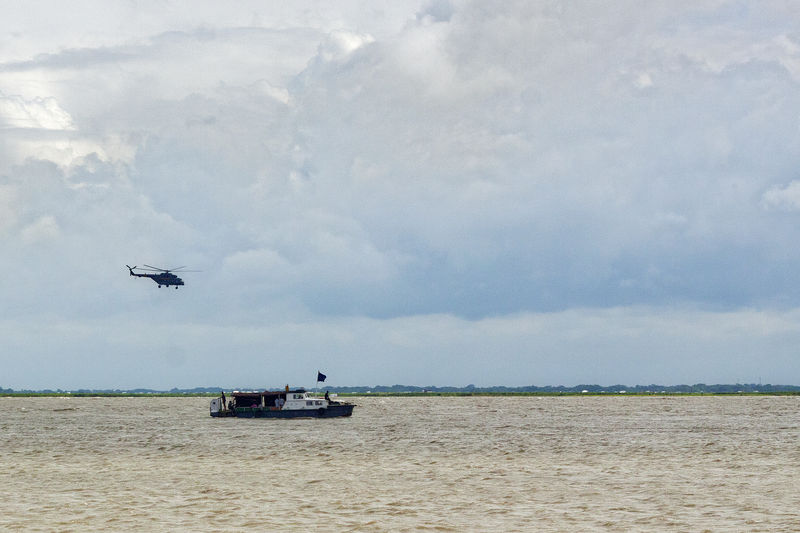
Overcrowded passenger ferry capsized in the Padma River in Munshiganj, Bangladesh

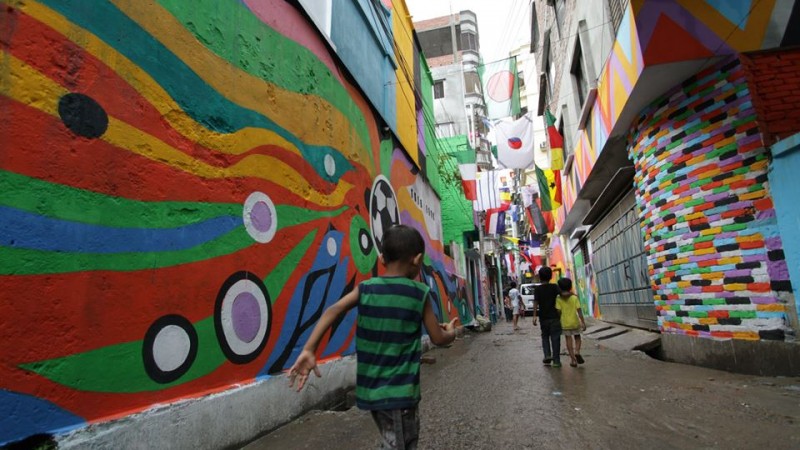
The World Cup Goal-E Project

This street in Bangladesh has a colorful world cup celebration

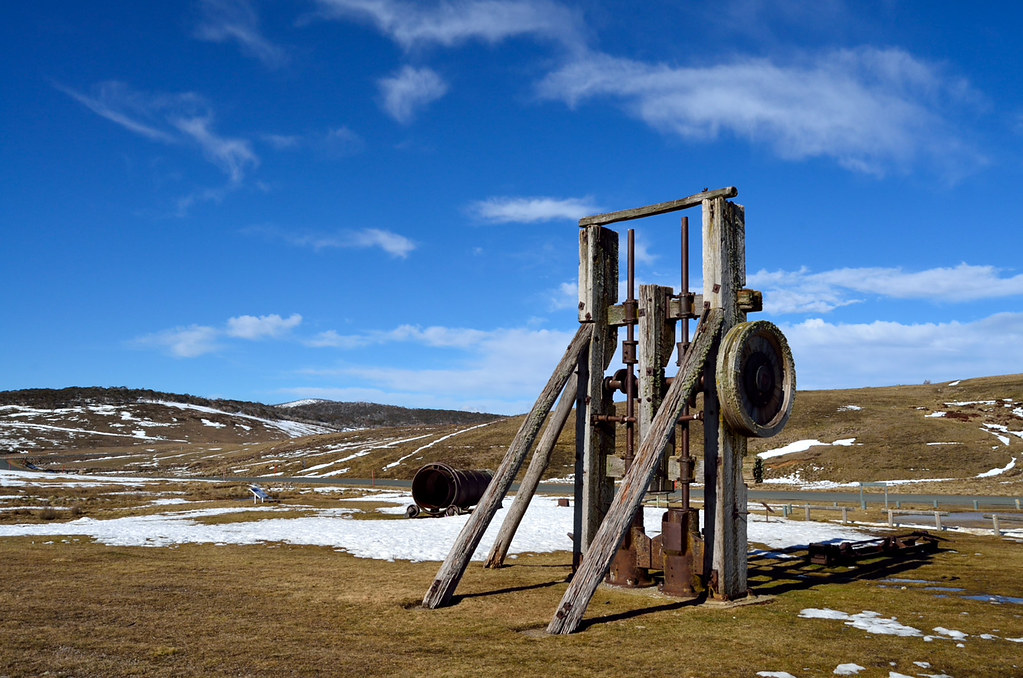
New Chum Hill Ruins

Remnants of Kiandra gold mine at New Chum Hill, #nsw #australia

Showing posts with label economy. Show all posts

May 20, 2014

Bangladesh's Economy Remains Stable, Analysis Finds

Equity analyst and blogger Asif Khan posts a brief economic update of Bangladesh in his blog. According to the analysis, despite political uncertainties the economy looks stable and inflation remains under control:
The chances of an interim election in the next 12 months look slim. Current account surpluses continue, currency looks stable and inflation remains under control, largely due to weak demand. On the negatives, tax revenue fell short of the target as per expectation. In our opinion, the major negative was the slower pace of recovery of business activity post election.

May 05, 2014

The Rise and Fall of Bengal’s Textile Empire

Bengal was once known as the richest province of the Indian subcontinent mainly due to its famous and varied agricultural and textiles products including the Muslin, world renowned finely-woven breathable fabric. M Ahmedullah posts in Alochonaa.com a two part series (Part 1, Part 2) discussing the history of the Bengal's textile empire.

November 28, 2011

The World That We Live In

July 28, 2010

Minimum Wages Raised For Garments Sector In Bangladesh

Ever wonder where were your T-shirts or pants made? If you are living in North America or in Western Europe, there is a high chance that you are wearing a cloth made in Bangladesh. And no wonder Bangladesh’s export earnings are mostly determined by the export of ready-made garments (RMG) which is about 75% of the total export earning of the country.

But in recent times the textile sector has seen some confrontation between the workers and their employers over wages related issues. Bangladesh's competitive advantage had been skilled workers and low wages but due to inflation the old minimum wages has become an absurd figure now. The garments factory owners associations have long been able to halt the talks of raising of minimum wages claiming that if wages are raised they will not be able to maintain competitiveness and lose market especially during the global recession. Their bargaining point was that because most of the workers do overtime they actually earn one and half to twice the amount of the minimum wages. But this has also increased the unhealthy practice of exploiting more labor hours from the workers.


They make your Tshirts. Image by Flickr User Niloy. CC BY

Around 3 million labors work in approximately 5000 garments factories across the country and almost 80% of the workforce are women. Mahfuzur Rahman Manik provides a background on the minimum wages issue:

সর্বশেষ ২০০৬ সালে বর্তমান বেতন কাঠামো নির্ধারণ করা হয়। সর্বনিম্ন বেতন স্কেলের জন্য তখন মজুরি বোর্ডের সুপারিশ ২৩০০ টাকা থাকলেও মালিক পক্ষের চাপাচাপিতে নির্ধারণ করা হয় ১৬৬২ টাকা। বর্তমান মূল্য ও মুদ্রা; দুইয়ের স্ফীতির এই বাজারে একজন শ্রমিকের নিজের পক্ষেই শহরতলীর বস্তিতেও দিনযাপন করা অসম্ভব। তিন বছর পার হলেও সে বেতনের আর পরিবর্তন হয় নাই।

The last pay scale was fixed in 2006. The wages board recommended an wage of Tk. 2300 per month (US$ 33) but after the hard bargaining from the employers Tk. 1662 per month (US$23) was fixed as the minimum wage. Due the inflation of currency and prices it has become difficult for the workers to live with this pay even in the slums of the towns. After three long years no change was made to the minimum wages scale.

Mohammad Golam Nabi advocates for the increase of wages:

বেতন বৃদ্ধির দাবীতে গার্মেন্টস ফ্যাক্টরিগুলোর উত্তাল হয়ে উঠার বিষয়টি বেশি করে শুরু হয়েছে ২০০৭ সালের শেষ ভাগে। [..]

আমাদের গার্মেন্টস শ্রমিকদের একদিনের বেতন ৫৫ টাকা থেকে শুরু। এই টাকায় খাবে, ঘর ভাড়া দেবে, সাবান কিনবে, গোসল করবে আমরা কি করে আশা করি। [..] প্রজনন স্বাস্থ্যের যত্নবিহীন এই নারীরা যে সন্তান জন্ম দেবে, সেই সন্তান এই দেশের আগামী প্রজন্ম মনে রাখুন।

The protests for raising wages started since the end of 2007. [..]

The wages of one day of any garments worker starts from Tk. 55. They will have to use this meager amount to pay their rents, meal, personal hygiene etc. [..] All these ladies will have to give birth to children without proper reproductive hygiene, these children will be the future generation - please beware.

Sharif Kafi writes that the reason for recent unrest in the garments industry is not because of wages issue but the exploitation of few of the employers:

এসব ঘটনা ঘটার মূল কারণ শ্রমিকদের অত্যন্ত কম বেতন দেয়া, গার্মেন্টস মালিক কর্তৃক বেতন বকেয়া রেখে পরে তা শোধ না করা, বকেয়া বেতন ও বকেয়া ওভার টাইম এবং বকেয়া ভাতাদি পরিশোধ না করে হঠাৎ করে ফ্যাক্টরি বন্ধ করে দেয়া এবং ঈদের আগে সময় মত বেতন-বোনাসের টাকা পরিশোধ না করা অথবা না করে ফ্যাক্টরী বন্ধ করে দেয়া। অথচ এক শ্রেনীর গামেন্টস মালিকরা এসব ঘটনাকে বিদেশী চক্রান্ত বলে সবার চোখে ধুলো দেয়ার চেষ্টা করছে।

The main reason for these unrest are underpaying the workers, defaulting on labor payments, shutting down the factory without paying their dues and not paying bonus during Eid festival. But a few garments factory owners are trying to fool people by blaming these incidents as politically motivated.

After long bargaining with the employers and the workers, the Government has finally decided to raise the minimum wages to Tk. 3000 per month ($44) which is approximately double of the current minimum wages. The wages structure will be formally announced tomorrow.

Arif Jebtik, blogger, writer and an entrepreneur provides a list of FAQs regarding the wages and garments industry from management's perspective. Some excerpts from his post at Sachalayatan:

* নতুন বেতন যদি নূন্যতম বেতন ৩০০০ টাকা করা হয়, তাহলে এই সেক্টরে কী সমস্যা দেখা দিতে পারে ? গার্মেন্ট শিল্প কি বন্ধ হয়ে যাবে ?

: নাহ, আদতে তেমন কোনো ক্ষতি হবে না। কারন তখন সব গার্মেন্টই বেতন বাড়াতে বাধ্য হবে, সুতরাং তারা মূল্যও বেশি দাবি করবে। বায়ারদের হাতে এই মুহুর্তে কোনো বিকল্প নেই, তাই তারা বেশি দামেই কাপড় কিনতে বাধ্য হবে। মনে রাখতে হবে আমরা যে কাপড় সেলাই করি, সেটি খুবই বেসিক এবং কম দামের, সুতরাং এই কাপড়ের চাহিদা দুনিয়াতে থাকবেই।

* নতুন বেতন বৃদ্ধিতে গার্মেন্টের লাভ কমে যাবে বলে অনেকেই ধারণা করছেন। গার্মেন্ট শিল্পগুলো কিভাবে চলবে তখন ?

: আসলে বেতন বৃদ্ধি আমাদের জন্য এক ধরনের আশীর্বাদ হিসেবে আসবে বলে আমার ধারণা। এখন গার্মেন্টগুলো বাধ্য হবে নতুন প্রযুক্তির প্রচলন করতে এবং বৈজ্ঞানিক পদ্ধতিতে উৎপাদন ব্যবস্থাপনা করতে। এটি এই শিল্পের জন্য ভালো হবে। প্রোডাকশন ইঞ্জিনিয়ারিং চালু হবে, দক্ষ শ্রমিক ও মিড লেভেল ব্যবস্থাপনা তৈরীর জন্য প্রশিক্ষনের ব্যবস্থা করতে হবে।

* If the minimum wages is increased to Tk. 3000, what problems will this sector face? Will many factories be closed?

: No I don't see the chance of incurring huge loss. Because every factory in the sector will have to increase wages, so the competitive prices will be at the same level. The buyers don't really have many options, so they will have to accept the increase in price. You have to keep in mind that the cloths we manufacture are very basic in nature and of low cost, so worldwide they will continue to have demand.

* People say that the profit of the garments companies will decrease causing them to shut down. How will they survive with the increased costs?

: I think the increase in wages will come as a blessing. The factories will have to embrace new technologies and deploy scientific production methods. this will be beneficial for the industry. The sectors like production engineering will be revitalized, skilled workers and mid level management will require more training.

(Also published in Global Voices Online)

March 04, 2010

Bangladesh Police Arrest Facebook stock tipster

I know many would raise their eyebrows reading this news:
A Dhaka-based Facebook stocks tipster with over 10,000 followers has been arrested on charges of illegally manipulating Bangladesh's overheated stock exchange, police said Thursday.

Mahbub Sarwar, 26, a prolific blogger who provided online stock tips through the popular social networking site, will be charged with market manipulation, Mohammad Sohel, spokesman for the Rapid Action Battalion police force told AFP.

'His Facebook account has 3,000 members and he has a number of blogs... we believe around 10,000 or more people have been acting on his tips for the last few months,' Sohel said.

'His tips could trick thousands of people into buying certain shares on certain days,' he said, adding that Sarwar would also be charged with providing market advice without a license.

Regulators said they had been investigating Sarwar for months. Membership of his Facebook group costs up to 70 dollars a month and he would also charge for individual tips, police say.

He is also accused of running an unauthorised portfolio management services company - advising clients on which investments to make - for which he charged 20 percent of profits.
However this news has some anomalies which even a reputed news agency like AFP did not verify. I think the journalist who reported do not use Facebook - so it is unknown to him that there is no facility in Facebook to earn money from group subscriptions (what was the basis of the 70 dollar fact - how the money was realized?). There is an option of a secret group by choosing individual members, but that group do not appear in the search engine - so there is no question of influencing thousands by it.


While searching Facebook I found Mahbub Sarwar's account, whose nick name is Shoikot. He has a blog, where I see posting of some stock related news. In his blogs he states that he is a capital market investment analyst and he provides some value added service and monitoring for clients (for apparent fees).
Its a personal blog created to educate the capital market investors of Bangladesh and to share the blogger's personal views on different issues. Is Mission is to develop an educated and learned investors community. (source)
So in fact he is actually gathering stock exchange related news from online sources and sharing it with public. Now what has he done to deserve this arrest? How his tips could influence thousands of people with those 2nd hand data which is anyway available in the internet? If it is for his value added personal services - I have no comment. But why making Facebook and his blog the villain? He is just expanding his client base using social media (traditional brokers - take note).

He has 2697 friends and he has a Facebook page containing mainly feeds from his blog posts where some his 743 fans are sporadically asking "what can i buy tomorrow?" "what abt gp today????" etc.

Now the question is all of this is public. You and I can see those. How he has influenced some and not all of us? And by providing Market information to public whom has he hurt? The professional brokers? Is there a group trying to keep the information away from public?

According to the news:
Bangladesh's bourse, one of Asia's smallest, is vulnerable to manipulation and regulators have struggled to stop a slew of online scams, publicly warning investors in January of a rogue Facebook group providing bogus tips.
So an alert was on. If the public still falls for alleged bogus tips (for money or free?) then who is to blame? There are other Facebook group like Dhaka Stock Exchange who are providing stock related tips (its a public group - you can join and participate). So why Mahbub Sarwar only?

I think the authorities got the battle wrong. They need to bolster their online presence to protect the investors. They have got a static page with databases. But there are no news aggregators, no presence in the social networking sites, no interactivity with the potential investors. It must be noted that they do not have Bangla version of their site which can target a lot more audience.

I have seen a few efforts online to educate the Bangladeshi investors, like this blog post where an analyst writes how to minimize risk in trading. The authorities should stop seeing devil in the Internet and act wisely.

I think the arrest of Mahbub was the result of some personal rivalry. Any attempt to control public information is a direct violation of freedom of speech which is protected in our constitution. Today there is Mahbub and tomorrow there will be more people harnessing the power of social media to inform people (or to manipulate to some extent). If the authorities do not joint the bandwagon of social media, they will never win the battle.

October 09, 2009

International Cost of Living Trends 2009

This salary purchasing power parity rank comprises cost of living indexes for each of 276 global locations. The indexes are calculated using the prices for specific quantities of the same goods and services in each location, based on expatriate spending patterns across 13 broad categories (Basket Groups). The latest salary purchasing power parity ranking, together with the overall cost of living index, sourced from www.xpatulator.com as at January 2009 is as follows: Rank Location (Overall Cost of Living Index New York=100)

1. Japan, Tokyo (126. 03)
4. Switzerland, Geneva (119. 59)
6. United Kingdom, London (118. 23)
10. Russia, Moscow (113. 41)
11. Nigeria, Lagos (112. 69)
14. France, Paris (112. 38)
16. Italy, Milan (111. 19)
27. Italy, Rome (107. 29)
29. Australia, Sydney (106. 52)
30. USA, San Francisco Calif (104. 53)
34. United Arab Emirates, Dubai (103. 36)
41. Korea Republic of, Seoul (101. 94)
47. Spain, Madrid (100. 26)
50. USA, New York NY (100)
56. Germany, Berlin (98. 18)
59. Canada, Toronto (97. 39)
66. Singapore, Singapore (94. 6)
86. Taiwan, Taipei (90. 07)
97. Vietnam, Hanoi (88. 03)
100. United Arab Emirates, Abu Dhabi (87. 16)
116. United Kingdom, Birmingham (84. 76)
126. Philippines, Manila (82. 07)
130. Indonesia, Jakarta (81. 76)
137. New Zealand, Auckland (80. 71
144. Thailand, Bangkok (79. 86)
147. China, Beijing (79. 73)
154. Kenya, Nairobi (78. 4)
171. India, Mumbai (76. 04)
183. Saudi Arabia, Riyadh (75. 08)
199. Afghanistan, Kabul (72. 13)
202. Malaysia, Kuala Lumpur (71. 82)
206. India, New Delhi (71. 4)
227. Syria, Damascus (67. 99)
234. Nepal, Kathmandu (65. 67)
239. South Africa, Johannesburg (64. 51)
241. Egypt, Cairo (64. 18)
248. Pakistan, Lahore (59. 48)
252. Sri Lanka, Colombo (58. 51)
258. Bangladesh, Dhaka (57. 03)
259. Bhutan, Thimphu (56. 78)
266. Libya, Tripoli (52. 74)
272. Cambodia, Phnom Penh (45. 65)
273. Yemen, Sanaa (45. 6)
276. Zimbabwe, Harare (17. 12)

The total list is here.

The above list consider the expatriate employee spending power and the standard of living maintained irrespective of global location. Bangladesh fares well as one of the cheapest locations in the world to maintain your living standard.

July 08, 2009

Glimpses of 1996: Investors Beware

Today I saw a report of share market manipulation in Bangladesh. BD Thai, a local company producing aluminum panels incurred losses for four consecutive years till 2007. Its share price dropped as low as Tk 43 while the face value of the share is Tk 100.

Now, how to turn the price of Tk. 43 into Tk. 1200 (current market value)? Enter a foreign investment fund called GEM Global Yield Fund from USA, offering to pump in a huge amount into the company with a hopeless record and some market propaganda.

The Daily Star reports:
A deal was cut between the aluminium panel producer and the foreign investment fund under which the foreign firm snapped up a huge chunk of shares at a huge premium.

The market went crazy with the news. The company's shares worth Tk 43 soon started trading at a breakneck speed at astronomical prices, reaching as high as Tk 1,199 a share.

Within a month and a half, the foreign firm dumped all its shares on the bourses, and made even more astronomical profits. It repatriated $2 million from Bangladesh against its investment of $500,000. A super deal by any standard, for a month and a half.

GEM Global sold 272000 BD Thai Aluminium shares at Tk 909.51 each, totaling in more than Tk 247.3 million.
GEM Global is an investment firm of GEM Global Emerging Markets, having offices in New York, London, Paris, Hong Kong, and Beijing.

GEM Global is incorporated in the Cayman Islands, a British overseas territory in the Caribbean. It is billed as a centre for tax evasion. It has a tax rate of zero for corporation tax, income tax, and capital gains, drawing some of the world's biggest banks and hedge funds to its shores.

GEM Global have purchased shares of more companies of Bangladesh, namely Beximco Pharmaceuticals, and Aftab Automobiles. GEM Global seeks to acquire 16% stake of Beximco pharmaceuticals.

The Security Exchange Commission presently does not have any lock-in system for the foreign fund. "In the past, the lock-in system had been in place for all companies -- both foreign and local -- to avert short-term speculative trading, and flight of capital from the market."

The problem also lies with the investors in Bangladesh whom can be easily manipulated. A tip for them:

How to Recognize Stock Market Manipulation vs Normal Stock Market Movement?

March 24, 2009

The world's 20 largest importers and exporters

Top 5 Exporters:
1. Germany, $1.47 trillion worth of merchandise.

2. China, $1.43 trillion.

3. United States, $1.30 trillion.

4. Japan, $782 billion.

5. Netherlands, $634 billion.
Top 5 Importers:
1. United States, $2.17 trillion.

2. Germany, $1.21 trillion.

3. China, $1.13 trillion.

4. Japan, $762 billion.

5. France, $708 billion.
Details can be found here.

November 01, 2008

The real situation of the US economy


Juan Enriquez (2008) Pop!Tech Pop!Cast from PopTech on Vimeo

10 commandments for the next US President Elect by noted debt crisis expert Juan Enriquez:

Combining information and ideas from many sources, Juan enumerated an urgent, non-partisan10 point plan, to be implemented during the next administration’s first 60 days. Enriquez posited that failure to act – or, in his view, further misguided efforts – run the risk of triggering an irreversible economic collapse that could plague the American economy for decades. More here.

October 24, 2008

Its about oil

Iraqi blogger Raed Jarrar reveals:
I think it's really interesting that while the bush administration are putting the last touches on this long term agreement with their Iraqi allies, bush issued a new presidential signing statement last week specifically to allow the U.S. government to control Iraq's oil resources! The statement was issued as a response to a congressional law that prohibits the U.S. government from taking control over Iraq's oil and gas resources.

What a great message to be given at this time: not only we're planning to occupy your country's military, but we also have the intention of steeling your oil and gas.

October 05, 2008

On US economy

This is quite old (from June '08) and probably had been circulated to millions of email accounts by now. But some pieces are timeless and they can be called a classic.

Here is what Dr. Marc Faber concluded in his monthly bulletin of June 2008:
"The federal government is sending each of us a $600 rebate.
  • If we spend that money at Wal-Mart, the money goes to China.
  • If we spend it on gasoline it goes to the Arabs. If we buy a computer it will go to India.
  • If we purchase fruit and vegetables it will go to Mexico, Honduras and Guatemala.
  • If we purchase a good car it will go to Germany.
  • If we purchase useless crap it will go to Taiwan and none of it will help the American economy.
The only way to keep that money here at home is to spend it on prostitutes and beer, since these are the only products still produced in US. I’ve been doing my part."
Via Wordbeats.

September 29, 2008

Another one bites the dust

September 24, 2008

Remittance rule in Bangladesh relaxed

For decades, in a bid to stop foreign currency flow outside Bangladesh, there was a bureaucratic rule that to remit money to a foreign country, even for paying fees or supporting children studying in a foreign land, a permission from the central Bank was required. And you might imagine, that involves lot of bureaucratic procedures, speed money which was not worth for small transactions. It may be relevant here to mention here that only the extreme wealthy people can afford an international credit card. So paying online was not also possible.

At last we see the Bangladesh Bank has made an important policy change. Ahamed Bauani reports:
From now, any government official, official of bank and financial organizations and faculty member of a recognized banking training institute can send registration fee for participating in any training, seminar or workshop abroad through approved dealers without approval of Bangladesh Bank.
...
Foreign currency can also be released to Bangladeshi students pursuing professional diploma/certificate courses alongside studies in regular course like graduation and post-graduation abroad.
This change was long awaited.

September 02, 2008

The banking industry vs. the poor

Only 13% of Bangladeshis have access to traditional banking accounts (19 million accounts). The rise of Dr. Muhammad Yunus's Nobel prize winning microcredit model Grameen Bank provides banking facilities with its 2100 branches spread in Bangladesh to 7.34 million people (as of October 2007, 97% of those are women). There are also many other microcredit institutions trying to bridge the gaps with their financial services but the purpose of those are purely self sustaining and ignore the wider social agenda of the Grameen Bank model.

Micro Capital blog examines a New Nation article:
According to the article, commercial banks in Bangladesh have begun to focus only on “rich clients” and have reduced attention on rural areas, leading to a “gradual decline” in credit to those areas of the country. The article also cites “exploitation of the poor loan-seekers from a section of micro-credit providers” and a lack of incentives for “small savers” as hindrances to expanding financial services.

Supporters of commercial institutions would argue that despite the success of the Grameen Bank and other non-profit Bangladeshi MFIs, the fact that Bangladesh’s poor are still without basic financial services points to a need for quicker expansion fueled by profitable organizations. Those opposed to for-profit organizations would contend that commercial institutions ignore the poor and that Bangladesh requires an expansion of non-profit lending in order to benefit the poor.

Funneling money to rural Bangladesh is crucial for poverty alleviation because 80 percent of the countries poor live in these areas and 54 percent of the country is employed in the agricultural center.
Another option is of course mobile banking. Bangladesh is well connected with mobile telecommunication networks thanks to the competitive industry and so far they have tapped about 45 million users. A huge portion of them do come from the remote rural areas where even the basic infrastructures like telephone, paved road or electricity are lacking. Mobile banking can really provide them opportunity to avail banking and financial services in their locality without investment in infrastructures like setup of branches etc.

The idea of mobile bank is floating and people are trying to make that possible in Bangladesh but they are facing resistance from the traditional banks.

David noticed this:
Banks, the traditional leader in payment systems, see mobile banking as a new threat if private telecom operators are allowed to use their outlets for money transfer without law,” writes journalist Sajjadur Rahman. I don’t know what he means by “without law”, but I do know what’s behind this quote by a government official: “We won’t let anything, which hurts the banking industry, happen.”

It is a classic example of powerful lobbyists delaying a new technology to protect their industry interests. Mobile banking allows any mobile phone customer to deposit money into his or her phone account at any mobile phone outlet (which are everywhere in countries like Bangladesh) and transfer that money to any other mobile phone user. M-PESA in Kenya has shown how this can bring basic banking services to millions of rural residents who would otherwise never open a traditional bank account.

..Traditional banks in Kenya are irked that Safaricom is able to operate its M-PESA mobile banking service with so few regulations in place. With 2.7 million clients, it may be that M-PESA became too successful too fast and, having learned their lessons, banks in other developing countries won’t allow mobile phone companies to dig into such a large market share.

July 20, 2008

This is insane!

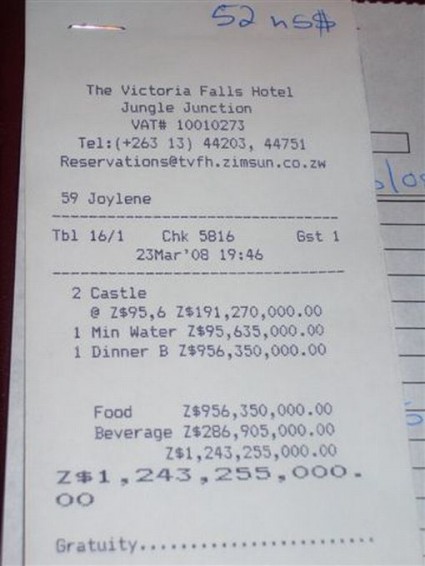
Just a month ago I blogged that a typical dinner in Zimbabwe can cost you more than a billion Zimbabwean dollars.

Now Zimbabwe introduces a $100 billion Zimbabwean dollars note. BBC reports:
The official annual inflation rate has exceeded 2,200,000%. Independent economists believe the real rate is many times higher. Zimbabwe's meltdown has left at least 80% of the population in poverty, facing mass shortages of basic goods.

Zimbabwe residents say the latest note is already worthless, and does not even cover their daily lunch. "Nowadays, for my expenses a day, I need about Z$500 billion".
This is not only weird, this is insane!

June 16, 2008

Inflation


A typical dinner in a Zimbabwe restaurant can be cost you in billion figures. I wonder what calculator they use.

Picture credit: Amit Varma of the India Uncut

May 16, 2008

Cashing in during load shedding

Engineered rolling blackouts or load sheddings is a way to manage short supply of electricity. Bangladesh is reeling under it.

But it also has a flip side.

Creating the Longest Marketing Idea Chain in the World suggests:
Traditionally, we are not big in board games. Let alone the likes of Monopoly, we haven't even developed a proper branded game that can help us pass some quality time with friends and loved ones. Ludu has always been the favorite one, but lost its flavor among the urban audience.

Thats why any new local board game brand can now move in and position themselves as the perfect pass time solution during load shedding. Reading books is out, watching TV is out of the question, IPS is expensive, going out is risky. What remains is spending 1 hour of quality close time with your family members playing any local board game. Good solution for a not so great problem - what to do during a load shedding?

April 10, 2008

Bangladesh: Hidden Hunger

First published in Global Voices:

Unheard Voices Blog quotes UNDP which hit the panic button for Bangladesh last month:
Skyrocketing oil prices have driven up the cost of food worldwide, but their impact has been particularly dire in Bangladesh, where almost half of the 145 million people live on less than one dollar a day.
For those who do not know, the staple food of Bangladesh is rice and the price of this commodity has almost doubled than what it was about a year and a half ago. And the poor in this populous country have been hardest hit.

WFP has warned:
The rising prices of food items, especially rice, may cause political instability in the country since poorer households spend up to 80 percent of their income on food.
Himu quotes a newspaper article which shows how many poor Bangladeshis even the middle class are barely making ends meet. The people are not well and you can hear their plights and anger echoing in blogs, media everywhere.Rumi Ahmed of In the Middle of Nowhere Blog questions about famine in his post "is it here". Posting photo of a skinny man who is presumably a drug addict he writes:
“The vulnerable groups are usually the homeless, the poorest of the poor of the society. And among them the first to fall through the safety net are the mentally-physically disabled persons, drug addicts, the elderly and the children. It has been many years I last saw a skeleton image of a Bangladeshi citizen.

News reports of hunger death started appearing scattered in our print media. This report [bn] confirms several hunger deaths. ”
Even the Ministry of Food and Disaster Management confirmed that no famine but a hidden hunger persists in the country.

Meanwhile Bangladesh's military chief’s remark encouraging eating potato instead of rice got bloggers reacting strongly. Shafiur has even posted recipes of mashed potatoes in response to his remark.

The reasons for this impending disaster are manifold. Bangladesh had a bad year in natural disaster in 2007. With a prolonged flood and the devastation of cyclone Sidr left its own rice production much lower than usual. There is a new government which did not have the experience in predicting the shortage and piling up sufficient stock although they were warned. Now the shortage in supply is effecting more on price. The government controlled food distribution centers were abolished some years ago with the pressure of World Bank and IMF. Now with no such wide scale distribution arm the government is not being able to keep the prices down with a small number of rationing booths.

Subinoy Mustofi, an blogger and an economist by profession describes [bn] why the price of rice has raised so much in his post in Bangla Blog Na Bola Kotha.
* Recent natural disasters in major rice producing countries hampered production
* The rice growing fields have decreased
* More demands from developing nations like India and China
So more demand and short supply have raised the price in the world market to a twenty years high.

Because of the rising price major rice producing countries like Vietnam, Egypt and India has decreased export and concentrated on keeping price in grip in domestic market. Neighboring India which is the largest suppliers of rice to Bangladesh set an import price of 1200USD per ton, a price almost three times high than 6 months ago. Moreover the food reserves all over the world is all time low.

Jyoti claims in Unheard Voices:
The chart below shows that taka depreciated by around 20 paisa against the (Indian) rupee since the beginning of 2007.

Taka depreciation

In addition to the global factors (see here) and the natural disasters, this depreciation alone could have sent our food market into a frenzy.
Subinoy Mustofi also shows [bn] that because of inflation the purchasing power (real income) of the poor in Bangladesh has gone down 5% although there is an overall GDP growth of 5%.

The situation is likely to persist in the near future. A Financial Times article on the March 28, 2008 reveals:
Rice prices jumped 30 per cent to an all-time high on Thursday, raising fears of fresh outbreaks of social unrest across Asia where the grain is a staple food for more than 2.5bn people.
Now the question is how to tackle the situation. Famous writer Anisul Haque quotes Indian noble laureate Amarta Sen in Bangla Blog Na Bola Kotha:
Famines are easy to prevent if there is a serious effort to do so, and a democratic government, facing elections and criticisms from opposition parties and independent newspapers, cannot help but make such an effort.
In a recent BBC debate (in Bangla) among politicians and general people the participants have echoed this and commented that Bangladesh needs to be back in the road of democracy really quickly.

An ordinary citizen reports that the government is introducing widespread employment opportunity for the poor people – a 10 million Taka project till April to enable the poor to have the purchasing power matching the price hike.

The Government hopes that a bumper Boro crop awaits and will be in market by end of this month to ease rice prices down. This news and the recent imports of rice from India at government level has apparently caused the price rises to cease but people fear will that be enough to minimize the hidden hunger?

April 05, 2008

Bangladesh's garment industry is now matured

This week's cover story in the The Daily Star weekend Magazine is on the state of the garment industry in Bangladesh.

It is the biggest contributor to the country's foreign exchange- around 76 percent- and employs around 2.2 million people, 80 percent of them women. The export figure of Ready Made Garments (RMG) reached US$ 9.2 billion in 2007 and there are predictions of it rising to US$ 12 billion or more in the next two years.

The report talks about the how the working conditions got better and safety regulations are now place. Of course it is a continuous process and we expect the same standard evenly spread across the industry.

It makes us proud to buy a cloth and later find it labeled as 'Made in Bangladesh' be it in Europe or in America.

March 30, 2008

Sending wrong signals

Bangladesh traditionally depends on India to import rice when there is a shortage in local production due to a bad harvest. This year the culprit was the cyclone Sidr and the floods. There was also a huge unofficial trade channel between the porous borders the scope of which is now limited because of the barbed wire border fencing by India. The smuggled goods evaded government duties and kept the price low.

The price of rice has soared in the past six months with an increase of upto 60%. This is probably the reality that Bangladesh is facing. India said it had a bad year too and are reluctant to export according to demand. After much drama the export price of the pledged government level exports were fixed at $430 per tonne.

And the final blow was Indian governments decision to hike rice export price at non governmental level to $1000 from $650. This is a ridiculous price as the international prices are much lower than that.

This will send a wrong signal to the market which will prompt stockists and brokers cashing in. Although the Bangladesh government says that it awaits bumper boro harvest in April when the prices will settle. But I doubt prices will not come down anytime soon because there are always a group of traders who exploits the uncertainties.

I think its time Bangladesh should look to import from other neighboring countries like Burma, Thailand or Vietnam. The dependency on one country will have many unwanted consequences. The poor people are the hardest hit as their staple food is rice. They are already mocking some senior government officials suggestion that people should start eating potato more instead of rice.