





Dragonfly

Image by Rezwan

Overcrowded passenger ferry capsized in the Padma River in Munshiganj, Bangladesh

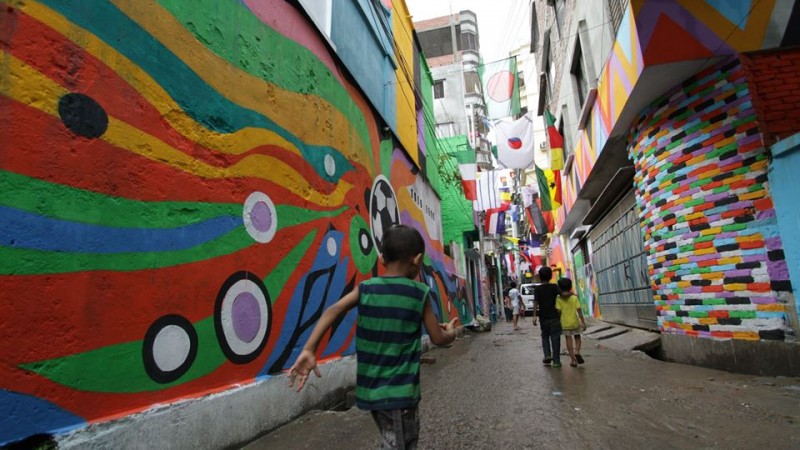
The World Cup Goal-E Project

This street in Bangladesh has a colorful world cup celebration

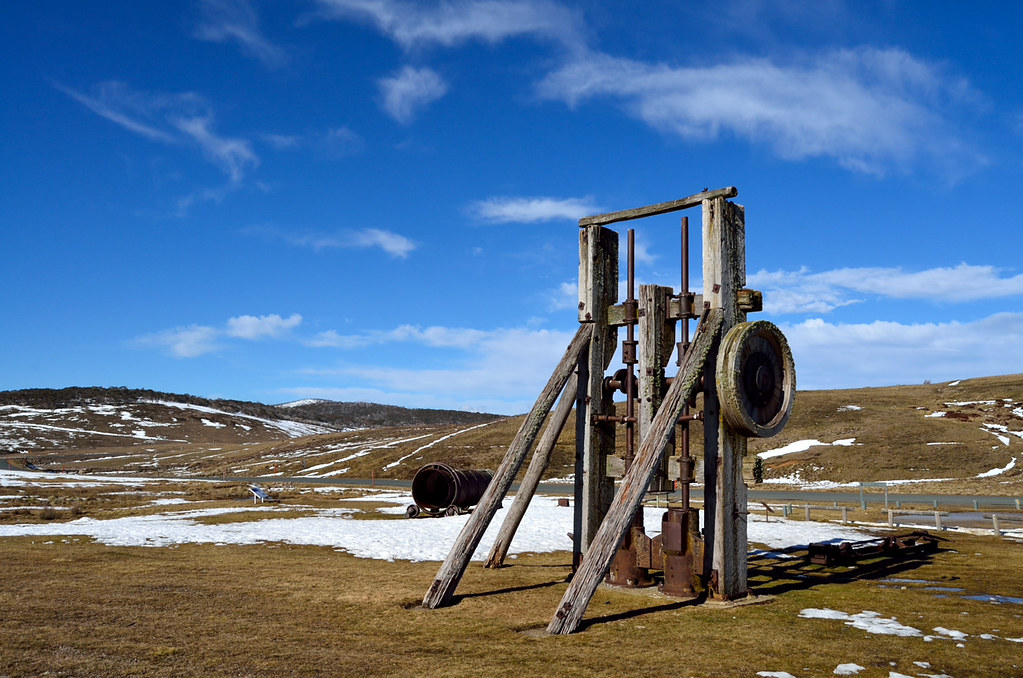
New Chum Hill Ruins

Remnants of Kiandra gold mine at New Chum Hill, #nsw #australia

May 16, 2012

India: Crackdown on Tamil Nadu Anti-Nuclear Plant Protests

This post was first published in Global Voices Online.

Concerns have been sparked that the Kudankulam Nuclear Power Project (KKNPP) currently under construction in the Tirunelveli district of Tamil Nadu, India, may have similar vulnerabilities to the ill-fated Fukushima nuclear power plant of Japan. Activists fear that in the case of an earthquake followed by a tsunami in the Indian Ocean, there could be an accident similar to the radiation leak at the Japanese coastal nuclear plant last year.
Construction started more than a decade ago and KKNPP is expected to be in operation soon. S. P. Udayakumar of the voluntary organisation ‘People's Movement Against Nuclear Energy' (PMANE) lists 13 reasons why the activists and locals do not want the power plant to start. He stress that:
More than 1 million people live within the 30 km radius of the KKNPP which far exceeds the AERB (Atomic Energy Regulatory Board) stipulations. It is quite impossible to evacuate this many people quickly and efficiently in case of a nuclear disaster at Koodankulam.
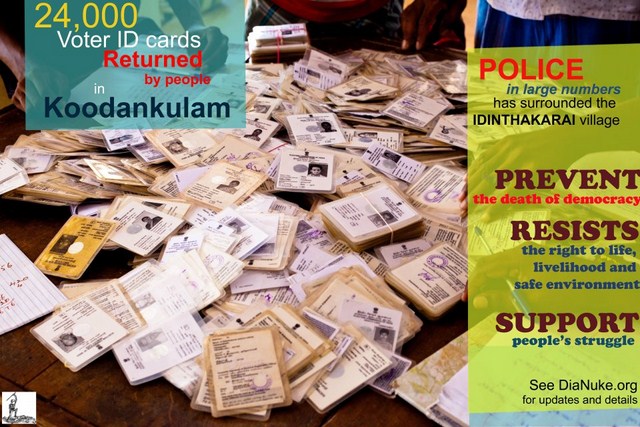
Protest campaign against Koodankulam Nuclear Power Plant. Image courtesy Kracktivist, used with permission.

Protest and arrests:

Shedding a light onto the government crackdown on the protesters, Kracktivist cites:
Between 10.9.2011 and 23.12.2011, police had filed 107 FIRs (field investigation reports) against 55795 people and “others,” among whom 6800 have been charged with “sedition” and/ or “waging war against the State.”
In March 2012, police arrested approximately 200 anti-nuclear protesters objecting the resumption of work on one of the two 1 GW (gigawatt=1000 megawatt) reactors, a day after the local government restarted work on the project. A Public Interest Litigation (PIL) has also been filed against KKNPP at India's Supreme Court. Amnesty International has written a letter to the Prime Minister expressing their dismay on the detainment of the protesters. However, there were also rallies and protests in favor of commissioning the nuclear power plant.

The protests continued as the ‘People’s Movement Against Nuclear Energy' (PMANE) recently launched three campaigns against the Kudankulam Nuclear power Plant, reports Kracktivist:
Collection of signatures by villagers who oppose the nuclear plant and surrender of voter identity cards will be observed in 60 villages belonging to three neighboring districts while [a] ‘respect India’ campaign will be observed throughout the country.
On May 9, around 23,000 people belonging to nine villages in Tamil Nadu surrendered their voter identity cards to draw attention to the continuing ignorance of the peaceful protest against the KNPP. The government did not take it lightly; Kracktivist also reported that thousands of police personnel were deployed near Idinthakarai village and a crackdown seemed likely.
According to a press release, “The People’s Movement Against Nuclear Energy (PMANE) called off the planned event at Idinthakarai on May 10, 2012 as the District authorities have clamped down prohibitory orders such as 144 in and around Kudankulam area”.
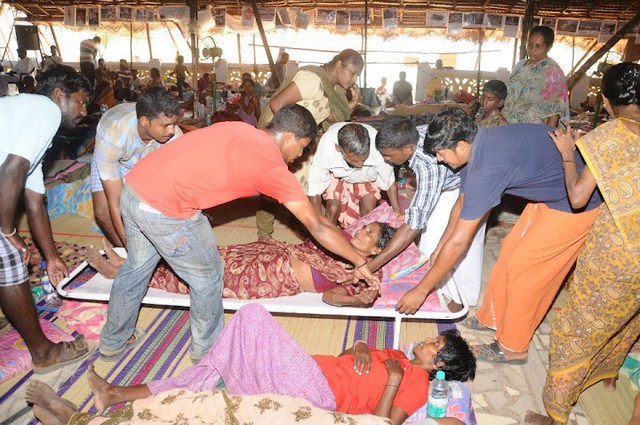
Protesters on hunger strike. Image courtesy DiaNuke, used with permission.
Protesters on hunger strike. Image courtesy DiaNuke/Aaam Janata, used with permission.

However, some 9,000 people still participated in a sit in, with several hundred on an indefinite fast. The hunger strike has been going on since last month. DiaNuke/Aam Janata has posted some pictures from Kudankulam which depicts women on hunger strike and villagers living under constant fear.

The Chief Minister of Tamil Nadu, Ms. Jayalalithaa, has vowed that the plant will start to function soon. Anuj Wankhede at DiaNuke invited a debate with Dr. M R Srinivasan, the former chief of India’s Atomic Energy Commission on whether the Kudankulam reactors are really the “safest in the world”, as claimed by the authorities.

The anti-Kudankulam activists are willing to end their protest if the government meets their demands.
May 09, 2012

Bangladesh: Movie Theaters Are Dying

This post was written in Bangla by Pantha Rahman Reza and translated for Global Voices Online by Rezwan

Watching movies in theaters was once a favorite pastime for Bengalis. The custom was to go to the movies on the holidays or special days. It was popular culture to follow the fashion and postures of the stars of the new released cinemas.

But cinema-loving Bengalis do not go to movie theaters nowadays and the country's cinema halls are closing one by one, as new shopping malls are being erected in their place. According to reports in the past decade, hundreds of cinema halls have been closed down [bn]. There also used to be approximately 100 cinemas built each year, which has now decreased to 30-40 [bn].

Darashiko blogs on cinema regularly. Here he shares the latest state of the Bangladeshi film industry [bn]:
Shyamoli Cinema Hall is just a memory. A 14-story shopping mall is being built in its place. Image courtesy Wikipedia
The Bangladeshi cinema industry is going through its worst time. In 1990-91 the number of cinema halls were around 1230. But in 2010 the number has decreased to 742. Out of 44 cinema halls in Dhaka 33 are surviving. Huge building were erected in their place. Big names like, Gulistan, Shyamoli, Naz, Lion, Star, Shabistan, Tajmahal cinema etc. went into oblivion. With Lack of quality script and mediocre performance the cinema industry managed releasing of 100 movies per annum. In 2010 the number was 63, one of the lowest in the decade. Its getting much worse. In 2011, in first six months only 19 cinemas were released and only 300 million Taka (US $3.6 million) was invested. Newspaper reports say that this year only 45 films will be produced and the next year it would be only 30.
But why are movie theaters being closed down? Why are audiences not going to movie theaters? Megh Roddur writes [bn] about it:
Of course I want to go to the movie theaters to watch movies. It hurts but the truth is that most of the movies are not of my taste. Why should I watch a movie full of weird costumes and blunt themes. Why should I go and watch repeating stories? Why should I go and watch copycats and gross copypaste movies?
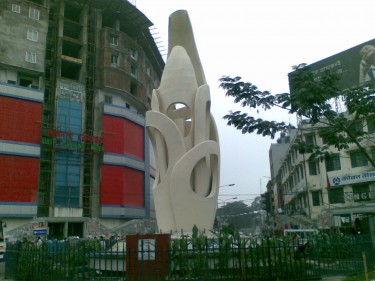
The building behind the sculpture was once the famous Gulistan Cinema Hall. Now its a clothes market. Image by Ranadipam Basu. Used with permission.

A guest blogger at Sachalayatan reminisces about his childhood memories of going to cinemas with family. The blogger blames the film distributors for lack of viewers in movie theaters:
Now we don't watch movies in Theaters with family. I would not blame low quality pictures. I would place the blame on the environment of the movie theaters. There are a few good movies still being produced. Still we cannot go with the family to watch them in this environment.
Lekhajoka Shamim cites three reasons for the demise of this industry:
The low quality of the local cinema, indecent movies and the environment of the movie thater are the causes of lack of movie viewers.
Once the thought of going to movie theaters was an exciting thing. Many had keen interest. Russel Ashraf tells one such story:
Me and my uncle went to see the movie “Aguner Poroshmoni”. We thought that there would be no rush and went a few minutes before the start. But alas, we saw that the queue was extended to the road. What to do! Waited in the queue for the tickets and manged a seat in front of the screen. I could not move my neck for three days in pain.
To save the film industry and bring more viewers in movie theaters, the government decided to remove the ban on Indian cinema (it should be noted that Indian movies have been banned here since 1965). This move attracted sharp criticisms online.
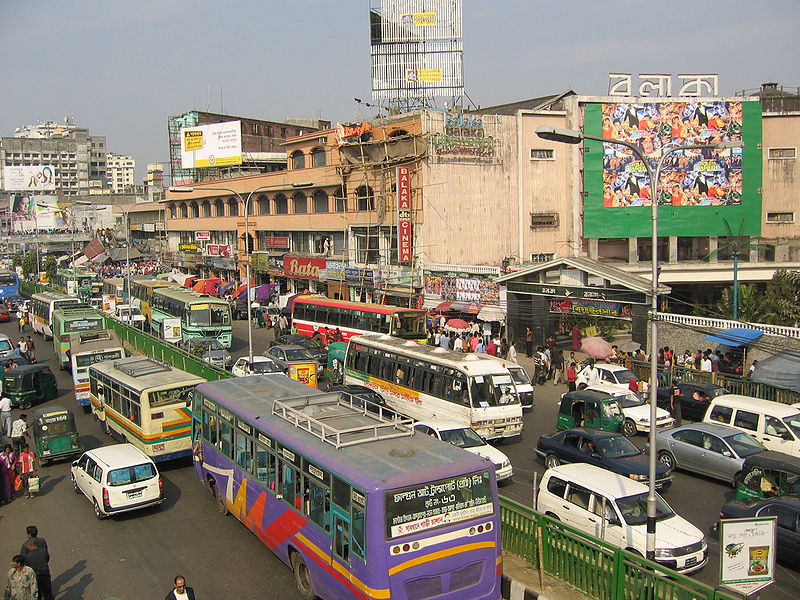
Balaka cinema hall besides Dhaka New market. Image from Wikipedia by Ragib Hasan

Nazrul Islam says in a post in Amrabondhu blog:
Not from the hatred of Hindi language films, the government has to back down from such wretched decision to save a dying industry.।
But there are also those who favor import of movies:

One blogger (Fahmidul Haque) says:
To me its a right of a citizen to be able to watch local and international movies of different tastes. Lets not limit this right with the debate of saving of local industry by stopping the import of Indian movies.
Due to much criticism the government decided to reverse the decision to withdraw ban from the Indian movies.

Kallol Mustafa has specific suggestions on how to revive the local film industry:
We need government institution support, financial responsibility, institutionalization of the industry and mandatory show of international movies (not only Indian) in a week each month in every theater.

May 06, 2012

India: Freedom Fast To Save Your Voice

This post was first published in Global Voices Online

The protests to stop the new IT rules in India (see our previous post on this) are still going on. Today is the fifth day of the hunger strike of Aseem Trivedi and Alok Dixit from Save Your Voice to support annulment motion against IT Rules-2011 in Rajya Sabha. They started this hunger strike on the 2nd of May and vowed to carry on until they get any satisfactory response from the government and the opposition regarding the annulment of IT Rules-2011. Sh. P. Rajeev, the Hon’ble Member of the Rajya sabha has moved an annulment motion to get these rules abolished and the motion has been admitted and is expected to come up in this budget session.
On behalf of Save Your Voice, a Facebook campaign, updates are being published in Aam Janata blog. Some excerpts:
(The) Government has enacted laws that give it a free pass to censor our Facebook posts, listen to every Skype conversation we have, monitor our tweets or blogs oraccess private photographs and documents we store online, or track our location using our mobile phones or surveil all of your online activity. We want to tell our government that they cannot use vaguely defined laws and loopholes to take away our freedom of speech and expression.
It seems that many Indians have not yet realized the perils of the new IT rules and the censorship it threatens - they think “can anyone really censor the Internet?”. Vidyut explains the situation and asserts why activism is needed to stop such dark law.
Indian Law and Technology Blog lists the things an activist should do to get rid of the IT rules 2011.
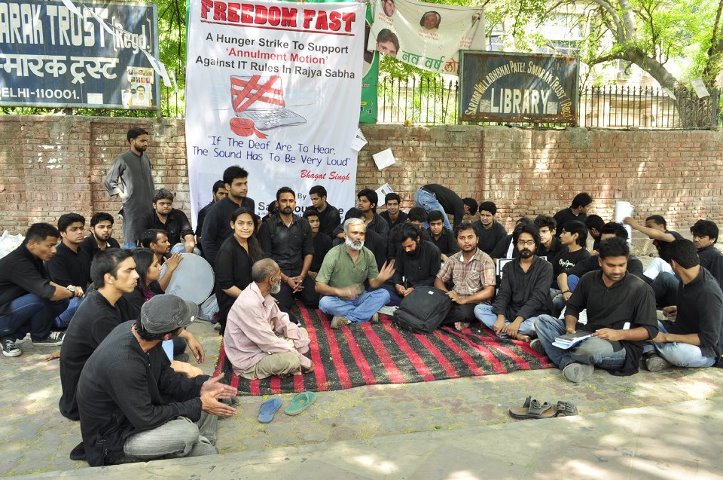
Freedom Fast Hunger Strike And Sit in at Jantar Mantar, New Delhi, India. Image courtesy ‘I Love India'

Arvind Gaur, prominent theatre artist and director of Ashmita Theatre, was at the Freedom Fast at Jantar Mantar, New delhi. In the above photo he is sitting with Alok Dixit and Aseem Trivedi.
Arvind is against the implementation of the IT Act and says that internet, which is a source of expression of the common man, should be provided ‘free' and not be brought under any rules.
The mainstream media has been silent on these protests. Some lone voices can be seen on Twitter providing updates:
@rahulgaitonde: RT @nixxin: In case you weren't aware, there's a hunger strike at Jantar Mantar against the IT Rules http://t.co/6865MHhb
@saveyourvoice: Fifth day of FREEDOM FAST- Alok Dixit and Aseem Trivedi have been admitted to Dr. Ram Manohar Lohia Hospital, due to health breakdown.
Thumbnail image courtesy Save Your Voice

April 28, 2012

India: Protests Against the New IT Rules

This post was first published in Global Voices Online


In April 2011, the Ministry of Communications and Information Technology of India quietly issued ‘Information Technology (Intermediaries Guidelines) Rules 2011’ restricting web content that are designated as “disparaging,” “harassing,” “blasphemous” or “hateful.” Rishabh Dara at The Center for Internet And Society cites the rule's chilling effects on free expression on the Internet.

Moreover, the Indian government has asked the United States to ensure that India-specific objectionable content are removed from the social networking such as Facebook, Google and YouTube. According to news reports they also want these international service providers to set up servers in India to help regulate the content locally.

We have already seen several incidents of online contents being taken down for containing ‘offensive’ content. Vinaya Naidu shares how the Mumbai Police Crime Branch put a ban on cartoonist Aseem Trivedi's website www.cartoonsagainstcorruption.com, following a complaint that his cartoons were disrespectful to the nation:
There was no legal notice, no court order, no advance warning and not even a letter/email requesting to remove the objectionable content. And this is the freedom of expression in the world’s largest democracy. Since then, Aseem has continued to fight against corruption through his blog ‘www.cartoonsagainstcorruption.blogspot.in’ which is quite under the scanner.
Add caption

The discussion forum on ‘Internet Censorship’ at Indiblogger.in captures more opinions on such threats.

Amrit Hallan writes:
To be frank, the Internet scares the shit out of them, especially after WikiLeaks, the unshackled conversations over Twitter and Facebook and social networking-supported civic unrests. And it’s not just the government; all the agencies, may it be bureaucracy, the conventional mainstream media and the old school businesses that thrive on people’s inability to communicate with each other, would like to throttle the free flow of information on the Internet. Precisely this is the reason why there is no hue and cry on TV channels on the government’s new censorship drive.
Amrit lists the threats according to the new Information Technology Guidelines notified by the government which will create an Orwellian world.

Internet Democracy project quotes Anja Kovacs talking about the background on such rule:
Since its founding, the independent Indian nation-state has wielded censorship as a tool to both contain the conflicts that emanate from India’s tremendous diversity and to ensure its homogeneous social, moral and political development. [..]
But if the advent of satellite television already revealed the vulnerabilities of this strategy, the Internet has of course made clear that in the long term, it is simply untenable. [..]
India’s use of censorship as a way to ensure national harmony has of course to some extent always had to elide, and silence, the enormous diversity within Indian society itself; censorship always benefits the status quo, and the Indian case has been no different.
This video by Internet Democracy Project shows the impact of the new IT rules:
The Indian Netizens are not sitting idle.

This petition titled “MPs of India: Support the Annulment Motion to Protect Internet Freedom #stopitrules” is circling in the web and more and more citizens are signing. On April 22, several organizations and forums issued this press release which revealed:
In view of the possible deleterious effects of the Rules, the Honorable Member of Parliament, Shri P. Rajeeve has moved a statutory motion to get the aforesaid Rules annulled. This motion has been admitted and will be coming up before the Rajya Sabha during the second half of the Budget session of the parliament that starts on 24th of April, 2012.
The press release calls all MPs to support the annulment motion. In the meantime a public interest litigation, calling the amended IT rules “unconstitutional”, has been filed in Kerala.
Here is a list of more campaigns:
  • Internet Democracy project organized a day-long training program on freedom of expression and censorship for bloggers called ‘Make Blog Not War’.
  • Aseem Trivedi and journalist Alok Dixit have started campaign on Facebook titled ‘Save your voice which highlights many protests.
  • A tumblr site publishes pictures of individuals holding the placard “Don't Censor me”.
Don’t Censor Me - Pranesh. Image courtesy http://dontcensormeindia.tumblr.com/

Protests are going in several parts of the country against the IT rule. Ashfaq reports about a protest on 21 April:
FreeSoftware Movement Karnataka(FSMK) organized a protest to show our concern over these vaguely made laws. Blogger's, students, Teachers, IT professionals, Photographers came together in the center of the city shouting slogans and holding banners showing their apathy towards this new rule.
Protest at Karnataka. Image Courtesy Ashfaq at Just Another Coincidence. Click on the image to see more pictures.

Harshitha shares the experience:
A mass of young, energetic and vibrant youth, software engineers and bloggers voiced their opinion. Being among them I felt the power of connectivity, an air of pride, of struggle for freedom. People sang in vigor, held placards and shouted slogans to save the internet.
I really hope the Indian government keeps the democracy alive by not passing the bill.Let's all strive for betterment of the society and let freedom of expression prevail.
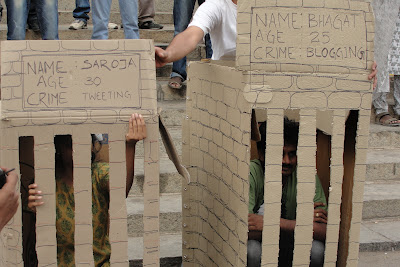
Freedom in a cage campaign. Image Courtesy Save Your Voice. Click on image for more pictures

Another protest by Save Your Voice titled “Freedom In A Cage” was held in April 22, in Delhi's Jantar Mantar. Check the report and the pictures at the Kafila blog.

April 22, 2012

Grilled Prawns, Calamari & rice for dinner & Ocean Basket, Dubai Airport

April 20, 2012

Lamb stake for lunch at 28th floor of Kaknästornet - the TV tower of stockholm

April 19, 2012

Side panel at #sif12 'Getting the right tools to the activists for freedom' #silc #fxinternet