




Dragonfly

Image by Rezwan

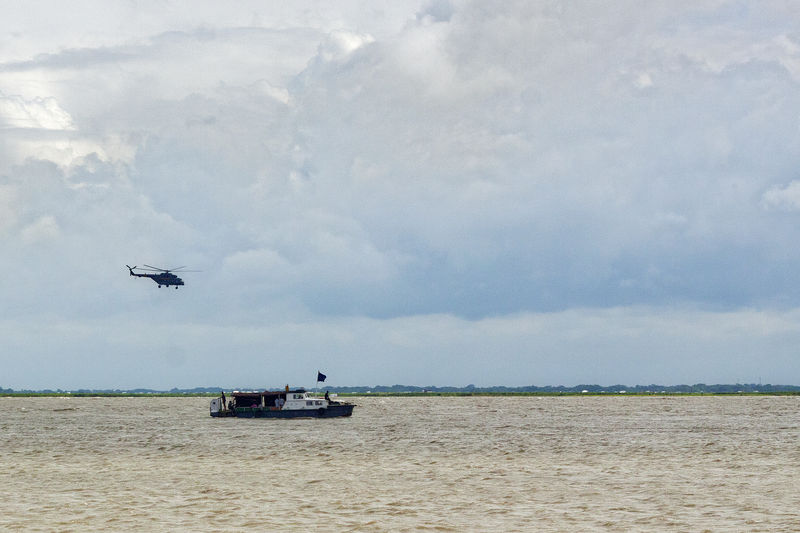
Overcrowded passenger ferry capsized in the Padma River in Munshiganj, Bangladesh

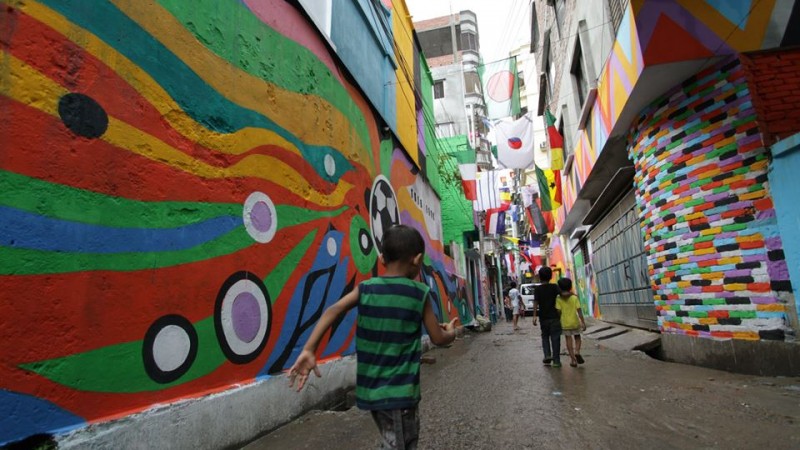
The World Cup Goal-E Project

This street in Bangladesh has a colorful world cup celebration

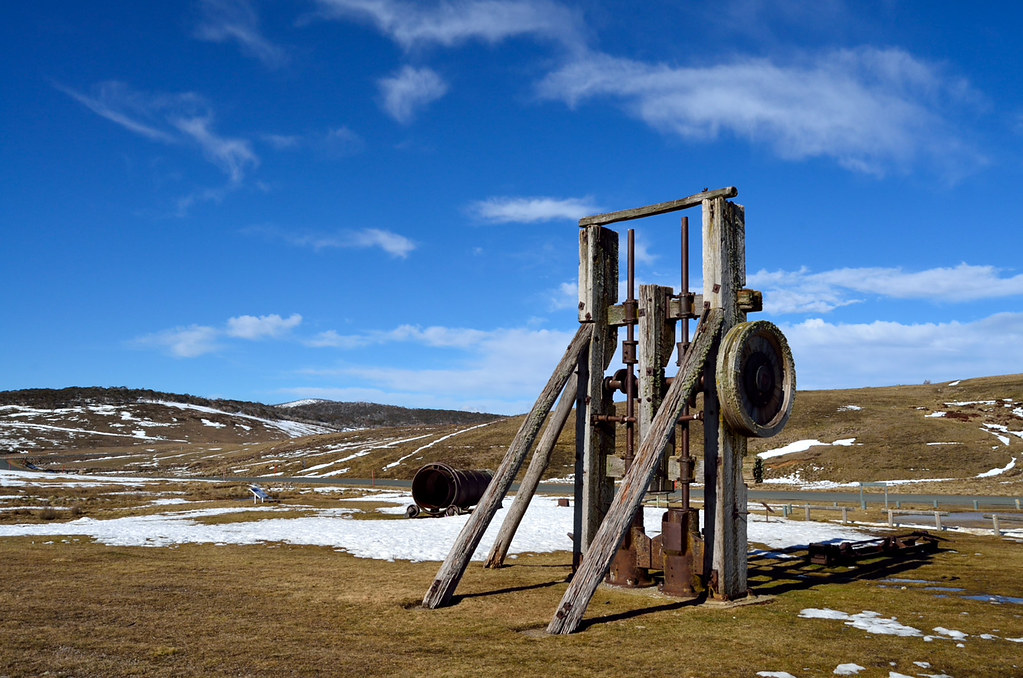
New Chum Hill Ruins

Remnants of Kiandra gold mine at New Chum Hill, #nsw #australia

November 27, 2013

The camera doesn't make the photographer

When some people buy a new shiny entry level DSLR camera they go out and take 1000+ photos. They load the photos on PC, try to learn a bit of Photoshop and think why don't these look like the ones in the magazines.

They then Google for photography tutorials, read about composition, focus, aperture, shutter, ISO and lots of other things. A year down the line they start taking better photos and they don't take as many photos as before. They take about 100 photos and store a quarter of them as outstanding. After sometime they think of upgrading to full frame. The quality blows them away.

Or

It must be the camera. An entry level DSLR user must upgrade to a full frame only to find they are no better but out of 1000 shots there is the odd good one that if they tweak it in PhotoShop. They put them on social network and think lots of people are looking at them so they must be good.

The moral of the story is to be a good photographer you have to put the work in. Its not (only) the tool but the skill and experience, which are required. Give an experienced photographer a cheap point and shoot, and an inexperienced beginner an expensive DSLR and the experienced photographer will still take better photos.

So what do you need to be a good photographer?

  • You need passion. You need to be obsessed with getting the shot.
  • Read photography tutorials, go for a Photo-walk
  • Find a mentor, get critics feedback
  • Understand your camera and all its features, upgrade when you outgrow its capabilities 
  • Take your camera everywhere
  • You need to be a story teller.
  • You need patience and lots of it.
  • You need to show your photos to everyone.
  • Develop a style of your own.

As for me I am yet to do all of above to start taking better pictures.

My Flickr photostream
November 26, 2013

Uncertainty And Hope During Elections in Nepal

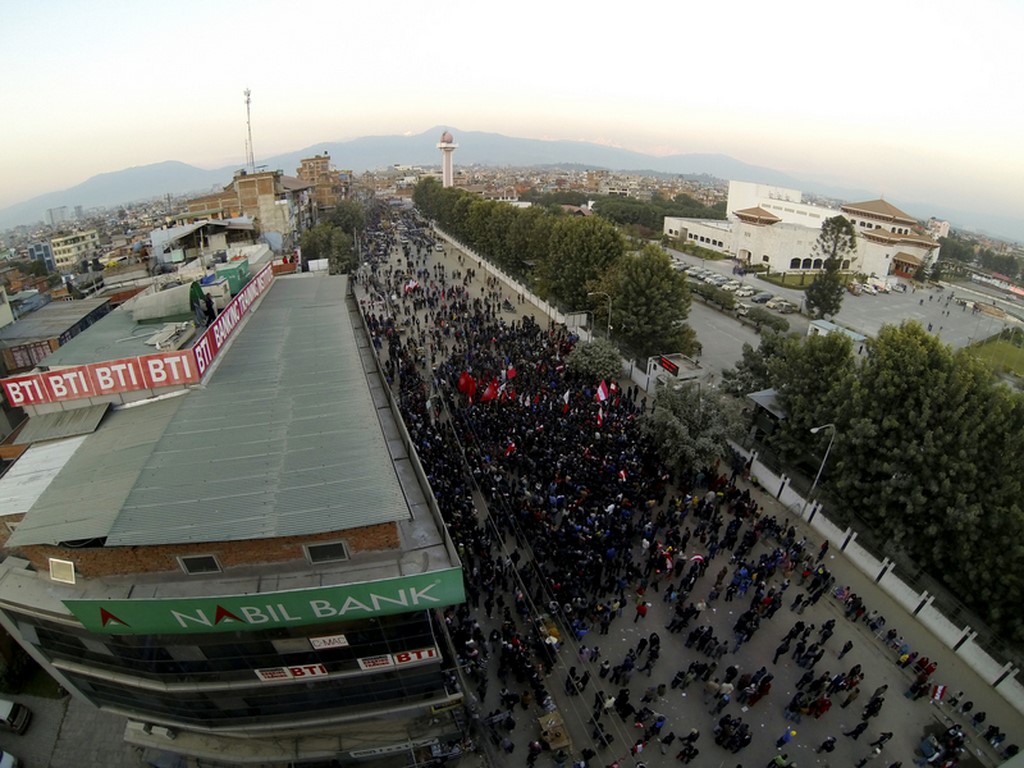
Supporters of different Nepali political parties outside BICC building where vote counting is continuing. Image by Kumar Shrestha. Copyright Demotix (21/11/2013)
Nepal's elections to choose a new Constituent Assembly were finally held on 19 November 2013 a year to the day that they were first planned. The vote counting is ongoing, with the latest reports pegging Nepal's oldest party, the Nepali Congress, as leading the polls.

The elections are shrouded with uncertainty as the Unified Communist Party of Nepal (Maoist) has alleged vote rigging. The Communist Party of Nepal (United Marxist-Leninist) and Nepali Congress are neck-and-neck, while the Maoists face electoral defeat.

Much rides on these elections because the new assembly will be tasked with drafting Nepal's much awaited Constitution. Not long after a decade-long civil war between the country's Maoists and government came to an end, the first Constituent Assembly was formed in 2008. But after four years it failed to write a constitution, and the country has been in political crisis since.

The voter turnout on the day was encouraging, with a large women participation. Blogger Ushaft discussed the general mood of voters on the voting day:
People who voted for Maoists last time have turned against them now. This is the general mood one can observe in districts, villages and streets.
However, the day did not pass without violence. Journalist and blogger Deepak Adhikari blogged about an election day bomb blast that severely injured children playing in the streets. There has been an increase in election-related violence in Nepal both pre-poll and during the poll, noted by blogger Ushaft:
A series of violent explosions were reported last week. It is not clear who did them, and most blame the Dash faction. But a large number of such activities are targeted at non-Maoist candidates.
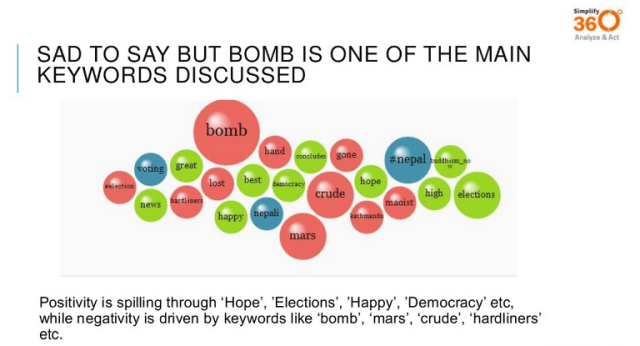
Aakar Post analyzed social media reactions regarding the elections. The pre-election buzzwords were topped by words such as "bomb":
Analysis of pre-election keywords in Social Media. Image by Aakar Tech. Used under a CC BY-NC license
While the post-election buzz words were dominated by words like "win" and "boycott".

Nepal’s Maoists are disputing the election results. Previous Prime Minister and Unified Communist Party of Nepal (Maoist) leader Pushpa Kamal Dahal (Prachanda) urged the election commission to stop the vote counting with complaints of “conspiracy and poll-rigging.”

On Facebook, Maoists leaders and supporters - notably Prakash Dahal (Prachanda's son) - have posted series of updates regarding their allegation of irregularities. Prakash Dahal has also posted pictures which he claims prove that the pools were not free. He has posted four photos of what purportedly show an army officer standing next to voters casting ballot. Nepal deployed 62,000 army personnel in all the constituencies to provide security for the November 19 Constituent Assembly elections.

But majority of comments posted seem to indicate that the people want the Maoists to take this defeat as a lesson:
निष्पक्ष चुनाव भनेको यहि रहिछ हैन । सेना कुन घेरामा बस्ने रे । निलकण्डलगायत षडयन्त्रकारीहरु । ब्यारेकमा मतपेटिका साटेर नपुगेर सेनालाई कहां भोट हाल्ने सिकाउन लगाउन
This is free and fair election. Which boundary would the Army abide by? Nilkantha [Chief Elections Commissioner] and the other perpetrators? Not happy with changed ballot boxes in barracks, made the Army teach voters where to vote.
Blogger Ushaft quotes a citizen's statement, which expressed concern on the Maoists allegation of election irregularities and rejected demands of the Maoists to obstruct the vote tallying process.

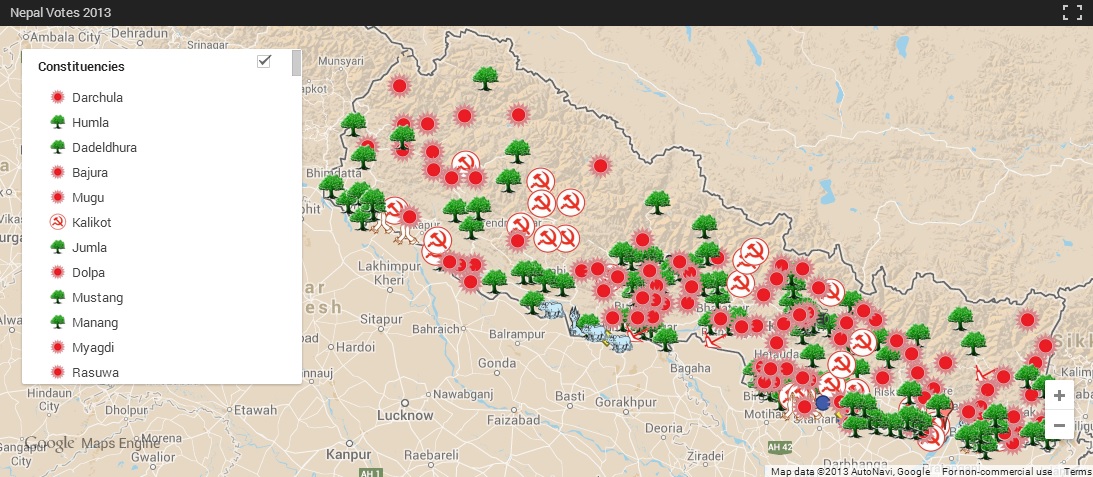
On Twitter, the #NepalVotes hashtag was used by many commentators to write about the elections. NepalVotes.com is on the forefront of disseminating and visualizing election-related data, and a popular Nepali-language blog has coordinated coverage with them:
Screenshot o
Screenshot of the website Nepalvotes.com with graphical representation.
This election also highlighted the importance of data journalism within the Nepali context, with sites like NepalVotes.com and MySansar active in monitoring.

Blogger and journalist Deepak Adhikari (@DeepakAdk) noted on Twitter:
Interesting to note that otherwise active Twitter user, former Prime Minister Baburam Bhattarai (@brb_laaldhwoj), has remained silent following the results. He tweeted just once after the polls, to thank his voters.

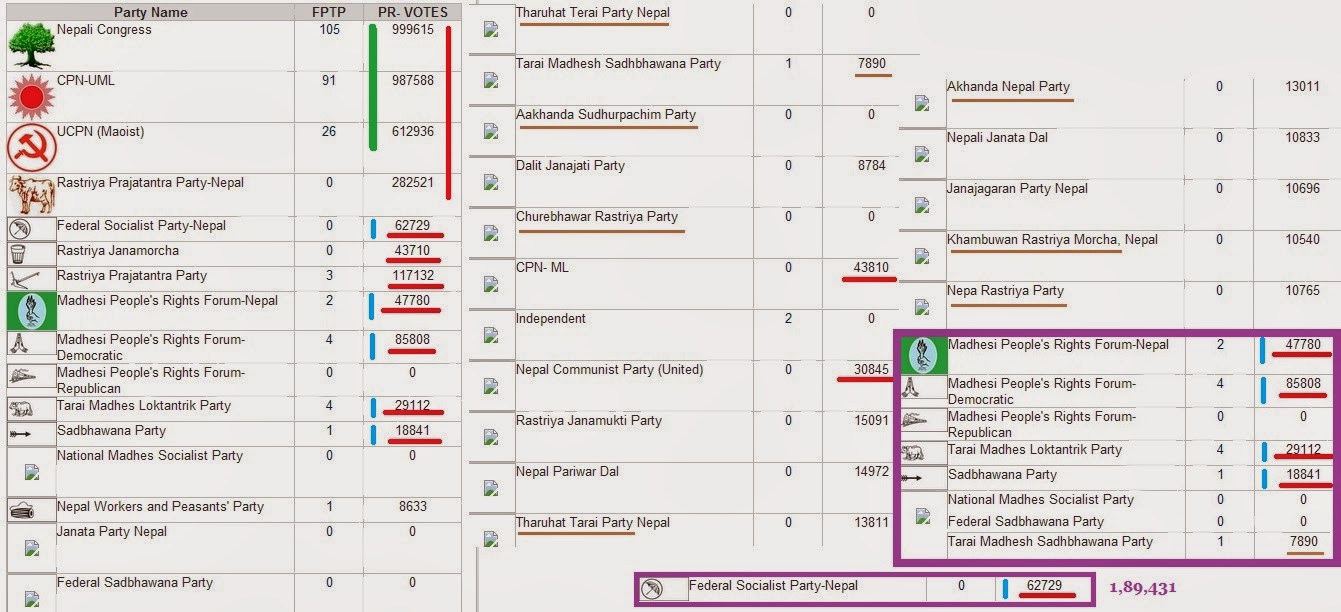
Paramendra Bhagat at Democracy for Nepal provides a snapshot of the latest standings as on 25 November 2013:

Image courtesy Paramendra Bhagat at Democracy for Nepal.
NepalVotes.com has the updates of results as they come in, and projections of seat count under the proportional representation as per their own analysis.

It's still not clear if these elections will result in a constitution, blogger Kaja wrote:
What I heard from some Nepali people was that for this election they hoped for a constitution. That was their biggest wish. Now only time will show what will happen.
First published in Global Voices Online. Bhumika Ghimire also contributed to this post.

November 22, 2013

Google Translation bot in Bangla

Today I met him. He was blinking in my Google chat list. I became very curious and googled the email address en2bn@bot.talk.google.com. Then I found out that its a bot, translation bot to be precise.

Google launched its first translation bots back in 2007. More than 20 languages had a translation bot by 2008. I don't know when they launhced the Bangla bot. But there is another similar bot (eng2ban@appspot.comavailable.

Here is a glimpse of the Bangla bot I encountered. According to Google:

Translation Bots will translate your messages from one language to another. These bots are named using two-letter language abbreviations formated as '[from language]2[to language@bot.talk.google.com,' and all available combinations are listed in the table below. For example, if you send 'Hello' to en2es@bot.talk.google.com (English to Spanish), it will respond with 'Hola.'
You can see from the screenshot that the quality of translation is still catching up. So you can't rely on it fully.

November 17, 2013

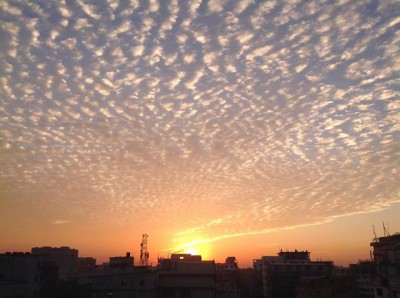
PHOTOS: Dhaka's Beautiful Blue Sky Briefly Takes Over Web

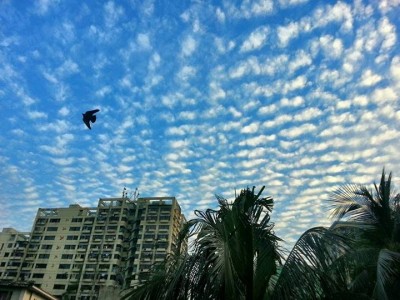
White patches of cloud are drifting in the sky.
White patches of cloud drifting in the sky. A lonely bird is flying. Image by Ashraful Alam, Baily Road, Dhaka. Used with permission.
The Bengali calendar is made up of six seasons, with two months comprising each season. Now is the Hemonto (হেমন্ত), or the dry season. During this season, the sky comes alive with vibrant color, from deep blues and pristine whites to the golden shades of dusk. Snowy patches of clouds hang overhead, and the sun warms the air.

Such was the scene on 17 November, 2013, with the striking beauty of the sky overwhelming the horizon above Bangladesh's capital city Dhaka. Talk of the stunning sight spread like wildfire on social media as netizens shared their beautiful images on Facebook and Twitter, some using the #Dhakasky hashtag.

Even some newspapers featured them. Journalist and blogger Simu Naser (@simunaser) wrote:
Oh no. Looking at newsfeeds, it seems everybody is watching the sky leaving all their work. This is good.
Torongo (@ttorongo) said:
I was amazed by the sky in the afternoon, it was a combination of blue and white stretching to the horizon. Now it seems that everybody's noticing it. Even saw the #Dhakasky hashtag.
Shafiul Alam (@shafiulnub) appreciated the moon too:
During the day, the sky was beautiful, now the moon is stealing the show.
Atif M Safi tweeted an Instagram photo of the sunset:
Others also shared photos of the sky on Twitter:
Many users uploaded pictures of the #Dhakasky. Global Voices republishes some with permission:
Nice cumulonimbus cloud, ideal for kite flying. Image by Tanmoy Kairy, Dhanmondi, Dhaka.
The sky at home. Image by ahmedur Rashid Tutul.
Who has floated the white cloud boats in the sky?
Who has floated the white cloud boats in the sky? Image by Suronjona Haque.
গোধূলী রং লেগেছে আকাশের গায়ে। ছবি তুলেছেন হাসান আহমেদ খান। মিরপুর, ঢাকা।
The color of dusk on the sky. Image by Hasan Ahmed Khan. Mirpur, Dhaka
নানা রঙে সেজেছে আকাশ আজ! ছবি তুলেছেন মঞ্জু আহমেদ।
The sky has colored itself. Image by Manju Ahmed. Mohammadpur, Dhaka.
On YouTube, Abhie Zibran shared a video of the sky:
 

 Original in Bangla by Pantha Rahman Reza. Translated by the author. First published in Global Voices Online

November 07, 2013

Mobile App Offers Indian Women Lifeline in Fight Against Rape

Rape is the most common crime against women in India, where the number of rape cases have doubled between 1990 and 2008. Amidst the search for a solution, people are turning to technology, such as easy-to-use and free mobile application for the ubiquitous cell phone.

The Smart Suraksha App is an Android application focused on giving Indian women a greater sense of security. It can send a distress message to five pre-chosen contacts at the press of a single button. Along with the message for help, it also sends information about the user's current location even if the GPS option on the cell phone itself is switched off. Thus, women can be reassured that their call for help will always reach someone.

  smartsuraksha contest

Indian blog directory Blogadda recently arranged a blog competition titled "I wish I had Smart Suraksha" to spread the words.

Kalyan Panja, a contestant, wrote about the app:
The App has as main objective to make smartphones, today a commonly used tool, a valuable ally for the safety of women in situations of potential or actual danger, providing a simple and timely aid, such as sending SMS rescue, and a set of rules that allows us to take conscious behaviour in case of need. [..] The program allows to configure a list of 5 phone numbers to send a standard text such relief message (along the lines of: "I'm in trouble, call me!"), as well as to communicate your location, using GPS technologies or relying on a network Wifi. [..] The operations are designed to be carried with ease and in the shortest possible time, precisely in order to ensure the use of the app also under difficult and uncomfortable situations. The focus is directed on prevention, with tips and tricks that they do not want in any way undermine women's freedom, but to advise the appropriate behaviors to be taken in dangerous conditions in the interests of defense.
Click the image for link to the app
Blogger Prava Vathi, another contestant, wrote:
This app is primarily created for women’s safety, which can track your whereabouts and at a single touch will text to the pre-listed five contacts simultaneously and also the police. It comes with an additional feature to give details of the would-be offender, and allows you to record info like model of the car or clothes he is wearing, in your text, provided if you are in such a situation. Use this app as a weapon that can prevent you from becoming an unfortunate victim.
Blogger Confused Humanity wondered if an application like Smart Suraksha would have made a difference in the lives of rape victims:
The BPO employee who was raped and killed by the car driver, who changed the route and took her to a remote place. If she had this app with her, could she have alerted her friends/family or company authorities. With the approximate GPS location, could they have found her and saved her life? In the case of the latest Mumbai rape case, could the victim or her friend have pressed the button and alerted their company or friends about the suspicious behavior of the culprits, without inviting their attention and could the tragedy been have averted?
The blogger also suggested additional features, such as recording the snapshot of the perpetrator:
Now only if the state would set up a helpline or something, that could accept and act on such emergency messages (which comes with the location of crime) by informing the nearest police station or patrolling team(or medical centers), wouldn’t it be a miniature emergency service system like the ’911′ in itself?
Afshan Shaik asked in a poem, "if only people were smarter than the apps":
If only people were smarter than the apps. 
If only every one had the courage to face the mobs. 
If only wits, actions and bravery over powered the fear. 
If only we had super powers we would have saved a tear. 
If only every one was loved , protected and fathered. 
If only instead of an app a fellow human being bothered!
Your confidence is the best weapon, says Knitha Urs, and this app can give women the confidence. Its better to be prepared than be sorry, reminds Swati.

 Shivani Gayal provides a list of other apps that are similar to Smart Suraksha.

Check out more submissions to the contest in the comment section of this post and on this Facebook page.

First published in Global Voices Online

October 27, 2013

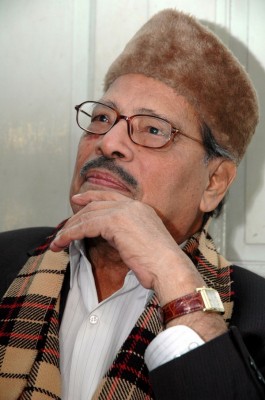
Legendary Indian Playback Singer Manna Dey Dies

Legendary Indian singer Manna Dey, whose original name was Prabodh Chandra Deydied of a heart attack in Bangalore on October 24, 2013. He was 94. Dey recorded more than 4,000 songs during his career spanning from 1942 to 2013, and was famous for his playback work, recording songs for hundreds of movies for actors to lip sync to. He sang mainly in Hindi and Bengali, and ventured into several other Indian languages. The singer was popular in both India and Bangladesh. Netizens revisited his memory after his demise. Venkataramanan Ramasethu, an academician and blogger, remembered him:
A legendary icon and a musical genius on his own right who ruled the bollywood musical arena close to 40 years, at times I felt he was an unsung hero.
Akash Upadhyay posted 10 lesser-known facts about the legendary singer. Radio jockey, author and blogger Reema Moudgil noted:
So many songs. So many versions of one, exceptional voice.
India Today (@IndiaToday) portrayed Manna Dey's career in numbers:
Writer and blogger Madhulika Liddle in a tribute post for Manna Dey wrote:
That is what I love and admire about Manna Dey: his versatility, his immense range of songs, his ability to imbue his songs with so much emotion—whether that emotion was a deep love for one’s motherland, or pathos, or a rollicking don’t-give-a-damn. This was the man after one of whose songs a restaurant chain (Bhojohorimanna) was named. An era has gone. Manna Dey, the last of the great male playback singers of the golden years, has passed on. His voice will live on, though, and that will be some consolation. Some.
Manna Dey received the Padma Bhushan, India's third-highest civilian honour in 2005. Image by D Chakrabarty. Copyright Demotix (24/10/2013)
Image by D Chakrabarty. Copyright Demotix
Journalist Abhinay Dey recounted a legendary song of Manna Dey that was popular among Bengalis which narrates the story of seven friends who met regularly at the legendary Coffee House at College Street Kolkata. The Coffee House has a historical significance for being the rendezvous of numerous scholars, editors, artists and writers based in Kolkata:
The song penned by Gauriprasanna Majumdar recounts the Coffee House days of seven friends, who sat over endless cups and cheap charminar cigarettes burning between their lips with dreams to make it big. But life has taken a toll on them, DSouza is now dead, Amal is dying of cancer, Rama is in an insane asylum betrayed by his lover, Sujata is married to a rich man, Nikhilesh is in Paris and Moidul has gone back to Dhaka. The seventh friend is the unnamed narrator pining for the old carefree days of Coffee House. There is not a time when I don’t get a lump in my throat listening to this song. The pain in his voice makes you die with DSouza, the guitarist of Grand Hotel, it makes you suffer as Amal, the failed poet, it makes you stare at nothingness like the insane Rama, the love less, failed actor.
He was also popular in Bangladesh. Blogger Professor Hijibijbij at Sachalayatan wrote:
আমার কৈশোর আর তারুণ্যের উদ্দাম দিনগুলিতে অবিচ্ছেদ্য সঙ্গী ছিল মান্না দের গান। সঙ্গী এখনো। কৈশোরের সেই দিনগুলি ছিল অসাধারণ - সারাদিন গান শুনতাম। দিন যেত, আর আমি একের পর এক আবিষ্কার করতাম মান্না দের গাওয়া এক একটি গান। গান তো নয় যেন সুরের জাল দিয়ে গেঁথে তোলা শব্দের মালা, যা অবলীলায় প্রকাশ করে আমার মনের একান্ত অনুভূতিগুলো! বাসার পুরানো ক্যাসেট প্লেয়ারে আমি শুনি মান্না দের গান। একবার শুনি, বারবার শুনি, কিন্তু গান পুরানো হয়না।
Manna Dey's songs were close to me during my adolescent days. They still accompany me. I listened to his songs everyday back then. As the day progressed I discovered more of his songs. Songs like necklaces of words sewn with music, which expressed my intimate feelings. I still listen to his songs in an old cassette player. I listen to them over and over, but they do not grow old.
Bangladeshi Blogger Zuberino (@zuberino) tweeted:
Indian writer and blogger Harini Calamur (@calamur) reported:
Anuradha Warrier, writer and blogger, listed a number of legendary songs of Manna Dey as a tribute. Bollywood Actor and anchor Amitabh Bachchan (@SrBachchan) remembered him:
First published in Global Voices Online

October 26, 2013

VIDEO: The Human Cost of Development in India

In the latest blow to the people of Jagatsinghapur's fight to keep their homes and livelihoods in the face of development, the South Korean and local Indian governments behind a massive steel plant slated to be built there rejected a UN panel recommendation to halt the land-grabbing project.  The residents of Jagatsinghapur, a town and a municipality area in Jagatsinghpur district in the Indian state of Odisha, have been resisting the POSCO project, a plan to construct a steel plant worth 12 billion US dollars, for eight years. In June 2005, the state government of Odisha and the Korean conglomerate POSCO signed a memorandum of understanding for the project, which would initially need 4,004 acres of land, of which 2,900 acres is forest land and the rest is private land. But rights over that forest land to be used for the project is claimed by the locals, who have made their living there for decades.
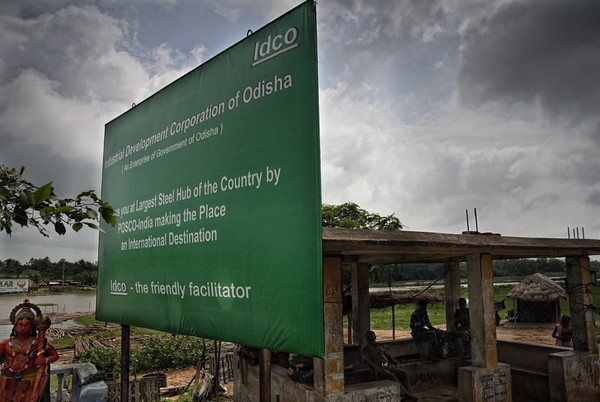
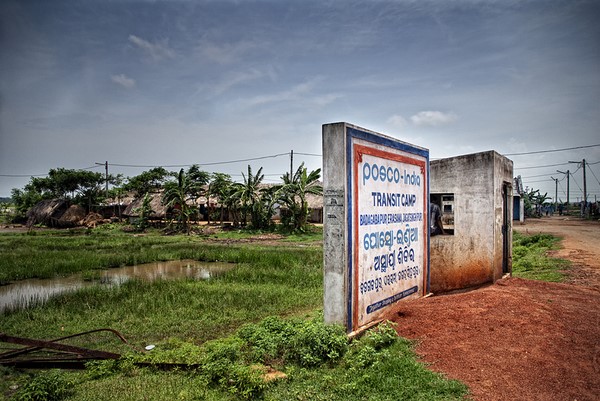
A signboard outside the village of Bailatutha. The bus stand behind it now serves as a make shift Police camping spot, keeping an eye on the movements of people in, out and around the proposed area. Image by Ayush Ranka. Copyright Demotix (22/7/2011)
A signboard outside the village of Bailatutha. The bus stand behind it now serves as a make shift police camping spot, keeping an eye on the movements of people in, out and around the proposed area. Image by Ayush Ranka. Copyright Demotix (22/7/2011)
If the project is implemented, over 22,000 people could be forcibly evicted thanks to the acquisition of land, destroying a thriving economy dependent on betel leaf cultivation, cashew plantations, and fisheries.  On 7 October 2013, both the Republic of Korea and the Odisha government stated that work would begin on the proposed plant in 2014, despite the UN Human Rights panel's recommendation that moving ahead with the project would mean the displacement of thousands of people and the disruption of many more livelihoods.  Commenting on the situation, Terra Lawson-Remer, an assistant professor at The New School and Fellow at Council on Foreign Relations, noted on Kracktivism blog that:
the tension between aggregate economic growth and the property rights of vulnerable groups is a longstanding development challenge. Often, growth-enhancing land acquisitions financed by foreign investors forcibly displace the original resource users and ignore their property rights claims, intensifying property insecurity and resource scarcity — even while bringing macroeconomic growth.
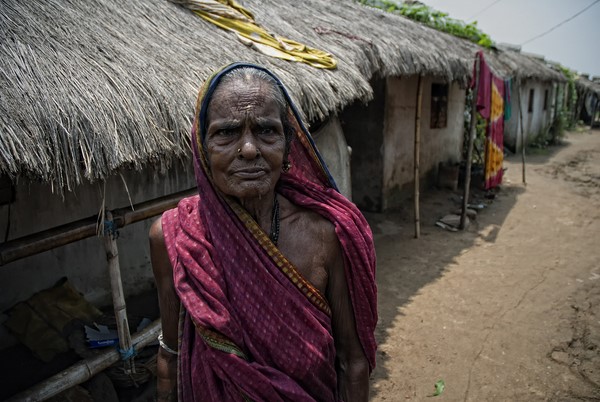
An old woman inside the transit camp of POSCO-India. They have suffered for the last four years in overcrowded, unhygienic living conditions with only Rs.20 (50 cents) per person per day to live on. Image by AYush Ranka. Copyright Demotix (22/6/2011)
An old woman inside the transit camp of POSCO-India. They have sufferedfor the last four years in overcrowded, unhygienic living conditions with only Rs.20 (50 cents) per person per day to live on. Image by AYush Ranka. Copyright Demotix (22/6/2011)
Delays have bogged the proposed facility since its inception. A large portion of land have been already acquired by the state, but construction has been delayed by regulatory hurdles and public protests against plans to clear more than 1,600 hectares of mostly forest land.  The project has attracted controversy not only for its impact on the local people and the environment, but also for how police have dealt with protesters against the plant.  There have been numerous protests, and a recent one in March 2013 claimed the lives of four anti-POSCO activists, reported Subhash Gatade at Kafila blog, when bombs thrown at the group exploded. Police allegedly dragged their feet in responding to the violence. The protesters demands included:
1. Ongoing forcible land acquisition for POSCO plant be immediately stopped. 2. Police force be withdrawn immediately from proposed POSCO plant area. 3. Suspend the District Collector and Superintendent of Police of Jagatsinghpur District immediately. 4. False criminalisation of the protesters be stopped immediately.
With the steel plant project forging ahead, Video Volunteers, an international media and human rights NGO, has released a documentary film highlighting powerful testimonies from the residents stating how their livelihoods will be adversely affected:
The documentary was shot by Video Volunteers’ community correspondents during a fact-finding mission carried out by a number of human rights organizations in November 2012. The mission also resulted in a report (pdf) titled "The Price of Steel". From the film's YouTube page:
The film evidence comes at a critical juncture as the affected areas and protest are recovering from the aftermath of cyclone Phailin. The people of the affected area have shared concerns that the destruction of 170,000 trees by POSCO and the Odisha Government made them extremely vulnerable to effects of the cyclone. In previous years the forest cover had mitigated the worst effects of cyclones. [..] "People in the project-affected area have reportedly been subjected to violence, harassment and intimidation, as well as arbitrary detentions and false charges, as a result of their activities to assemble peacefully and collectively defend their human rights", said the UN Special Rapporteur on freedom of peaceful assembly and association, Maina Kiai.
More UN special rapporteurs have given their opinion, calling for the project to be stopped:
The construction of a massive steel plant and port in Odisha, India, by South Korean steel giant Posco must not proceed as planned without ensuring adequate safeguards and guaranteeing that the rights of the thousands of people are respected.
The transit camp of POSCO, India that has been set-up for the few villagers who are so-called Pro-POSCO. Image by Ayush Ranka . Copyright Demotix (22/7/2011)
The transit camp of POSCO, India that has been set-up for the few villagers who are so-called "Pro-POSCO". Image by Ayush Ranka . Copyright Demotix (22/7/2011)
Chai Kadai blog reported that some of the videos were filmed by Debendra Swain, an IndiaUnheard community correspondent who is also an anti-POSCO activist:
He was arrested on 3rd February 2013 by the police on false charges, taken to Kujang prison where he stayed for 26 days and released on bail on 01 March 2013. 
For its part, POSCO India has strongly denied having any role in the abuse of human rights:
Posco has always urged the government of Odisha to first safeguard the human rights and livelihood of innocent villagers and rejects/deplores any unlawful violence against them.
More information can be found on the Stop POSCO campaign and Video Volunteers website.

First Published in Global Voices