











Bengal was once known as the richest province of the Indian subcontinent mainly due to its famous and varied agricultural and textiles products including the Muslin, world renowned finely-woven breathable fabric. M Ahmedullah posts in Alochonaa.com a two part series (Part 1, Part 2) discussing the history of the Bengal's textile empire.

Dragonfly
Image by Rezwan
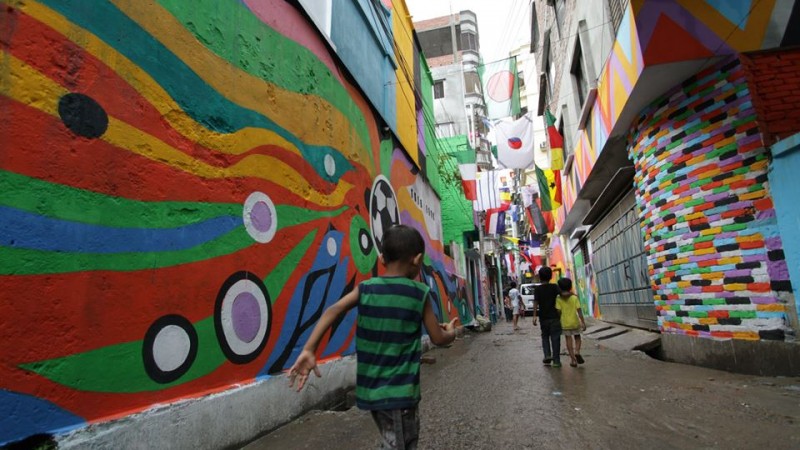
The World Cup Goal-E Project
This street in Bangladesh has a colorful world cup celebration
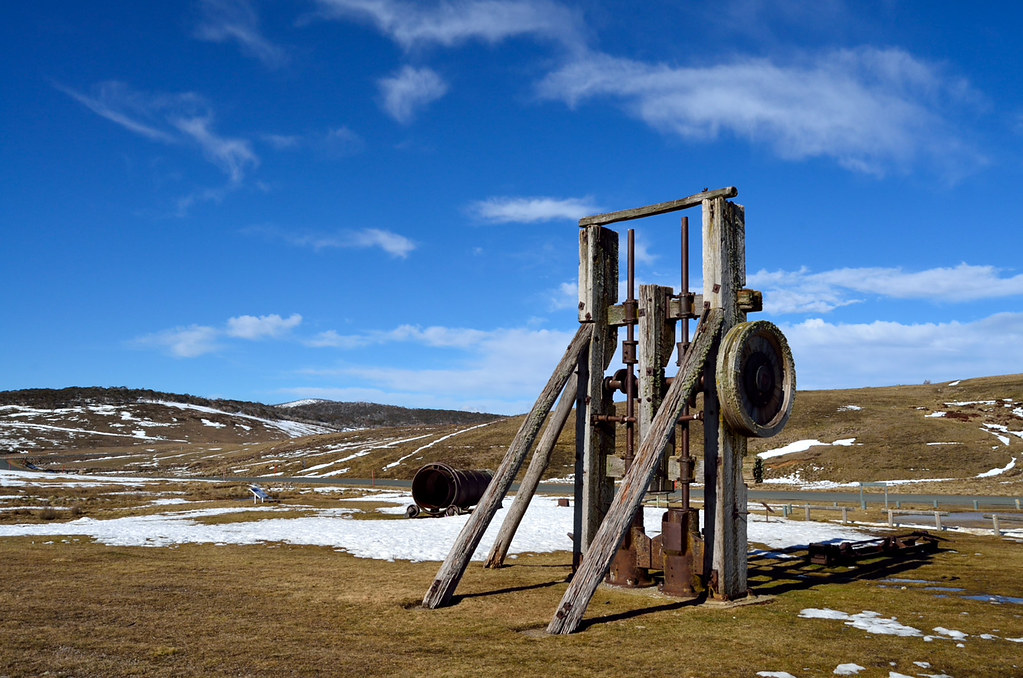
New Chum Hill Ruins
Remnants of Kiandra gold mine at New Chum Hill, #nsw #australia
May 05, 2014
May 01, 2014
Online Tools And Resources For Learning Bangla Language
Kolkata based British expat blog My Bangla Diary posts an interview with Steve Capell, the creator of Bangla Tangla. This resourceful website by Capell contains useful tools and contents for learning Bangla (Bengali) language online.
The Bengali Tradition of Halkhata, New Accounts Ledger
The centuries old Bengali new years celebrations include an important tradition, opening the Halkhata, a new ledger book for the year for the businesses. Blog Amader Kotha explains what Halkhata is. The traditional red color ledger book signifies the marking of a new beginning and the festivities, rituals, hopes and uncertainties that come along with it.
Bangladesh's LGBT Community Steps Out in Rainbow Colors for New Year's Celebrations
Members of Bangladesh's lesbian, gay, bisexual and transgender (LGBT) community marched alongside the country's recent New Year's festivities, a bold step for the oft-vilified minority.
Roopbaan, a magazine aimed at gay Bangladeshis, arranged the colorful march, which they maintained wasn't a gay pride parade but a celebration of diversity and friendship. In Muslim-majority Bangladesh, homosexuality is considered to be unacceptable socially and religiously. Gay sex is illegal, according to the country's penal code.
On April 14, the Bengali New Year, the traditional colorful procession "Mongol Shobhajatra" set off from Dhaka University's Faculty of Fine Art building. Immediately following them were a group of people dress in rainbow colors representing the underground gay community. The people around them did not understand what was going on, but later realized from the media reports that the rally was for the same-sex community. Online portal Priyo.com reported (the translation of the article is here):
LGBT rights blog The Muslim Outcast noted:
Other comments included threats of violence, comparisons with animals, addiction, peadophilia and incest, mentions of religious taboos and blame towards the government.
However, there were rays of hopes in some comments:
The post was first published in Global Voices.
Roopbaan, a magazine aimed at gay Bangladeshis, arranged the colorful march, which they maintained wasn't a gay pride parade but a celebration of diversity and friendship. In Muslim-majority Bangladesh, homosexuality is considered to be unacceptable socially and religiously. Gay sex is illegal, according to the country's penal code.
On April 14, the Bengali New Year, the traditional colorful procession "Mongol Shobhajatra" set off from Dhaka University's Faculty of Fine Art building. Immediately following them were a group of people dress in rainbow colors representing the underground gay community. The people around them did not understand what was going on, but later realized from the media reports that the rally was for the same-sex community. Online portal Priyo.com reported (the translation of the article is here):
The rally contained seven parallel rows of activists clad in Punjabi [a type of shirt] in each of the rainbow colors. They had balloons, flowers and birds made of paper. They released the helium balloons to the sky after completing the rally. This diversity rally created interest among the crowd.
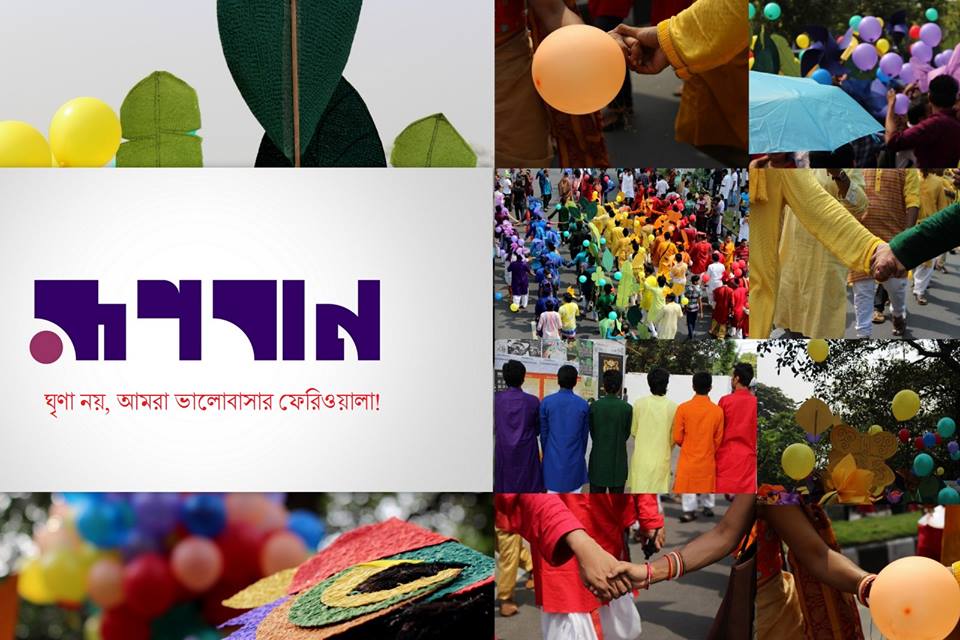 |
| Spread love, not hatred. Image courtesy Roopbaan Facebook group |
Whether you are pro or anti LGBT, you cannot help but be in awe. For a group of demonised individuals to remain firm and march out onto the streets of Dhaka, knowing that it is not without risk, I believe, is an act of commendable bravery. They have begun the long road to acceptance and these incredible individuals will be remembered by the following generations of LGBT individuals as those that laid the foundations for acceptance within the nation's society.The parade drew much reaction on social media, mainly on Facebook. The majority of commentary was negative, though some did laud the effort. Facebook group Gay For Girls listed some of them and observed:
The only reason I wasted my time taking screenshots of the comments and putting them up here is to prove a point. People will say shit just to hurt others. They will say terrible things to people they don't even know. They will hate us without even knowing our stories.Rainer Ebert, a US activist based in Dhaka, wrote on Twitter of the threats that followed the march:
#Roopbaan FB page down, violent threats against #LGBT people & allies after #Bangladesh's first pride parade http://t.co/YhYmKEcajG #shame
— Rainer Ebert (@rainer_ebert) April 16, 2014Bangladeshi diaspora LGBT blog "Coming out" as a bisexual Bangladeshi compiled some of the reactions. One user wrote, "they were lucky a handful knew.. neyxt [sic] one should surely be announced sooner and get bombed."Other comments included threats of violence, comparisons with animals, addiction, peadophilia and incest, mentions of religious taboos and blame towards the government.
However, there were rays of hopes in some comments:
Who are we to judge whether this is good or bad, and why does it concern everyone so much.
Why are you personally so hostile towards them?The blogger concluded:
Most of the comments are negative. Let's face it, we knew this was going to be the case. Besides the banging collection above, there are a lot of negative comments with no likes that I haven't posted here. But interspersed within those are a few good comments, and then there are the few good comments with lots of likes. And this is what gives me hope.
The post was first published in Global Voices.
April 29, 2014
Bangladeshis Are Not Happy With India's Bharatya Janata Party
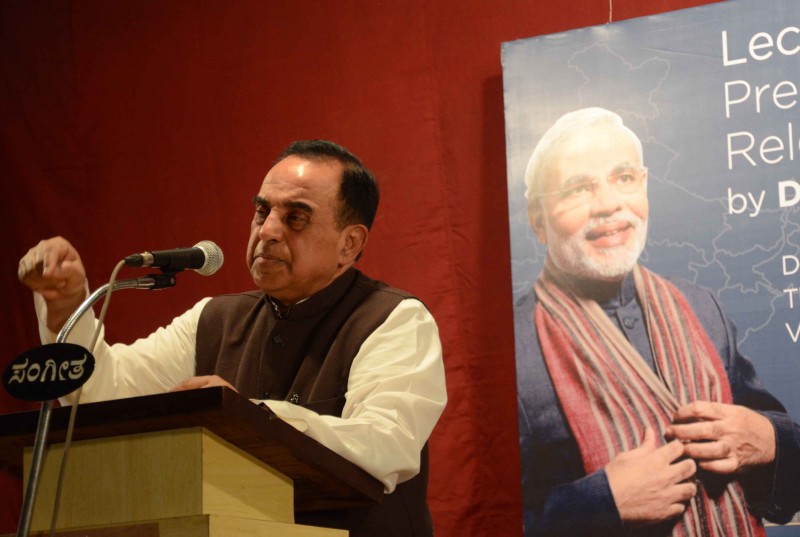 |
| Subramanian Swamy speaks in Mangalore, India on 17/12/13 |
Subramanian Swamy, a leading figure of the conservative Bharatya Janata Party (BJP) whose prime minister candidate is Narendra Modi, caused much outrage in neighboring Bangladesh when he mentioned in an election rally in Assam that Bangladesh should compensate India for its undocumented migrants there by giving the country one-third of its land.
He also claimed that since the independence of Bangladesh from Pakistan in 1971, one-third of Bangladesh's Muslim population migrated to India. According to him, Bangladesh should take them back or hand over one-third of the land to India.
There are no reliable figures for how many Bangladeshi immigrants are in India, but a significant number of Bangladeshis do migrate to India to reunite with family members, for job opportunities, to escape environmental crises and other reasons. The wave of people in the past decade has prompted India to step up security along its border with Bangladesh, including the installation of barbed-wire fences.
Bangladeshi newspapers first picked up Swamy's remarks from Assam's Bengali daily Samayik Prasanga on 19 April. Along with Nepal, Bhutan, Pakistan and China, the country's political analysts are closely following the election as international relations will be shaped by the policies of the parties that win.
Angry reactions soon followed. User Veja Beral on forum projanmo.com commented:
BJP is an anti-Bangladeshi party. If it comes to power, it will mean trouble for Bangladesh. The [long] pending issues like the Teesta water-sharing contract and border disputes will remain unresolved and all implemented treaties will be stopped by the Modi government.The user also wrote:
There are a number of undocumented Bangladeshis in India that everybody knows. But the astronomical figure of 50 million (which is BJP's claim) is illogical and untrue. Maybe BJP is purposefully campaigning the figure 50 million instead of 500,000.Shamim Sujaet opined on the blog Shobdoneer:
As if Bangladesh is a plaything. You can shape it however you like.Meanwhile, Bangladeshi hacker group "Bangladesh Cyber 71" allegedly hacked more than 300 of the Indian government's websites in protest of Swamy's comments. The admin of the group told BanglaNews24.com that they will continue the attacks until BJP withdraws the statement.
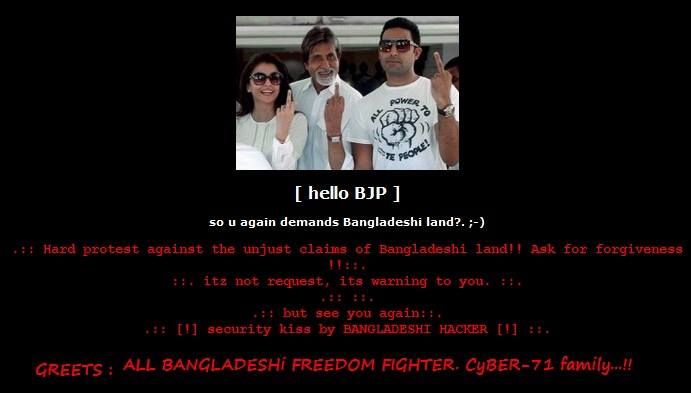 |
| Screenshot of a website hacked by "Bangladesh Cyber 71" |
Narendra Modi, the prime minister candidate from BJP, doubled down on the comments during a rally in West Bengal:
You can write it down. After May 16, these Bangladeshis better be prepared with their bags packed.Undocumented Bangladeshi immigrants have been a part of the BJP's agenda, which claims that they are being used as a vote bank for the ruling Indian National Congress party. But Modi's comments indicate that this could be a political weapon they would use against their neighbor if the party comes to power.
This isn't a case of one-way migration, however. India would stand to lose its fifth largest source of remittance if relations were to sour. Around half a million Indians work in Bangladesh, and they remitted 3.716 million US dollars to India last year.
This post was written in collaboration with Abdul Aleem Khan
April 19, 2014
Bangladeshis Mourn Gabriel García Márquez, the 'Magician Of Words'
[caption id="attachment_467088" align="aligncenter" width="658"]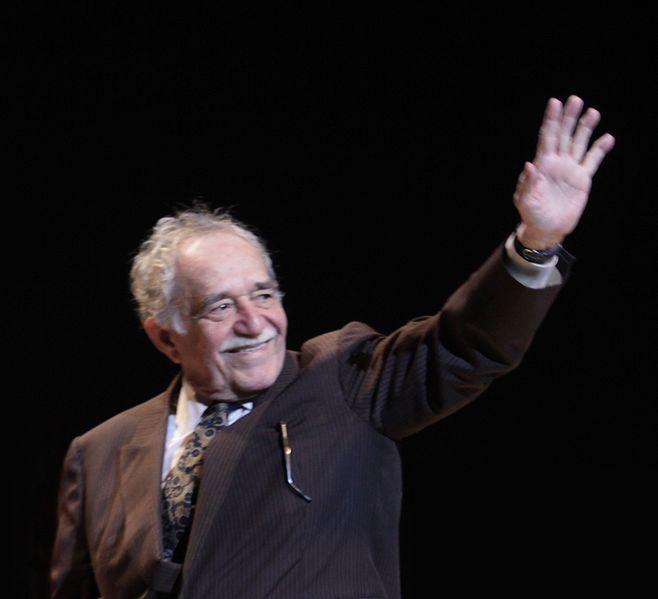 Gabriel García Márquez. Image by Wikimedia/Festival Internacional de Cine en Guadalajara. CC BY 2.0[/caption]
Gabriel García Márquez, the Nobel-prize winning literary legend from Colombia, died April 17, 2014 at the age of 87. He was not only popular in Latin America but also in South Asia, especially in Bangladesh through translations of his works. There, he was known as the "magician of words".
Most of the local newspapers in Bangladesh carried the news of his death with importance. On Facebook, Bangladeshis paid tribute to the author of such beloved works as "One Hundred Years of Solitude" and "Love in the Time of Cholera".
Blogger and author Mahbub Morshed wrote:
 Gabriel García Márquez. Image by Wikimedia/Festival Internacional de Cine en Guadalajara. CC BY 2.0[/caption]
Gabriel García Márquez, the Nobel-prize winning literary legend from Colombia, died April 17, 2014 at the age of 87. He was not only popular in Latin America but also in South Asia, especially in Bangladesh through translations of his works. There, he was known as the "magician of words".
Most of the local newspapers in Bangladesh carried the news of his death with importance. On Facebook, Bangladeshis paid tribute to the author of such beloved works as "One Hundred Years of Solitude" and "Love in the Time of Cholera".
Blogger and author Mahbub Morshed wrote:
Márquez is the greatest author of our lifetime.Tanvir Haider Chowdhury acknowledged the influence of Márquez:
Nostalgia. Melancholy. Solitude. Romance.In literary critique Facebook group Boi Porua, writer Ahmed Mostafa Kamal mentioned while discussing the influence of Márquez on Bengali literature:
I look at these words, and they always make me think of Gabriel Garcia Marquez. He taught me to look for the magic underneath the facade of the everyday. Mr Marquez's prose to me defined lyricism. In his hands, the poetry, poignancy and pathos of the human condition lay revealed.
He will always evoke to me my early youth, when I incredulously devoured 'One Hundred Years of Solitude' and 'Love in the Time of Cholera'. I vividly remember sitting there stunned, trying to absorb the fact that these were contemporary works of fiction.
Márquez's style did not influence Bengali authors much. It was hard to mimic his writing style. Some skills remain unique, such was Márquez's.Blogger Megha wrote earlier on Sachalayatan blog in a review of a Márquez novel:
I have read many [of his] books. I have learnt how imaginative a person can be, how magnificently one can write about the future and the past in one line. I have known what a "magician of words" truly means.Kaberi Gayen, an educator and writer, paid homage to him:
No, I will not cry. As I believe that he will live at least a few more centuries with resonant words of love, how could I cry mourning his death? Let his love and dreams conquer our hearts little by little.Blogger and Global Voices author Pantha Rahman Reza bod farewell:
Farewell Márquez. You will live on in our reading lives.
February 24, 2014
Subscribe to:
Posts (Atom)