




Dragonfly

Image by Rezwan

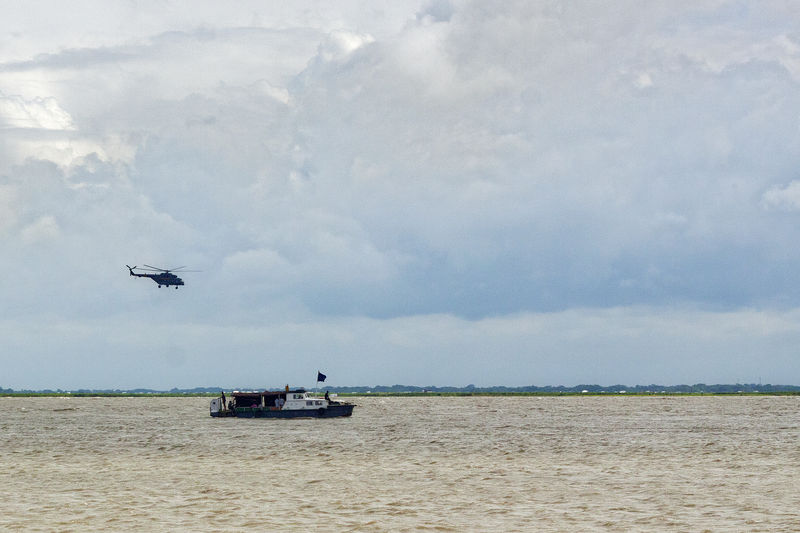
Overcrowded passenger ferry capsized in the Padma River in Munshiganj, Bangladesh

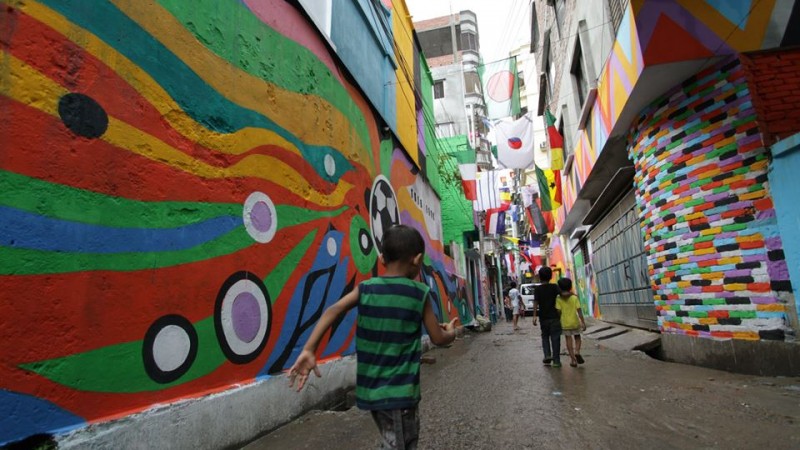
The World Cup Goal-E Project

This street in Bangladesh has a colorful world cup celebration

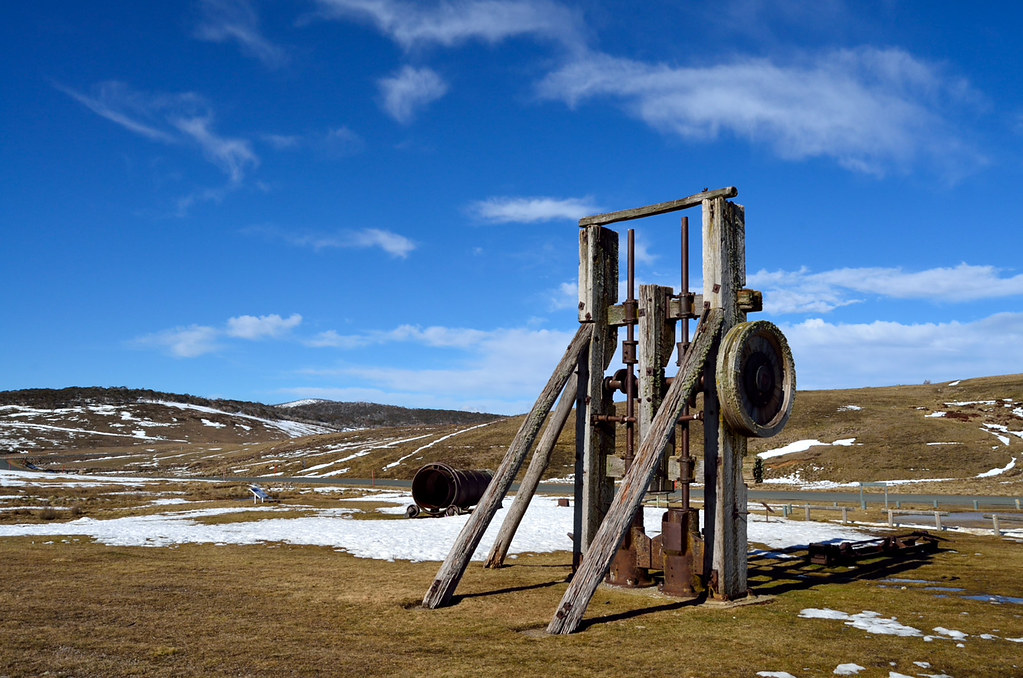
New Chum Hill Ruins

Remnants of Kiandra gold mine at New Chum Hill, #nsw #australia

September 29, 2014

Your leave - when you want and as long as you need

Image credit Clayton State University
In most jobs there are annual holidays you cannot use flexibly. You don't get leave when you require it most or are forced to take annual paid leave when you don't want it. But there can be other ways to deal with it. What if there is not annual leave policy. You get the leave you need as long as your boss and co-workers are ok with it and your work is not hampered. How about it?

Sir Branson wrote in his blog about the new vacation policy that has been adopted by Netflix and also by his organization, Virgin:

The policy-that-isn’t permits all salaried staff to take off whenever they want for as long as they want. There is no need to ask for prior approval and neither the employees themselves nor their managers are asked or expected to keep track of their days away from the office. It is left to the employee alone to decide if and when he or she feels like taking a few hours, a day, a week or a month off, the assumption being that they are only going to do it when they feel a hundred per cent comfortable that they and their team are up to date on every project and that their absence will not in any way damage the business – or, for that matter, their careers!

Branson continues:

The Netflix initiative had been driven by a growing groundswell of employees asking about how their new technology-controlled time on the job (working at all kinds of hours at home and/or everywhere they receive a business text or email) could be reconciled with the company’s old-fashioned time-off policy. That is to say, if Netflix was no longer able to accurately track employees’ total time on the job, why should it apply a different and outmoded standard to their time away from it? The company agreed, and as its ‘Reference Guide on our Freedom and Responsibility Culture’ explains, ‘We should focus on what people get done, not on how many hours or days worked. Just as we don’t have a nine-to-five policy, we don’t need a vacation policy.’

The above are excerpts from Branson's book The Virgin Way. Blogger and social media expert Mark Hillary analyses Branson's ideas:

What Branson is really suggesting is that employees can organise their own working life - the company can reduce the rules and bureaucracy governing the working day and both should win from this more flexible arrangement. Individual teams at the front line of a business know how many people they need to keep the ship running, so they can work out their own holiday patterns.

I think we are going forward to an era of employment which is not location based or office hour based. As long as the job is done you can shape your life according to that. That will be your ultimate work life balance.
September 25, 2014

How Climate-Smart Villages in Bangladesh, India and Nepal Are Preparing Farmers for the Future

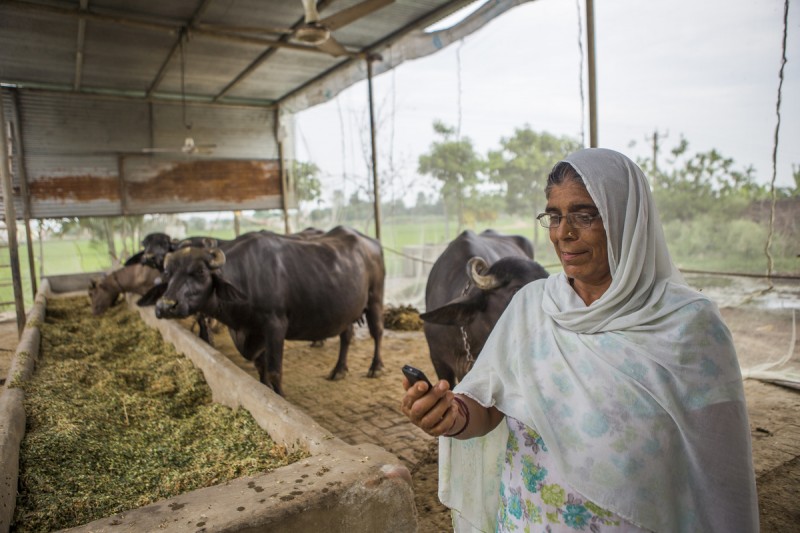
56 years old Kamla Devi listens to messages of weather and best climate friendly crop practices on her mobile phone while working in the cowshed at her home in Anjanthalli. Image by Prashanth Vishwanathan. Used with permission.
56-year-old Kamla Devi listens to messages about the weather and best climate-friendly crop practices on her mobile phone while working in the cowshed at her home in Anjanthalli village. Image by Prashanth Vishwanathan. Used with permission.
One of the initiatives to come out of the United Nations' summit on climate change on September 23 was the Global Alliance for Climate-Smart Agriculture, a group of 16 countries and 37 organizations that aim to enable 500 million farmers around the world to practice climate-smart agriculture by 2030.

What is climate-smart agriculture? It's the idea of helping farmers adapt to changing climates while weaning them off techniques and technologies that produce greenhouse gases. In a number of countries in Africa and Asia, Climate Change Agriculture and Food Security (CCAFS), a research program of CGIAR (a global partnership dedicated to agriculture research), has already set up "climate-smart villages" to put the idea into practice.

Farmers in northern India have grown used to a wide range of weather, and work their fields around monsoon seasons that regularly bring them torrential rains. But as climate change begins to change the weather, scientists predict that growing conditions in the country are likely to become even more challenging and could alternate abruptly between periods of severe rainstorms and drought, according to the group.

In response to the farming challenges brought on by climate change, Climate Change Agriculture and Food Security (CCAFS), together with the International Maize and Wheat Improvement Centre and partner organizations are introducing a portfolio of climate-smart agriculture practices and technologies in their climate-smart villages.

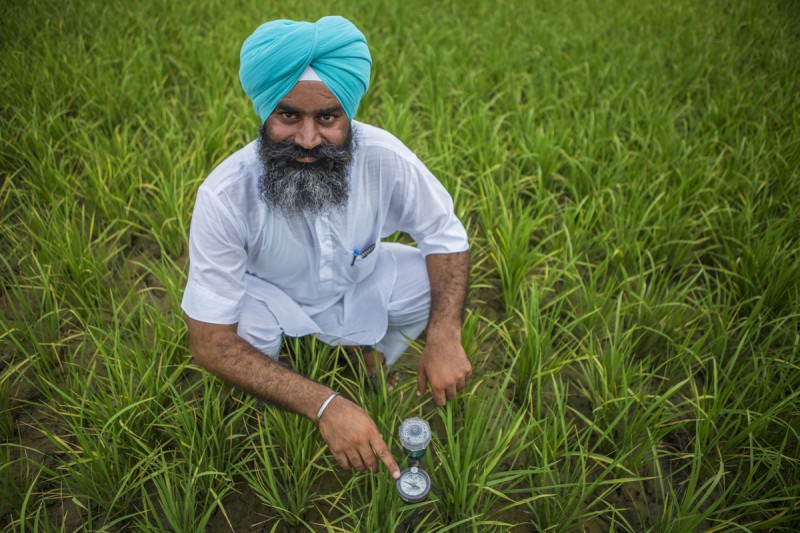
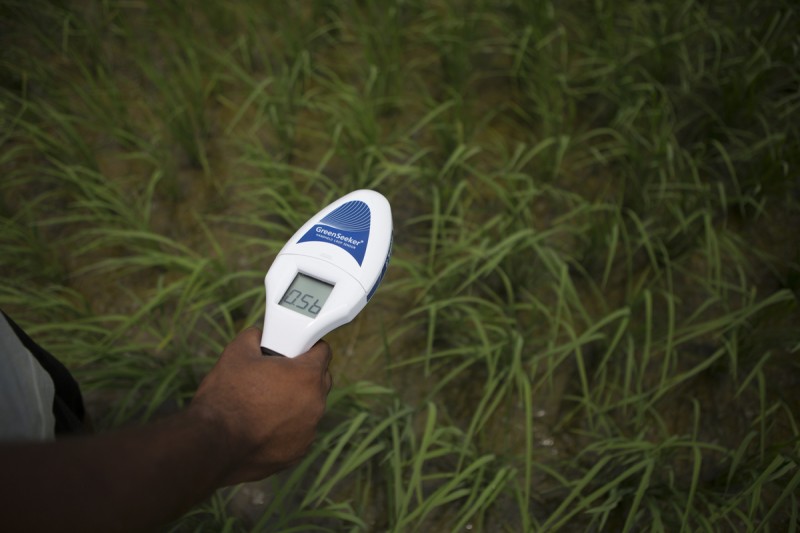
Paramjeet Singh uses the “Green Seeker” to check the nutrient levels of his paddy fields in Uncha Samana. The device helps him decide the most appropriate dosage of nitrogen fertilizers (Urea) for his crops.
Paramjeet Singh uses the “Green Seeker” to check the nutrient levels of his paddy fields in Uncha Samana. The device helps him decide the most appropriate dosage of nitrogen fertilizers (Urea) for his crops. Image by Prashanth Vishwanathan. Used with permission.
Researchers, farmers’ cooperatives, government bodies and private sector partners are working together at these villages to identify which agriculture practices and technologies can improve productivity and incomes and build resilience to climate risks. “Climate-smart” agriculture is highly localized; interventions that work in one place will not necessarily be suitable for another.

In India the project is undertaken currently in Haryana, Bihar and Punjab. The same model also operates in Khulna, Bangladesh and Rupandehi in Nepal. This video explains the idea behind the villages:


In the climate smart villages in India, farmers have begun to alter their use of mobile phones, the Internet, and basic measurement devices to adapt to the changes initiated by climate change, according to CGIAR. An interesting aspect is that farmers are actually not talking much about climate change, but rather are engaging themselves in alternative and innovative practices. The money that they are saving by doing things like using new planting methods for rice that reduces the amount of labor and water needed are resulting in a significant cost savings, CGIAR says.

Harpreet Singh checks the water level through a Tensiometer in his paddy fields in Birnaryna as a part of the Climate Smart Village (CSV) programme.  Image by Prasanth Viswanathan. Used with permission
Harpreet Singh checks the water level through a Tensiometer in his paddy fields in Birnaryna as a part of the Climate Smart Village (CSV) programme. Image by Prasanth Viswanathan. Used with permission
Under the project, voice and text messages are sent to farmers twice a week in Hindi or in other local language. The text messages include information on weather forecasts and suggestions for farmers, information on pests and remedies, etc. Last year messages were sent to 1,400 farmers in 50 villages in Karnal and Bihar and 10 villages in Punjab, according to the group.
Farmers are being encouraged to improve their nutrient management, for example through the use of a leaf color chart:


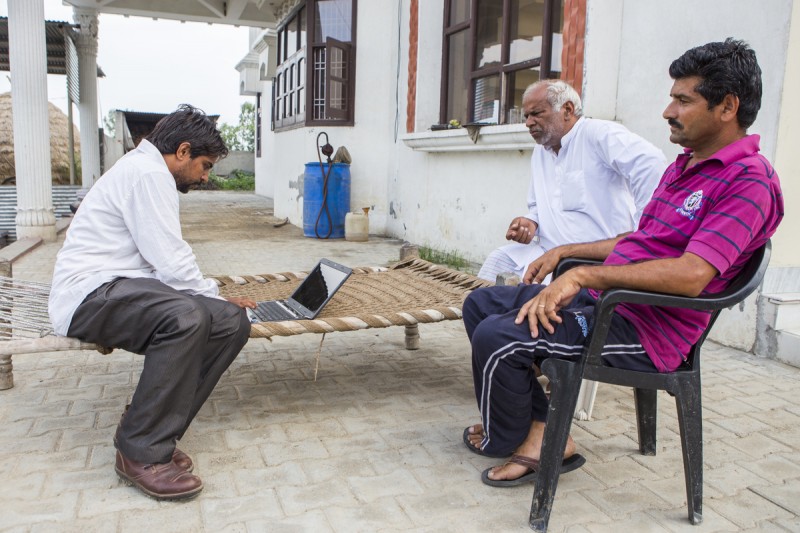
27 year old Vinod Kumar (L) uses the Nutrient Expert computer programme to ascertain his farms nutrient needs being part of the Climate Smart Village programme in Anjanthalli. Image by Prashanth Vishwanathan. Used with permission.
27-year-old Vinod Kumar (L) uses the Nutrient Expert computer programme to ascertain his farms nutrient needs being part of the Climate-Smart Village programme in Anjanthalli. Image by Prashanth Vishwanathan. Used with permission.
The CCAFS South Asia Program has also successfully implemented a climate insurance program as part of their climate-smart village model to save farmers from losses due to failed crops as a result of natural calamities.

The success of the models in India has prompted replication of the initiative under climate smart village in various South Asian and African countries. The CGIAR's blog narrates a lot of initiatives and challenges that the climate-smart villages face.

The post was also published in Global Voices Online.

September 07, 2014

How hot or cold do you like your tea?

This graph has been drawn by a geochemist and a blogger. How cool is that?


August 31, 2014

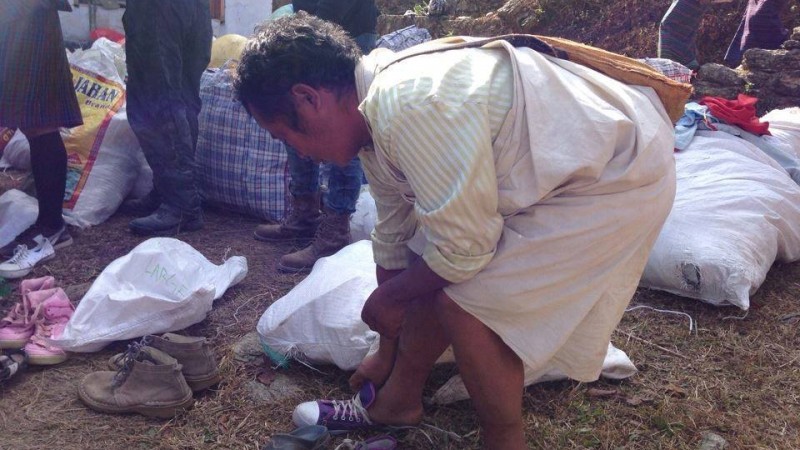
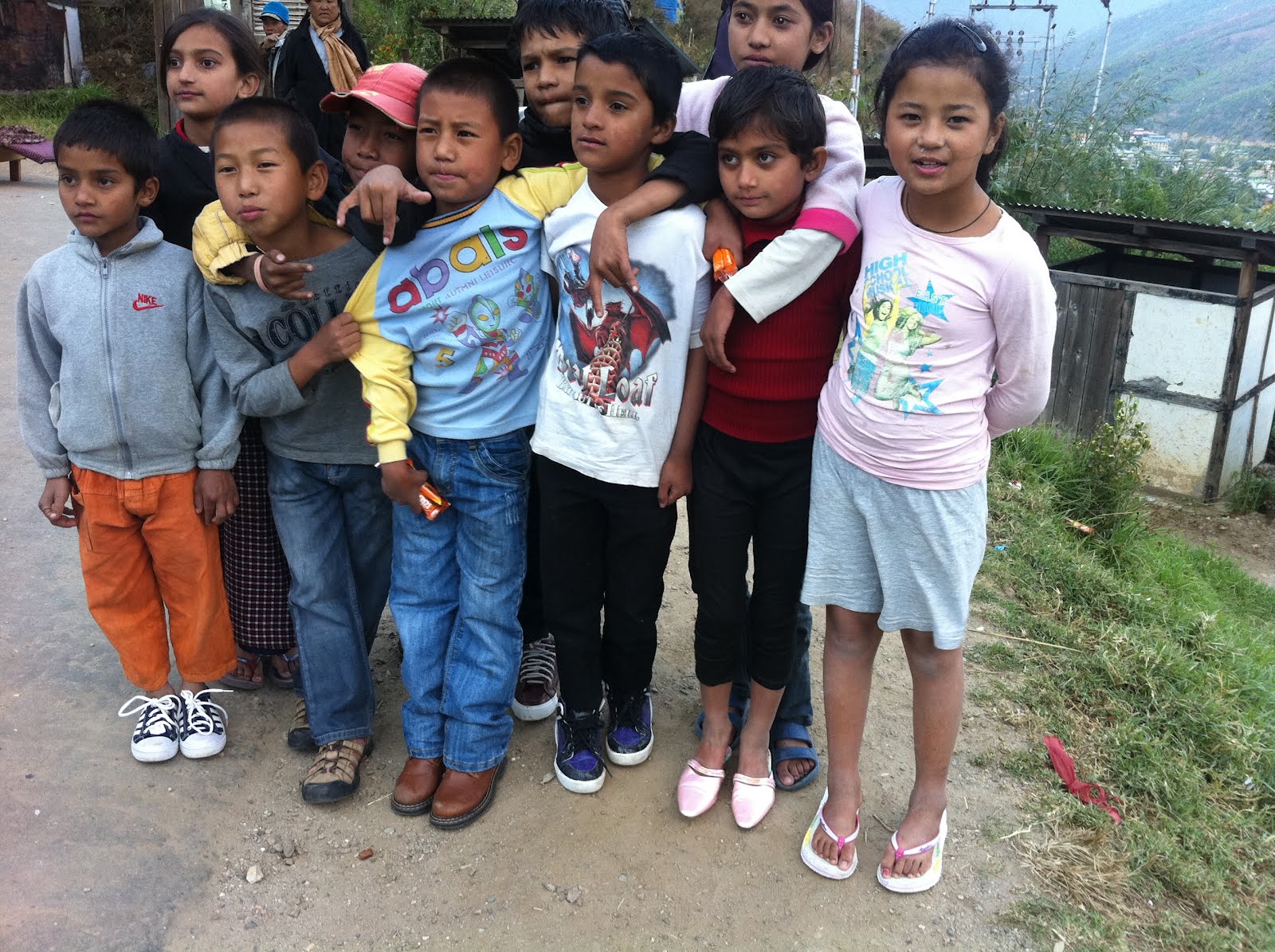
A Home-Grown Campaign in Bhutan Is Giving Refurbished Shoes to Thousands Who Need Them

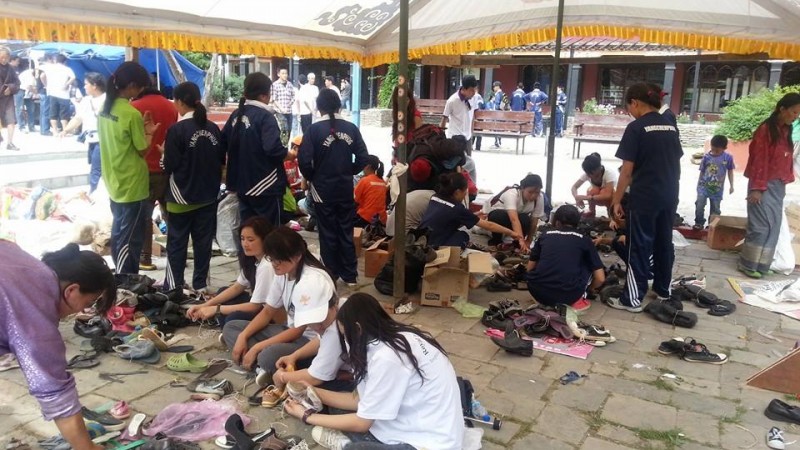
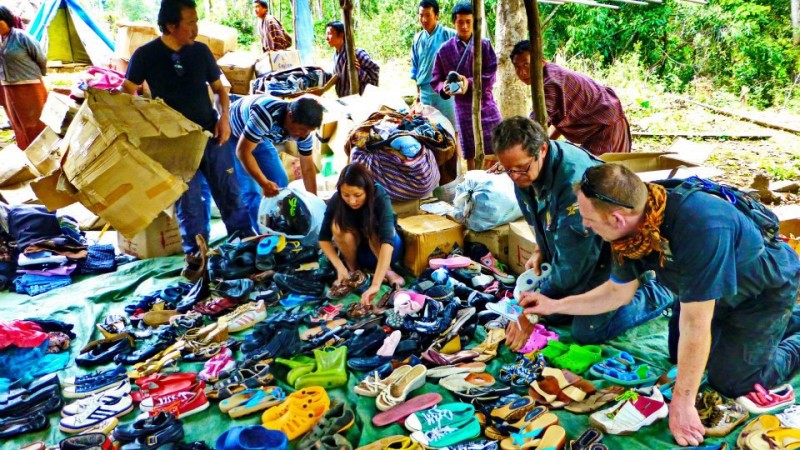
olunteers concentrating on how to recycle the shoes collected during the collection drive. These will soon be sent to corners of Bhutan for distribution. 500 pairs equals 500 smiling faces. Image used with permission.
Volunteers concentrating on how to recycle the shoes accumulated during the collection drive. These will soon be sent to corners of Bhutan for distribution. Image by Help Shoe Bhutan. Used with permission.
A campaign in Bhutan led by a Bhutanese entrepreneur is collecting used shoes and cleaning them to distribute the footwear to those who cannot afford a decent pair. Help Shoe Bhutan has so far given shoes to nearly 1 percent of the country's population of 740,000.

The story begins with Sandeep Gajakas, an engineer from India, who founded the concept of shoe laundry. Gajakas saw that some people did not make an effort to clean their shoes. If they expect someone else to do it for them, then it is certainly a feasible business model. In 2003, he started India's first professional footwear laundry and refurbishing service for all types of footwear in Mumbai. So far, its ShoeVival franchise has expanded to 10 cities in three countries.

Young Bhutanese entrepreneur Dawa Drakpa brought ShoeVival to Bhutan in 2011. Bhutanese blogger Passang Tshering narrates what happened next:
His parents had sent him to get a degree in BSc Nursing from Bangalore [India], but to their disappointment he returned from Mumbai with a shoe laundry franchise, and without the degree. Unimaginable, but that's the strangeness of destiny. [..]

Overnight he turned what was earlier perceived as 'dirty job' into a sexy profession.
help shoe bhutanDawa Drakpa writes in his blog about the initial struggles and how his venture started the social business called Help Shoe Bhutan. Drakpa saw a lot of shoes in a trash yard and thought a good portion of them could be recycled and reused. In rural Bhutan, many children walk for miles without decent shoes to go to school. Farmers often work the field without wearing shoes because they cannot afford footwear.

The old shoe collection campaign began in September 2011. In Drakpa's words:
The intention was clear-
1. Collect as many old shoes.
2. Revive them.
3. and finally distribute them among the people who cannot afford a decent pair of shoe.
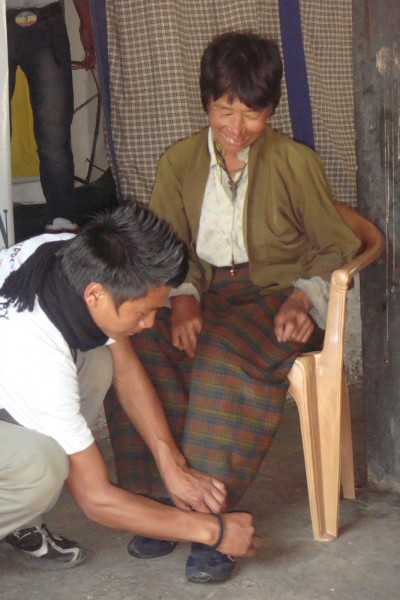
Help-Shoe Bhutan distributes 500 pairs of shoes at Blind school in Merak. Image used with permission.
Help Shoe Bhutan distributed 500 pairs of shoes in Merak, a settlement in the far east of Bhutan, in Trashigang District. Image by Help Shoe Bhutan. Used with permission.
Drakpa recalls how many Bhutanese organisations, businesses and individuals came forward to help the effort by providing funding or just a helping hand. The cleaning and repairing of the shoes cost as little as Nu. 80 (US $1.30) per pair, a service Drakpa's Shoe Laundry business is providing. Bhutan Dragons Motorcycle Club joined as a distribution partner to deliver the shoes to rural areas that needed them. He narrates how its members rode together in a charity ride in cold and foggy weather to distribute the footwear and other items in Samtse district in southwest Bhutan.

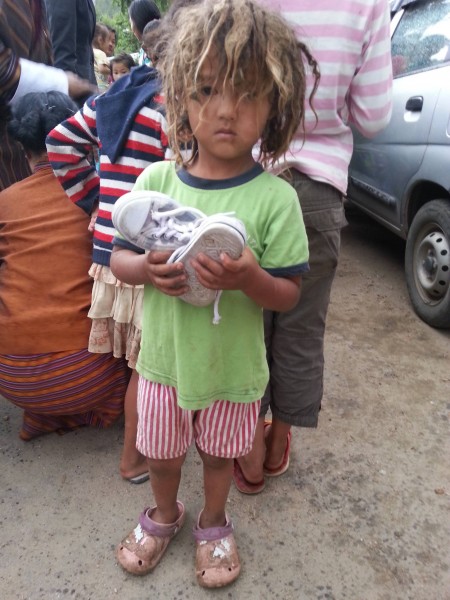
A little girl with a pair of recycled shoes during distribution in Ghasa. Image used with permission.
A little girl with a pair of recycled shoes during a distribution. Image by Help Shoe Bhutan. Used with permission. 
The first distribution was in March 2012. Drakpa writes:
The distribution team reached there around 3pm. And the children started standing in queue. Even at this moment, i was not very sure how those shoes will be accepted. [...] There were different kinds of shoes- adults, kids, flip flops, boots, leather shoes and the list goes on. [...] Help-Shoe Bhutan took 221 pairs of cleaned and repaired shoes.

Kids came one at a time to try out shoes... They were very excited, we could clearly see that the kids and adults as well were choosing their shoes even before their turn came to try out their shoes. Soon kids and adults rushed towards the shoes and the view looked more like a fish market. Having said that, it was indeed a honor for us, the distributing team.
The signs of joy of getting a pair of shoes to walk during distribution in Zhemgang district, one of the poorest regions in Bhutan. Image by Help Shoe Bhutan & used with permission.
The joy of getting a pair of shoes to walk in during distribution in Zhemgang district, one of the poorest regions in Bhutan. Image by Help Shoe Bhutan. Used with permission.
The Help Shoe Bhutan team also distributed shoes to Zhemgang, the poorest district in Bhutan. Drakpa recalls:
We made it a point not to miss a single person leave the room without getting a pair of shoes. The distribution began with Bardo Tshogpa calling the names according to the house hold names. There are 68 households in Bardo gewog. And approximately 300 people. The charity goods include shoes, clothes, toys, New blankets, sweets, biscuits etc.
The first campaign, which ran until May 2012, distributed about 1,300 pairs of shoes. Help Shoe Bhutan's second campaign was launched in June 2012 by Her Royal Highness Princess Chimi Yangzom Wangchuck with a plan of distributing 2,000 pairs. The initiative is ongoing, with the total number distributed as of May 21, 2014, standing at 5,996.

Distributing partner Bhutan Dragons Motorcycle Club had distributed 742 pairs of shoes in Pemagatshel. Image by Help Shoe Bhutan. Used with permission.
Whats next for the campaign? According to its Facebook page, the team is going to high schools to train the students how to clean and recycle shoes. A post on July 24 mentioned:
We are just trying to empower the students themselves to take care of their own shoes.
It is often said "give a man fish, he will feed for a day. Teach him how to fish, he will start a fish shop and feed his neighbourhood"
You can follow the project via its Facebook page.

Happy kids with recycled shoes. Image by Help Shoe Bhutan. Used with permission.
The post was also published in Global Voices Online.

August 21, 2014

Watch How Conversations Between Strangers Help Bridge the Divide Between Indians and Pakistanis

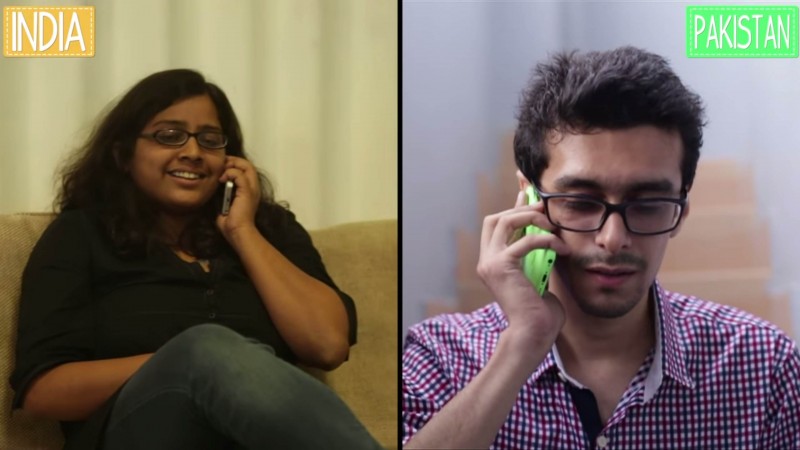
Screenshot from the AIB Video
Over the years, India and Pakistan have seen a number of efforts trying to break the perpetuated animosity between the two countries. On India's Independence Day on Aug. 15, 2014), Indian comedy collective All India Bakchod (AIB) gave it another shot, releasing a video that features ordinary Indians talking over the phone to strangers in Pakistan.

In this video strangers from India and Pakistan speak to each other over the phone. They talk about what Indians and Pakistanis perceive about each other, learn about their personal lives and hobbies, find common grounds between themselves and congratulate each other on the Independence Day of both the countries.


The bad blood between India and Pakistan dates back to 1947, when the British partitioned India into the Dominion of Pakistan (later Islamic Republic of Pakistan and People's Republic of Bangladesh) and the Union of India (later Republic of India) primarily along religious lines, to stem growing tensions between the Hindu and Muslim communities. The divide devastated both countries, and their relationship to date is often strained, marred by wars, border disputes, military stand-offs and a continuing conflict over Kashmir.

If you still are wondering why such effort is necessary to reduce the notion of animosity between citizens of both the countries, then just gloss over the YouTube comments on the above video.

Indian blogger Farzana Versey offered her nuanced reaction to the video:
Will this bring people on both sides (we are not even speaking about the two nations) closer together? This was a ‘controlled’ atmosphere, and even if comments were not censored it was understood that the conversation was to be light. What we see is one reality – the coffee shop or corner store one. The young even on campuses are politically aware and most certainly come with a bagful of stereotypes about the other. It does not negate the awareness about Bollywood, cricket, or food. Yet, all of these can be politicised on the day there is a clash of films, a match or a culinary competition.
She also provided her verdict:
Love it…just don’t take it as the whole truth.
The post was also published in Global Voices Online.

August 19, 2014

Google Is Tracking and Recording your Location

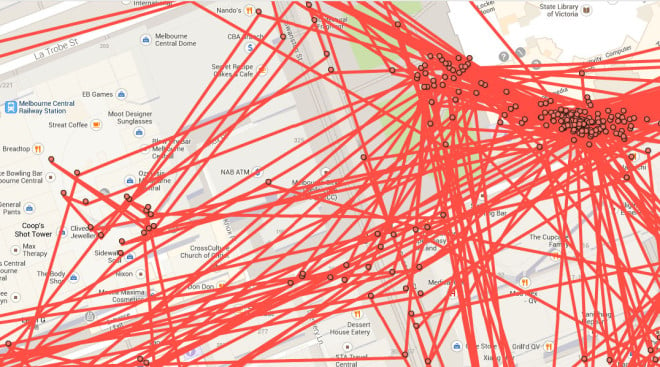
Elizabeth Flux at Junkee.com uncovers a truth many of us smartphone users fail to realize. By allowing our smartphone to find out our location we are letting services like Google maps to record our movements. Here is a typical map of movements you will find from here:

Image courtesy Junkee.com
If you login at this site with the same Google login you use for your smartphone you will be able to find your Data updated daily. You will be surprised with some of the entries and wondering did I actually go there? Apparently due to loss of network coverage and the GPS not being turned on it records approximate location values. So don't rely on it to be used as a proof of something or an alibi.

Some of you may find that there is no data. And yes you did not turn the 'location services' in your phone on. So knowing this give you an advantage - you can be visible or simply switch your existence off from such services. The problem is that many apps and services (like Google now or Nike+ Running App) works only if you have the location services turned on.

So will we be able to control dissemination of our information? Apparently there is hope as you can delete your Google location history and you can opt out from location services.  

August 18, 2014

Journalist and Democracy Advocate Ahmed Rizwan Abdulla Missing in the Maldives

Poster for the missing journalist of Minivan News. Image courtesy Facebook page of Minivan News
Poster for the missing journalist. Image courtesy Facebook page of Minivan News. Click Image to enlarge.
Prominent Maldivian journalist, blogger and human rights advocate Ahmed Rizwan Abdulla went missing Aug. 8, 2014. He was last seen waiting for an early morning ferry to travel to Hulhumale Island from the capital Male. It is not known whether he boarded the ferry.

The 28-year-old, who works for online news site Minivan News, is an advocate of democracy and free speech and a prolific social media user. He is one of the first Maldivian bloggers and writes on many subjects, including religion, politics, and the environment. Rizwan's last tweet from his account @moyameehaa went out at 1:02 a.m. in which he reported seeing local movie star Yoosuf Shafeeu at the ferry station.

His employer Minivan News reported that Rizwan had been the target of some online intimidation and had been followed from work in recent months.

Dhivehi Sitee blog described Rizwan:
His online persona has the name of ‘Moyameeha’. He has vast empathy, and a good sense of humour; his #ferrytales entertain many. He is knowledgeable about how centuries old Maldives’ national and religious identity has been hijacked by fundamentalists within a short span of just over a decade.
Rizwan is also vocal against hatred in the name of religion and has not been shy about criticizing the Maldives Islamist Adhaalath Party and other political parties, often pointing out the hypocrisy of their scholars and politicians. When Maldivian supporters of militant group Islamic State (IS) flew their flag at the surf point in Malé last month, Rizwan tweeted a photo:
Political unrest has plagued Maldives since its first democratic presidential election in 2008. The young democracy climbed on Reporters Without Borders' Press Freedom Index immediately following the vote to a peak of 51 in the ranking. After the alleged ouster of President Mohamed Nasheed, however, and journalists considered to be his supporters were threatened and attacked, the country plummeted to its latest ranking of 103.

The instability has lead to a rise in gang violence. On Aug. 3, 2014, 15 Maldivian journalists received an anonymous SMS threatening them for their coverage of the gangs in the wake of street violence which has seen at least one death and a number of injuries. Rizwan was not threatened by SMS, but covered the news and tweeted about it:
Threats continue to be a reality for many journalists in Maldives. An analysis from the Maldives Broadcasting Commission in last May revealed that 84 percent of journalists surveyed reported being threatened at least once, while 5 percent reported being threatened on a daily basis. As many as 30 percent of journalists said they weren't keen to report these threats out of fear.

Sunni Islam is the official religion of the entire Maldives population, as adherence to it is required for citizenship. Many in Maldives are polarised with extreme religious views, evident in the hateful comments on this article about Rizwan's disappearance from Minivan News, Maldives reputed online news site and Rizwan's employer.

Amira, another blogger from Maldives, feared the worst:
I can’t help feel pessimistic about his going missing given the death threats that has been going around on journalists critical of the gang operations in the Maldives. He is highly critical of the religious extreme groups that has been getting a strong hold of the Maldivian culture and society. I can’t help but think that something has really gone wrong and his life has been endangered. I hope I am wrong. But it is difficult to explain a missing person of his calibre on social media. It is difficult to explain a missing person in the tiny island nation. It is difficult to be positive given the recent stabbings that has been reported in the Maldives media back home. I am sitting far away from home and yet I feel a dread and fear travelling up my spine.
The blogger requested that other outspoken journalists take extra care for safety and always share the whereabouts with family members and close friends.

Many on Twitter expressed their concerns:
More reactions can be found under the hashtag #findmoyameehaa.

The International Federation of Journalists (IFJ) has called on the Maldives government to speed up the efforts to find Rizwan.

The post was also published in Global Voices Online.