
Occupy Wall Street, the peaceful protest against financial corruption and capitalism that started last month in the New York City's financial capital, has already spread in many countries of the world. People have joined under the motto: “We are the 99% who will not tolerate the greed and corruption of the remaining 1%.” And the statement is also being resonated in some streets of Dhaka, the capital of Bangladesh.
The People Solidarity Movement from Bangladesh gives solidarity to the global occupy Wall Street movement by holding a protest.
Activists chant and wave placards and banners supporting the global movement against the banks, and corruption. Image By Safin Ahmed. Copyright Demotix (19/10/2011)
Blogger Rasel Parvez writes [bn] about the need of such protest and asserts that the movement should be non-violent:
আমাদের জীবনযাপনে রাষ্ট্রের আরও সক্রিয় আন্তরিক অংশগ্রহনের দাবীতে আমাদের একমত হতে হবে। আমরা ৯৯% মানুষ রাষ্ট্রের ক্রমাগত উদাসীনতা, উপেক্ষায় বিক্ষুব্ধ এবং আমাদের ভেতরে এই অভাববোধ বিষয়ে সচেতনতা জন্মেছে এটা নিশ্চিত করতে হবে।
একই সাথে সহিংসতা এড়িয়ে চলতে হবে। অকুপাই ওয়ালস্ট্রীটের অবস্থানে অংশগ্রহনকারীদের সবচেয়ে বড় সম্পদ তাদের শৃঙ্খলাবোধ, গত ১ মাসেও তারা সহিংসতা দেখান নি।
We have to agree on the fact that the government should be more active and earnest in ensuring our livelihoods. We, the 99%, are outraged by the the long negligence and ignorance by the state and we are now building awareness.
We have to avert violence. The greatest asset of the occupy wall street movement is their discipline, they have not resorted to violence in the past month.
Soon more organizations joined the cause and planned a "Occupy Dhaka" [bn] movement on October 22, 2011 at Teacher and Student Center (TSC) square inside Dhaka University Campus which was promulgated using Facebook and Twitter.
The Poster for We Are 99% (Occupy Dhaka)
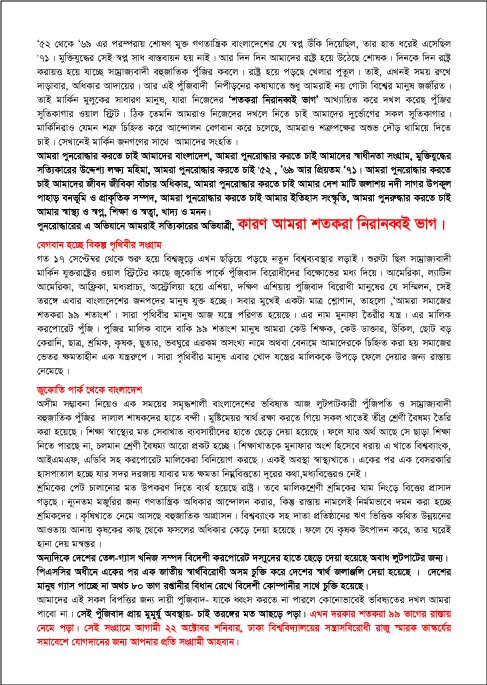
Renowned teacher, economist and activist Anu Muhammad urged everybody [bn] to join the protests to take back Bangladesh:
Click image to view the leaflet
দেশে দেশে একই শ্লোগান দিয়ে মানুষ উঠে আসছে রাস্তায়। শ্লোগানের মূল কথা দুটো; একটি, নিজের পরিচয় ঘোষণা: ‘আমরা ৯৯%’। আরেকটি, আন্দোলনের লক্ষ্য ঘোষণা: ‘দখল কর….’! কি দখল? দখল ক্ষমতার কেন্দ্র, দখল নিজের দেশ, দখল নিজের জীবন। প্রকৃত অর্থে নিজের জীবন, সম্পদ ও দেশ দখল করেছে শতকরা ১ ভাগ লুটেরা, দখলদার, যুদ্ধবাজ সন্ত্রাসী। লক্ষ্য এসব দখলমুক্ত করা। কেননা দেয়ালে পিঠ ঠেকে গেছে।[..]
ক্ষমতার কেন্দ্র অটুট রেখে সরকারের বদলে কিছুই বদল হবে না। এটা যুক্তরাষ্ট্রের শিক্ষা, এটা বাংলাদেশের শিক্ষা। মানুষ এখন তাই দখল করতে চাচ্ছে ক্ষমতার কেন্দ্র। বাংলাদেশেও মানুষকে বাঁচতে হলে, নতুন ভবিষ্যৎ নির্মাণ করতে হলে, দ্বিজোটীয় বিভাজনের ঘোরে লুটেরা, দখলদার সন্ত্রাসী শতকরা ১ ভাগের যে শৃঙ্খল, তা থেকে মুক্ত হতে গেলে এই মেরুকরণকেই নতুন রাজনীতির কেন্দ্রে আনতে হবে। বাংলাদেশে এই লড়াই নতুন নয়, জনগণের শতভাগ মালিকানায় দেশ ও তার সম্পদ প্রতিষ্ঠার চলমান লড়াইয়ের অন্তর্গত শ্লোগানই হল: আমরা ৯৯%, দখলমুক্ত কর বাংলাদেশ।
A placard. Image by Kowshik Ahmed
In every nation people are coming out in the streets chanting the same words. The slogan has two parts; one, identify ourselves: 'We are 99%'. The other part; set the goal of the movement: 'Occupy..' Occupy what? Occupy the center of power, occupy your own country, occupy your own lives. In reality your lives, natural resources and country are being controlled by 1% looters, acquirers and war mongers. Our goal is to free those because we are pressed back at the wall.
Changing the government keeping the power centers intact will not change anything. This is the learning from the US, This is the learning from Bangladesh, too. So people want to occupy the center of power. If the Bangladeshis want to live, build a new future, get themselves free from the two feuding, corrupt and occupier political alliances then they have to re-polarize the politics. This struggle in Bangladesh is not new, if the citizens want that their country and the resources will be controlled by them then the slogan of the movement is applicable to them: We are the 99%, free Bangladesh from occupation.
Bloggers and online activists expressing solidarity at TSC. Image by Kowshik Ahmed. Used with permission
An anonymous blogger at Sachalayatan describes about today's protest in Dhaka:
হাজার হাজার মানুষ ওয়ালস্ট্রিটে অবস্থান নিয়েছে কর্পোরেট তন্ত্রের প্রতিবাদে। আজ শনিবার ঢাকায় টিএসসিতে সেই আন্দোলনের সাথে সংহতি জানিয়ে একত্রিত হয়েছিলেন কয়েকশ উচ্চকন্ঠ মানুষ। [..] আজ বামধারার রাজনীতিকরা এই প্রতিবাদের সামনের সারিতে আছেন। কিন্তু এই জায়গাটা এমনকি তাদেরও না। এই জায়গাটা আমাদের। আমরা যারা বিকল্প ধারার মিডিয়াতে- ব্লগে, ফেসবুকে সচেতন হয়ে উঠছি ক্রমশ, সেই আমাদের। বাম মানুষগুলোর সাথে, তাদের পুরো দৃষ্টিভঙ্গির সাথে সহমত না হবার পরেও, সেই সচেতনতার ছাপ তাদের মধ্যে দেখতে পেয়ে, আজ আমরা 'অকুপাই বাংলাদেশ' এর সাথে সংহতি জানাচ্ছি।
এই প্রতিবাদগুলো, এই স্লোগান আর মিছিল সফল হবে কী হবে না আমার জানা নাই। ফেসবুকের ওয়ালপোস্টে আর ব্লগিঙে গতি পেতে থাকা এই নতুন প্রজন্মের আন্দোলন আগামিকাল বা পরশু সাফল্য নিয়ে আসবে কি না জানা নাই। কিন্তু একটা বিশ্বাস আছে। একদিন, ঘুমিয়ে থাকা মানুষেরা জেগে উঠবে। একদিন সবাই রাস্তায় নেমে আসবে। একদিন ১% মানুষের হাতের পুতুল হবার বদলে, ৯৯% মানুষ নিজেদের মতে চলবে। সেই দিন জেগে উঠে তারা দেখবে, তাদের আগে আমরা ছিলাম। আমাদের উপর দায়িত্ব, তারা জেগে ওঠা পর্যন্ত এই প্রতিবাদ সামনে এগিয়ে নিয়ে যাওয়া।
Thousands of people gathered in Wall Street to protest against Corporatism. Today Saturday a few hundreds of vocal Bangladeshi citizens expressed solidarity with that protest. [..] Today the left leaning politicians are in the fore front of this protest. But this place is not even theirs. This place is ours. This place is for those who are becoming aware by sharing the news and expressing themselves using the alternative media - blogs and Facebook. We do not share the ideology of the left, but we see the awareness in them. So we are with them in solidarity with the "Occupy Bangladesh" movement.
We cannot tell whether these protests, these slogans and rallies will be successful. We do not know whether this movement of the new generation generating Godspeed by posting in Facebook or blogs will bring success in the coming days. But we believe in one thing. One day, the sleeping citizens will be awake. One day everybody will be in the streets. One day, instead of being a puppet of the 1%, the 99% will be on their own. That day they will rise and realize that we were before them. Our responsibility is to carry this movement till they wake up.
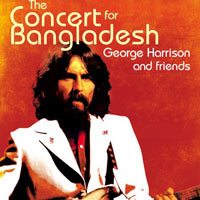
Ever since Bob Geldof and Midge Ure arranged Live Aid, a dual-venue concert to raise funds for relief of the Ethiopian famine on 13 July 1985, which was aired to 2 million viewers from 150 countries, such benefit concerts have become widely popular in the world. But in the backdrop of this event was the Concert For Bangladesh, the two benefit concerts organized by musicians George Harrison and Ravi Shankar on August 1, 1971, which is not known to many people. Bangladeshi bloggers celebrate the 40th anniversary of that epic event and tell the world why it matters for Bangladesh.
Naadir Junaid at Sachalayatanprovides the background of that historical event:
১৯৭১ সালের আগস্ট মাস; এক ভয়াল সময় অতিক্রম করছে বাংলাদেশের অগণিত মানুষ। বিশ্বের বৃহৎ পশ্চিমী রাষ্ট্রগুলি বাংলাদেশে পাকিস্তানী সামরিক বাহিনীর গণহত্যা আর ধ্বংসযজ্ঞের ব্যাপারে সচেতন হচ্ছে না। বাংলাদেশের মানুষের যৌক্তিক দাবী দমন করার জন্য পাকিস্তানী সামরিক সরকার বেছে নিলো নির্মম সামরিক আক্রমণের পথ; অজস্র বাঙালী তাদের ঘরবাড়ি ছেড়ে, কেবল প্রাণ বাঁচানোর তাগিদে ভারতে শরণার্থী হিসেবে আশ্রয় নিলো। শুরু হলো বাংলাদেশের মুক্তিসংগ্রাম। অথচ ক্ষমতাধর মার্কিন যুক্তরাষ্ট্র বিশ্বের এই প্রান্তে নিজেদের রাজনৈতিক প্রভাব টিকিয়ে রাখার জন্য নতুন দেশ হিসেবে বাংলাদেশের আবির্ভাবের বিরোধিতায় ব্যস্ত। বাংলাদেশের শরণার্থীদের আশ্রয় দেয়ার জন্য, বাঙালী মুক্তিযোদ্ধাদের সমর্থন করার জন্য ভারতের প্রধানমন্ত্রী ইন্দিরা গান্ধী তখন নিক্সন প্রশাসনের চক্ষুশূল।
It was August 1971; many people of Bangladesh were going through a terrible time. The important Western countries were not becoming aware of the repression and genocide of the Pakistani army in Bangladesh (then East Pakistan). The Pakistani army chose to militarily tackle and silence the valid demands of Bangladeshi civilians. Millions of Bangladeshis left their home to run for their lives and many ended up in refugee camps in neighboring India. But the mighty United States kept resisting the advent of a new country named Bangladesh just to maintain their political interests in this region. The Indian Prime Minister Indira Gandhi was resented by the Nixon administration because she sheltered the Bangladeshi refugees and aided the freedom fighters.
এমন পরিস্থিতিতেই ১৯৭১ সালের পহেলা আগস্ট বাংলাদেশকে সাহায্য করার জন্য বাংলাদেশের স্বাধীনতা যুদ্ধের প্রতি বিরূপ মার্কিন যুক্তরাষ্ট্রেই আয়োজন করা হয় এক অসাধারণ কনসার্ট, যা ইতিহাসে স্থান করে নিয়েছে বিভিন্ন কারণে। এর আগে কখনো একদল অসম্ভব খ্যাতিমান এবং বরেণ্য সঙ্গীতশিল্পী কোন দেশকে সাহায্য করার জন্য একসাথে কোন অনুষ্ঠানে অংশগ্রহণ করেননি; ইতিহাসে এমন কনসার্ট এই প্রথম। এই কনসার্ট অগণিত মানুষের সামনে তুলে ধরে সঙ্গীত আর শিল্পের শক্তি, যে শক্তি অতিক্রম করে যায় অনেক রাজনৈতিক শক্তিকেও। নিউ ইয়র্কের ম্যাডিসন স্কোয়্যার গার্ডেনে উপস্থিত হওয়া বহু মার্কিন তরুণ-তরুণী দেখতে পান তাদের প্রিয় সঙ্গীতশিল্পীরা তুলে ধরছেন মানবতা আর বর্বরতার পার্থক্য, আর তাঁরা সবাইকে আহ্বান জানাচ্ছেন অসহায়, অত্যাচারিত মানুষের পাশে দাঁড়াবার জন্য যখন তাদের দেশের সরকারকে বহু নিপীড়িত মা আর শিশুর ক্রন্দন স্পর্শ করছে না। রবি শঙ্কর কনসার্টে আসা অসংখ্য দর্শকদের উদ্দেশ্যে বলেন, “আমরা কোন রাজনীতি করতে আসিনি; আমরা শিল্পী। আমরা শুধু আমাদের অনুষ্ঠানের মধ্য দিয়ে একটি বার্তা পৌঁছে দিতে সমবেত হয়েছি। আমরা চাই আমাদের সঙ্গীত আপনাদের বাংলাদেশের মানুষের তীব্র বেদনা আর মনোযন্ত্রণা অনুভব করতে সাহায্য করুক”।
In this circumstance a concert was arranged on the 1st of August 1971, in the very place USA, which was not in favor of Bangladesh's Liberation War. This concert has been en-grafted in history for several reasons. Never before so many talented and popular artists had gathered to help a population, a country; such event is the first in history. This concert shows people the power of music and arts, which overshadows political powers. Many young men and women standing in the Madison Square Garden had witnessed in front of them how their beloved musicians portrayed the difference between humanity and barbarism, how they appealed to people to stand by the helpless, tortured people when their government was not being touched by the plights of the repressed mothers and the crying children. Ravi Shankar said to the crows: "We have not come for politics; we are musicians. We have gathered to spread only one message. We want you to feel the deep pain and plights of the people of Bangladesh through our music."
My friend came to me,
With sadness in his eyes,
He told me that he wanted help,
Before his country died,
Although I couldn't feel the pain,
I knew I'd have to try,
Now I'm asking all of you,
To help us save some lives
(Bangladesh: George Harrison)
Naadir remembers that the song Bangladesh by George Harrison gave him shivers and inspired him when he listened to it after 20 years and still the song produces the same reaction.
সবসময়ের শ্রদ্ধা আর ভালবাসা থাকবে এই সব গুনী মানুষদের জন্য,যাদের প্রান কেদেছিল এই আমার মাটি আর মানুষের জন্য ১৯৭১ এর স্বাধীনতা সংগ্রামকালীন সময়ে। [..]
কেন জানি বিশ্বাস হয় সেই সময়ের কনসার্টে যারাই দর্শক হিসেবে অংশ নিয়েছিল তারা সবাই ই আমাদের দেশের শুভ কামনার জন্যই জড়ো হয়েছিল।
Our gratitude and respect will forever be with these talented people; who felt and cried for our people and country in 1971, during our liberation war.
I believe that those who came to the concert had good wishes for our people.
Bangladesh, Bangladesh
When the sun sinks in the west
Die a million people of the Bangladesh
….
And the students at the university
Asleep at night quite peacefully
The soldiers came and shot them in their beds
And terror took the dorm awakening shrieks of dread
And silent frozen forms and pillows drenched in red.. (Joan Baez)
Some 40,000 peoples attended the Concert For Bangladesh and $243,418.50 was collected from the event and was given to Unicef for the war affected children of Bangladesh. The sale proceeds of the album and DVD continue to benefit the George Harrison Fund for UNICEF.
To celebrate the 40th anniversary of the Concert for Bangladesh, The George Harrison Fund for UNICEF is streaming the video of the entire concert HERE till 1 August, 2011 11:59PM EDT.
Image Courtesy Omi Rahman Pial
Omi Rahman Pial at Somewhereinblogreminds [bn] everyone of another forgotten benefit concert for Bangladesh, which took place in Kennington Oval in London on the September 18th, 1971. The advertisements for the event titled Goodbye Summer clearly stated that it was "A Rock Concert In The Aid Of The Victims Of Bangladesh". The artists included The Who, The Face (vocal: Rod Stewart), America, Mott The Hoople etc.
Mosaddik Uzzalinforms [bn] that the Bangladesh government will be awarding different merits to foreign friends who helped Bangladesh and Bangladeshis during the liberation war in 1971. The list includes musicians George Harrison, Bob Dylan, Joan Baez and Pandit Ravi Shankar among many.
Grameen Bank Office in Dhaka. Image by Flickr user Rainer Ebert. CC BY-SA
Since its launch in 1976 as a research project in rural Bangladesh, the Grameen Bank has walked a long way to become what it is now, a microfinance organization and community development bank with affiliated ventures in many countries of the world. More than three decades later and boosted by many awards including the Nobel Peace Prize (jointly with its founder Dr. Muhammad Yunus in 2006), it has expanded into a family of social organizations.
Each year many volunteers and activists from the world come to visit the Grameen organizations to learn how they work and gather first hand experiences. This summer, eight students and faculty members from the Master of Public Administration program of the Northern Kentucky University (NKU) in Kentucky, USA are completing an internship in Bangladesh at Grameen Bank. They have made numerous field visits and are recording their experiences in their blogs using texts, pictures and videos.
Beth, the MPA program editor shares her experiences in her blog “They're taking me to Bangladesh“. It was hard for her to adapt to the rural infrastructure during field visits and she commented:
Being in the country at the villages is so much different than the city. It is greener. The air is less polluted and it definitely is much quieter.
Yesterday and today we visited a school programs called Grameen Shikkha, a non-formal school program for slum children and initiative of Grameen which aim is to offer a basic education (English, Bangla, math skills, social sciences and the environment) so that when they grow older, their employment opportunities are enhanced. Odds are that without this program, these children would have no education opportunities. [..]
School runs from 2pm to 5 pm. Outside of these hours, all of these children work. Most get up early to work (around 6 am) in whatever their family business is – mostly tailoring – in this neighborhood. After class, they return and work until at least 10 pm. The work because the family needs them to as those who live in the slums earn very little (anywhere from $4 – $11 per day depending on what the children there told us their goods sold for) and need their kids to help. [..]
These kids work six days a week with this schedule. I will never complain about my workload again…can you imagine being a child and not having the time to play?
Grameen Shakti, solar powered electricity system for rural Bangladesh. Image by Flickr user Marufish. CC BY-SA
Today is our last day in Bangladesh and I can’t believe the trip is coming to an end. I’ve had such a wonderful time learning about Grameen Bank and the country as a whole. There is so much that I will miss about this country that I am hoping I have written enough, taken enough photos, and committed enough to memory to not let the things I love here escape me.
Read the NKU student blogs to learn more about the Grameen Bank and Bangladesh.
At last we see the instance of a whistle blowing incident from the US army - a classified US military video shot from an Apache helicopter. Reuters had been trying to obtain the video through the Freedom of Information Act but failed until Wikileaks.org published them online. The US helicopter gunship attacked a group of Iraqi men in New Baghdad on July 12, 2007:
Short Version
Full version (38 minutes)
Two Reuters journalists were killed and more innocent people were killed. Reddit.com analyzes the video and comes up with these conclusions:
1. The cover-up of the pilots' mistake in killing the Reuters cameramen and mistaking their cameras for an RPG is the worst thing about this episode
2. While the pilots who fired at apparently armed men (and at least 3 were actually armed) thought they were saving US ground troops who had been pinned down from men with small arms, they had less justification for firing on the van. Indeed, the latter action may have been a war crime since the van was trying to pick up the wounded and it is illegal to fire on the wounded and those hors de combat.
3. While many actions of the pilots may not have been completely wrong under their rules of engagement, nevertheless they often acted inexcusably, and their attitude is inhuman and deplorable.
The voice betrays the adrenalin of combat, but the words are clearly audible over the static. “Let me engage,” the gunner demands, “can I shoot?”
A ground controller asks: “Picking up the wounded?” Seconds later the gunner asks again: “Come on, let us shoot.”
Permission is granted and a dust cloud envelopes a van and several Iraqis picking up bodies from a Baghdad square. Only afterwards do the crew of the American helicopter gunship realise that two children, now gravely wounded, are in the van. “Well,” one says, “it’s their fault for bringing kids into a battle.”
And this is the US government's reaction:
US officials acknowledge privately that the tape was genuine, but the Pentagon has continued to argue that the pilots followed their rules of engagement and that there was no evidence that the two Reuters employees were not working with insurgents. A spokesman for US Central Command in Florida said there were no plans to reopen the original 2007 investigation, which was conducted at brigade level by US forces in Baghdad.
Teeth Maestro from Pakistan refers to the ongoing US drone attacks on Pakistan and is apprehensive about the human rights violation of the US forces.
"Then I must ask, with such a hideous track record, what assurance do
we have that they wouldn’t do that in Pakistan."
A Sri Lankan blogger analyzes this video and defends Sri Lanka's war crime against LTTE by naming USA and a hypocrite and asserting that "they have no right to judge us" as they also have blood on their hand. I can see where the world is heading.
Hurt Locker is neither adventurous nor cutting edge, and not much better aesthetically than a TV show like CSI. Ultimately it’s a really boring movie with bad dialogue that poorly fleshes out a series of tension and release sequences that draw on music video and video game aesthetics. It is full of cliches about poor American soldiers who cannot make sense of a chaotic environment not of their choosing as they enter the labyrinth of a surreal war landscape populated by an alien Other. Framed as an “American tragedy,” once again an invaded country becomes a purification drama for Hollywood’s liberal consciousness.
The draw-down from Iraq includes the withdrawal of approximately 128,700 U.S. troops, over 115,000 contractor personnel, the closure or transfer of 295 bases, and the retrograde of over 3.3 million pieces of equipment.
Yesterday Senator Edward Moore "Ted" Kennedy (February 22, 1932 – August 25, 2009), the second most senior member of the US Senate, died of cancer. Here is how Bangladesh prime minister Sheikh Hasina expressed her reaction:
The prime minister in her message recalled the unstinting support of the senator to the war of independence from Pakistan and his role in mobilising world opinion for Bangladesh.
"The people of Bangladesh will remember his contribution forever."
She said in his death Bangldesh lost a real friend.
In her condolence message, Khaleda Zia (the leader of the opposition) said, "The late senator was a humanist and democratic personality. The people of Bangladesh will remember him forever for the role he played in mobilising world opinion in favour of Bangladesh liberation war".
She sympathised with the members of the Kennedy family.
"The United States has lost a great leader in the death of Senator Kennedy and the people of Bangladesh have lost a real friend".
After the invasion of East Pakistan (also called East Bengal, now called Bangladesh) by West Pakistani forces in the spring of 1971, some 9,000,000 refugees streamed across the border into India. The world and the United States (Nixon/Kissinger mired in Vietnam, famously "tilting" toward West Pakistan) took little note. All except the 39 year old senior senator from Massachusetts, Edward M. Kennedy.
In the brutal heat and monsoon muck of August, Senator Kennedy traveled to refugee camps throughout West Bengal (the neighboring Indian state) and reported back to the Senate in an extraordinarily passionate document (1) about the plight of the refugees in India and what he called the "reign of terror which grips East Bengal."
He concluded:"America's heavy support of Islamabad (West Pakistan) is nothing short of complicity in the human and political tragedy of East Bengal."
Kennedy not only bore witness, he jolted the world into taking notice and aiding the refugees if not the independence fighters in East Bengal.
Bangladesh gained its independence in December, 1971 after Pakistan was defeated in a short and brutally effective war by India. Senator Kennedy returned to India and now Bangladesh in February, 1972. The United States had so far refused to recognize the new nation (see Kissinger's extraordinary memo). Kennedy called for its recognition. He was lionized in Dhaka, the capital, with cries of "Joi Kennedy" (Hail, or literally, Victory to Kennedy) as well as in Calcutta, India, when he revisited the refugee camps.
Senator Kennedy has remained a steadfast friend of Bangladesh and India. In fact, there is a move to recognize him officially as a Bangladeshi hero, along with the late George Harrison, who had organized the 1971 Concert for Bangladesh, the archetype for such benefits in later years.
During the Bush era the West distanced itself much from the Muslim world. Here is Obama's approach to reconcile with the differences and lending a hand towards a new future.
Some excerpts:
I have come here to seek a new beginning between the United States and Muslims around the world; one based upon mutual interest and mutual respect; and one based upon the truth that America and Islam are not exclusive, and need not be in competition. Instead, they overlap, and share common principles – principles of justice and progress; tolerance and the dignity of all human beings.
I do so recognizing that change cannot happen overnight. No single speech can eradicate years of mistrust, nor can I answer in the time that I have all the complex questions that brought us to this point. But I am convinced that in order to move forward, we must say openly the things we hold in our hearts, and that too often are said only behind closed doors. There must be a sustained effort to listen to each other; to learn from each other; to respect one another; and to seek common ground.
Sujatha says "The speech is most definitely worth a read and worth sharing with our children."
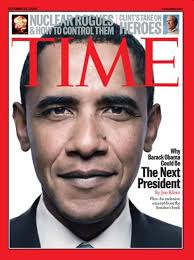
Time magazine named US president-elect Barack Obama its 2008 "Person of the Year.
I think this is one selection everybody around the world will agree. There was a survey once which showed if the world could vote, Obama would win over McCain in a landslide. So no surprises here.
It's unlikely that you were surprised to see Obama's face on the cover. He has come to dominate the public sphere so completely that it beggars belief to recall that half the people in America had never heard of him two years ago — that even his campaign manager, at the outset, wasn't sure Obama had what it would take to win the election. He hit the American scene like a thunderclap, upended our politics, shattered decades of conventional wisdom and overcame centuries of the social pecking order. Understandably, you may be thinking Obama is on the cover for these big and flashy reasons: for ushering the country across a momentous symbolic line, for infusing our democracy with a new intensity of participation, for showing the world and ourselves that our most cherished myth — the one about boundless opportunity — has plenty of juice left in it.
US president elect Barack Obama received a clear mandate from USA and with the support of the world became the first Democrat to win a majority of the popular vote since 1976. Here are some of the interesting reactions found around the web:
Everything in my life is exactly the same as it was 30 minutes ago; and yet I feel as though everything is different.
I know Obama isn't going to fix the economy overnight, I know he won't be able to provide healthcare to all Americans by February '09. I know Obama isn't a Messiah who four years from now will have turned this country into a fabled utopia. But I also know Obama will make moral decisions. I know Obama will try to unite where others try to divide. I know Obama will help to make America the beacon of hope it once was to others. I know that at 27 years of age, I witnessed one of the most important and hopefully glorious chapters in American history.
Tears surged in my eyes as I left the polling place. This change is not the product of a brilliant fundraiser's fancy marketing campaign, but a very real transformation among people as they have moved through space & time and shared experiences with each other. If a black man with the middle named Hussein can become President of the United States of America, anything is possible.
Forty years after Martin Luthor King gave voice to his dream, American voters have, by the many millions, judged a black man by the content of his character. I worry they are wrong on the substance and will argue like hell against his philosophy and policies, but I can also be happy that it happened and hope that Barack Obama governs as well as he campaigns.
Who among us is not at a loss for words? Tears pour out. Tears of joy. Tears of relief. A stunning, whopping landslide of hope in a time of deep despair.
In a nation that was founded on genocide and then built on the backs of slaves, it was an unexpected moment, shocking in its simplicity: Barack Obama, a good man, a black man, said he would bring change to Washington, and the majority of the country liked that idea. The racists were present throughout the campaign and in the voting booth. But they are no longer the majority, and we will see their flame of hate fizzle out in our lifetime.
The racists may not be a majority but their bites can still be felt.
Robert Spencer writes in Human Events that "Americans should be made decidedly uneasy by this Muslim enthusiasm for the new President." I guess in his eyes there are Muslims only. The KKK aren't too happy about the election of Barack Obama as President of the United States. We hope that they will not be a majority again.
The US presidential election was closely watched by many nations in the world. Bangladesh was not far behind. In a recent post in Voices without Votes we see how Bangladeshi blogs engaged in cheering for Obama and McCain.
What impact the victory of the US presidential elect senator Barack Obama had on Bangladesh? Back to Bangladesh is a blog of a Bangladeshi who came back to the country after living many years in USA. The blogger writes about the sentiments this great victory produced:
Today was a very special day for anyone who loves America.
Grown men cried tears of joy, not just in America, but also in many other parts of the world.
Dhrubo Hasan writes a poem in his blog at the Bangla blogging platform Sachalayatan:
বারাক ওবামা, আমার এই ক্ষুদ্র ৩২ বছরের জীবনে সবচেয়ে বড় আশাজাগানিয়া মানব তুমি! …তোমায় স্বাগতম!!
Barack Obama, in my short span of life of 32 years you are the greatest man I know who brings hope .. you are welcome!!!
When I woke up today, walking on my way to office, I felt different, nothing was literally different, same people, same crowd, same city, same roads…still I smell something different in the air, I felt a change has started happening. I don’t know if it’s the believe that things will change with Obama’s powerful presence as a President or something is really around! But I strongly felt a vibe, I could foresee a better nation, a better future for America - the land of opportunities.
Tanim from Bangladesh writes in My Bangladesh about the amazing phenomena this election revealed:
“In this match of Donkeys vs. the Elephants, we saw an optimistically turbulent evolution where many recognized red states turned blue. And this was because, it was a win for people who seek change, a win for the youth deeming a message of unity from Obama, a change for US citizens from all the different color, creed, race, belief and communities – I haven’t seen a more unified United States of America until now.”
Tanim adds that this will have an impact in the coming parliamentary elections in Bangladesh on December 18, 2008:
He motivated and engaged young people from all walks and the middle-class of the United States, successfully mobilized them and created such an inspirational upsurge of youth takeover worldwide that I believe that this effect will be strongly felt in the upcoming polls here in Bangladesh as well.
Now we can proudly say that it’s not only ‘Obama for America’ but Obama for the World and let me be hopeful and emotional while saying ‘Obama for Bangladesh’ as well.
People say that the Obama story is possible in America, and only in America. Can it be replicated in Bangladesh? But then again Bangladesh needs a leader who can unite the parties.
Back to Bangladeshreminds what lessons Bangladesh could learn from this election:
And let's hope the Bangladeshi politicians learn a little from the grace that McCain showed:- none of that “hey to churi koira jitya gesey (to the opposition -he has won by vote-fraud)” stuff in December, ok?