Dragonfly

Image by Rezwan

Overcrowded passenger ferry capsized in the Padma River in Munshiganj, Bangladesh

The World Cup Goal-E Project

This street in Bangladesh has a colorful world cup celebration

New Chum Hill Ruins

Remnants of Kiandra gold mine at New Chum Hill, #nsw #australia

Showing posts with label Technology. Show all posts

November 14, 2014

The Google Bus Is Bringing Internet Skills to Half A Million Students in Bangladesh

Screenshot of Google Bus from the Intro Video on YouTube
Screenshot of Google Bus from the Intro Video on YouTube (click to watch the video)
A team from tech giant Google is driving across Bangladesh to teach half a million college and university students throughout Bangladesh how to make the most of the Internet. The specially retrofitted Google Bus powered with 3G mobile Internet will visit 500 campuses in 35 locations across the South Asian country.

More and more people in Bangladesh are going online, thanks to 3G mobile Internet. In last two years, Internet penetration jumped to 20 percent from just 5 percent in 2012. These new users, especially young people, do not have adequate training to harness the potential of Internet and new media.

The Google Bus initiative seeks to change that, not only allowing students to connect to the Internet but also learn about new tools that aid their education and development and attend instructor-led training sessions. Students involved in the project will also be able to use a number of Internet-connected Android devices.

The bus has already visited several colleges and universities in the capital Dhaka. In the coming months, it will start its journey towards academic institutions in and around Chittagong, Khulna, Sylhet, Rajshahi, Rangpur, Barisal and other major cities.

Netizens have expressed their enthusiasm for Google's initiative:
Many students have shared their experience on the Google Plus community page. Murad Hossain from Adamji Cantonment College posted:
The Google bus team came to our #ACC college Campus..It's just great :) Though it's new to me but feeling excited. Hope in Bangladesh it will spread soon and gain popularity...
Orpita Ahmed (Bristy) wrote:
Hi, I'm bristy from tejgaon college. I like Google Bus. It is very essential for our daily life. So I like it very much.
On Bangladeshi blog Jhalmoori, Ahmed Rabib Towsif explained the significance of the Google Bus:
Google as we all know by their search engine is a multinational company with a mission to organize the world’s information and make it universally accessible and useful. With the Google Bus Bangladesh initiative it would not only benefit the youth from today, but benefit the whole country tomorrow.

The post was also published in Global Voices Online.

October 02, 2014

Mobile Apps Put Durga Puja at the Fingertips of Millions

Durga Puja, the annual Hindu festival that involves worship of the Goddess Durga, who symbolizes power and the triumph of good over evil in Hindu mythology. Image by Luit Chaliha. Copyright Demotix (27/9/2014)
During Durga Puja, an annual Hindu festival in West Bengal and other parts of India and Bangladesh, worshippers erect elaborate makeshift structures called pandals. Inside each of these structures, there is a stage on which a statue of the Goddess Durga mounts a lion while wielding ten weapons in her ten hands. The pandals depict Durga's victory over the evil buffalo demon Mahishasura. Afterwards, Durga is invited to visit her maternal home and there is an invocation by "Mahalaya" (chanting and singing devotional songs). Goddess Durga then visits home and Bengalis celebrate, worship, and enjoy the five days of Durga Puja. (Read more about this legend here.)

The highlight of the Puja festivities is viewing the many different displays of Goddess Durga, each of which has a unique theme. "Pandal hopping" has become a part of the popular culture, and people sometimes visit hundreds of pandals in large cities like Kolkata. During the week of Durga Puja, life comes to a complete standstill, as roadblocks, traffic management, and fun-fare to the sound of drums chants and devotional songs take over.

This year, there are several mobile apps available to make pandal hopping better planned and more informed than ever. Indians' growing tech savviness has brought mobile computing to new spheres of life. Apps that help navigate religious and cultural festivities are now at the fingertips of millions in India.

In this article, Global Voices look at some of the mobile apps related to the Puja festivities. The apps fall into four basic categories:

1. Virtual Puja-hopping experience:

Blogger Agnivo Niyogi writes about the Android App Durga Puja Parikrama:
The lights, pandals, chaos on the streets, hyper-active Kolkata Police, food, and above all the spirit of togetherness – these define Durga Puja in the truest of terms. Sadly, for Probashis (and Bengal-lovers who cannot visit Kolkata during Pujo) often give this opportunity a miss because of the physical distance. [..]

The interactive Durga Puja app will help you to:

-Find out location and other details of Durga Puja Pandals around
-Check ratings and comments by other users
-Check the pictures of the Durga Puja pandal uploaded by other visitors.
-Search Durga Puja pandal by popularity or traditionally well-known.
-Create a wishlist of pandals
-Share which Durga Puja pandals you have visited on social network.
-Upload your picture, make your comment or rate a Durga Puja Pandal you visited.
-Get important news and updates from Kolkata Police and West Bengal Government.
Durgotsava Puja Parikrama is a similar app offering map-navigation features and GPS-tracking to aid users in Puja hopping. It also provides information about nearby services like cash machines, public transport, restaurants, medical services, and so on. Puja Hoppers is another such app.

Durga Puja Pandal Hopper also allows users to add their own pandal information and maintain a travel budget.

Another app in this group is The Puja App, which offers 360-degree interactive virtual tours of pandals. Users can vote for their favourite pandals. Virtual tours are only available for older pujas from before 2013, the app also offers a map with some of the current puja locations.

Bengali House wifes play "Sindur Khala" on the last day of the Durga Puja festival at Kolkata in India. Image by Reporter #7585286. Copyright Demotix (14/10/2014)
2. Puja-related updates:

The Big Green Durga app is an initiative from 92.7 BIG FM Kolkata, a radio channel, which describes it as the perfect way to get around congested streets:
The app is a great utility as during puja this will be your news channel on all the Roads that are blocked, all the awarded Pujas you must see and all the celebrities who are visiting different Puja Pandals so that you can have a real glimpse of them. The data will be live and updated by 92.7 BIG FM Kolkata.
Durga Puja is another app in this group. It educates users about Durga Puja, the importance of each day of the celebration, the legends therein, how puja is performed, what is required for each day, and the datse and proper puja timings according to the Hindu calendar. The Durga Puja Organiser apps, as the name implies, help worshippers plan their puja celebrations.

The Navratri Durga Puja Sangrah app has a collection of puja-related songs, aarti, and mantra (prayers) in both audio and video formats, which can be performed when making puja offerings.

3. Puja locators:

These apps help users find all the nearby pujas.

Available on iOS and Android, Puja Locator was not designed specifically for Durga pujas. It was made for pujas held in the Maharashtra region. Mandapp provides information about the various puja pandals in Kolkata.

Kolkata Puja Guide and Map makes it easy for people to find a route to select puja pandals. Durga Puja RoadMap 2014 is a similar app with navigation features.

4. Virtual Puja offerings:

These apps allow users to offer virtual pooja (prayers) to Maa Durga Devi. Maa Durga Pooja offers a complete pooja experience to users. Durga Pooja is another app which lets you to worship the lord goddesses through aarti and garland.

There are undoubtedly many other useful apps out there for the Puja festivities. If you know of any not mentioned here, GV invites you to mention it in the comments below this post.

One of the idols of Devi Durga is ready for immersion on the Ganga river in Kolkata. Image by Suman Mitra. Copyright Demotix (14/10/2013)
The Durga Puja ends by immersing Maa Durga's idol in water and chanting "asche bochor abar hobe" (It will happen again next year). Thanks to the the growing supply of Durga Puja apps, however, worshippers don't have to wait a whole year anymore. The virtual experience of Durga Puja is forever at the fingertips of anyone who wants it.
Aparna Ray contributed to this post.

The post was also published in Global Voices Online.

September 25, 2014

How Climate-Smart Villages in Bangladesh, India and Nepal Are Preparing Farmers for the Future

56 years old Kamla Devi listens to messages of weather and best climate friendly crop practices on her mobile phone while working in the cowshed at her home in Anjanthalli. Image by Prashanth Vishwanathan. Used with permission.
56-year-old Kamla Devi listens to messages about the weather and best climate-friendly crop practices on her mobile phone while working in the cowshed at her home in Anjanthalli village. Image by Prashanth Vishwanathan. Used with permission.
One of the initiatives to come out of the United Nations' summit on climate change on September 23 was the Global Alliance for Climate-Smart Agriculture, a group of 16 countries and 37 organizations that aim to enable 500 million farmers around the world to practice climate-smart agriculture by 2030.

What is climate-smart agriculture? It's the idea of helping farmers adapt to changing climates while weaning them off techniques and technologies that produce greenhouse gases. In a number of countries in Africa and Asia, Climate Change Agriculture and Food Security (CCAFS), a research program of CGIAR (a global partnership dedicated to agriculture research), has already set up "climate-smart villages" to put the idea into practice.

Farmers in northern India have grown used to a wide range of weather, and work their fields around monsoon seasons that regularly bring them torrential rains. But as climate change begins to change the weather, scientists predict that growing conditions in the country are likely to become even more challenging and could alternate abruptly between periods of severe rainstorms and drought, according to the group.

In response to the farming challenges brought on by climate change, Climate Change Agriculture and Food Security (CCAFS), together with the International Maize and Wheat Improvement Centre and partner organizations are introducing a portfolio of climate-smart agriculture practices and technologies in their climate-smart villages.

Paramjeet Singh uses the “Green Seeker” to check the nutrient levels of his paddy fields in Uncha Samana. The device helps him decide the most appropriate dosage of nitrogen fertilizers (Urea) for his crops.
Paramjeet Singh uses the “Green Seeker” to check the nutrient levels of his paddy fields in Uncha Samana. The device helps him decide the most appropriate dosage of nitrogen fertilizers (Urea) for his crops. Image by Prashanth Vishwanathan. Used with permission.
Researchers, farmers’ cooperatives, government bodies and private sector partners are working together at these villages to identify which agriculture practices and technologies can improve productivity and incomes and build resilience to climate risks. “Climate-smart” agriculture is highly localized; interventions that work in one place will not necessarily be suitable for another.

In India the project is undertaken currently in Haryana, Bihar and Punjab. The same model also operates in Khulna, Bangladesh and Rupandehi in Nepal. This video explains the idea behind the villages:


In the climate smart villages in India, farmers have begun to alter their use of mobile phones, the Internet, and basic measurement devices to adapt to the changes initiated by climate change, according to CGIAR. An interesting aspect is that farmers are actually not talking much about climate change, but rather are engaging themselves in alternative and innovative practices. The money that they are saving by doing things like using new planting methods for rice that reduces the amount of labor and water needed are resulting in a significant cost savings, CGIAR says.

Harpreet Singh checks the water level through a Tensiometer in his paddy fields in Birnaryna as a part of the Climate Smart Village (CSV) programme.  Image by Prasanth Viswanathan. Used with permission
Harpreet Singh checks the water level through a Tensiometer in his paddy fields in Birnaryna as a part of the Climate Smart Village (CSV) programme. Image by Prasanth Viswanathan. Used with permission
Under the project, voice and text messages are sent to farmers twice a week in Hindi or in other local language. The text messages include information on weather forecasts and suggestions for farmers, information on pests and remedies, etc. Last year messages were sent to 1,400 farmers in 50 villages in Karnal and Bihar and 10 villages in Punjab, according to the group.
Farmers are being encouraged to improve their nutrient management, for example through the use of a leaf color chart:


27 year old Vinod Kumar (L) uses the Nutrient Expert computer programme to ascertain his farms nutrient needs being part of the Climate Smart Village programme in Anjanthalli. Image by Prashanth Vishwanathan. Used with permission.
27-year-old Vinod Kumar (L) uses the Nutrient Expert computer programme to ascertain his farms nutrient needs being part of the Climate-Smart Village programme in Anjanthalli. Image by Prashanth Vishwanathan. Used with permission.
The CCAFS South Asia Program has also successfully implemented a climate insurance program as part of their climate-smart village model to save farmers from losses due to failed crops as a result of natural calamities.

The success of the models in India has prompted replication of the initiative under climate smart village in various South Asian and African countries. The CGIAR's blog narrates a lot of initiatives and challenges that the climate-smart villages face.

The post was also published in Global Voices Online.

August 19, 2014

Google Is Tracking and Recording your Location

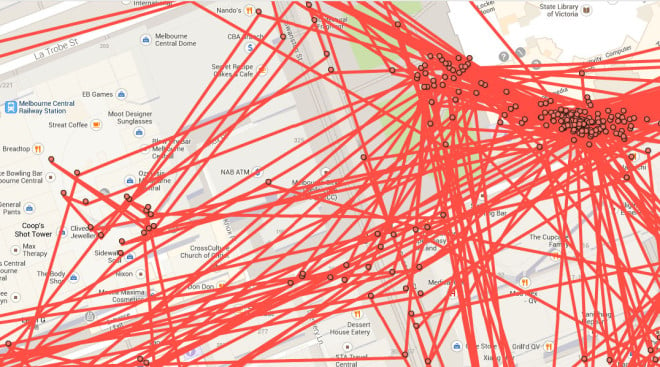
Elizabeth Flux at Junkee.com uncovers a truth many of us smartphone users fail to realize. By allowing our smartphone to find out our location we are letting services like Google maps to record our movements. Here is a typical map of movements you will find from here:

Image courtesy Junkee.com
If you login at this site with the same Google login you use for your smartphone you will be able to find your Data updated daily. You will be surprised with some of the entries and wondering did I actually go there? Apparently due to loss of network coverage and the GPS not being turned on it records approximate location values. So don't rely on it to be used as a proof of something or an alibi.

Some of you may find that there is no data. And yes you did not turn the 'location services' in your phone on. So knowing this give you an advantage - you can be visible or simply switch your existence off from such services. The problem is that many apps and services (like Google now or Nike+ Running App) works only if you have the location services turned on.

So will we be able to control dissemination of our information? Apparently there is hope as you can delete your Google location history and you can opt out from location services.  

August 06, 2014

Students in India Have Developed a "SmartCane" for the Blind

Screen Shot SmartCane
Screenshot from the video explaining how SmartCane works
The marriage of two technologies can achieve awesome things. Students at IIT Delhi are certainly making an impression with a new invention, the SmartCane, which enhances one of the world's oldest instruments—the walking stick—by adding SONAR, a technique used to navigate and communicate underwater, to help visually impaired people to walk independently.

One out of every three blind people in the world (an estimated 15 million) lives in India. There are approximately 2 million blind children in India and only 5 percent of them receive any education.

Visually impaired people face no shortage of problems in India, where disabilities can be especially challenging. Pedestrians are often forced onto the street, as sidewalks are cluttered with vendors, animals, and other obstacles. Blind people typically use canes, of course, but the traditional cane cannot detect objects higher than one's waist. Inventing an affordable and simple tool to aid the visually impaired has been a priority for many researchers across the world. Innovations like Roshni, also developed by students at IIT Delhi, are promising, but suffer from various logistical issues that make large-scale production impractical.

Professor Meenakshi Balakrishnan, a computer engineer at the Indian Institute of Technology in Delhi, lead a team of researchers and students to develop SmartCane, which emits ultrasound waves to detect nearby obstacles and vibrates to warn the user. It was officially launched last March. SmartCane copies the skills of animals, like bats, which also emit sonar calls into their surroundings and guide themselves using echoes. The vibration is much better than an audio alert, moreover, because sound may not be audible on noisy streets.
Unlike a similar British innovation, the $985-USD UltraCane, the SmartCane is affordable at just INR 3000 (about $50).

The video below depicts a typical day in the life of a SmartCane user, portraying the various challenges one faces:


The field stage validation trial of Smartcane was conducted among approximately 150 users in 6 cities in India of which almost all are now regular SmartCane users. The training/learning material for SMartCane is available for download in Hindi and English in different formats like epub, daisy, braille, clear print, etc.


According to the Facebook page of SmartCane, the device is being provided to the under privileged visually impaired in Punjab for INR 400 only under the Partial Subsidy Scheme aided by the National Donation Pool.

Right now the SmartCane is available to the user from a network of over 16 welfare organizations for the blind across 12 states in India. Here is a video of a SmartCane use of a College girl:


The Better India magazine lists some user comments:
“It is a very useful device because earlier with a regular cane, I quite often collided with vehicles like truck, tractor or bus. This was because my cane would pass beneath these big vehicles and I would collide abruptly. I have got injuries on my forehead due to such incidents. With this device I get a pre-warning of such dangerous obstacles through vibrations. This also helps me in detecting street animals such as a cow.” - Ketan from Ahmedabad

“It feels great to be able to move around alone. I no more take help from people to move around. I now enjoy being all by myself. Family and friends now have the confidence in me that I can travel independently without getting hurt or injured.” - Indrani from Mumbai
Recently, celebrities like Bollywood Actress Vidya Balan have come forward to publicise the SmartCane.
As the SmartCane's publicity grows, so too will its user base hopefully expand, putting this ingenious new device in the hands of more and more people.

The post was first published in Global Voices Online

May 27, 2014

Creating Biogas from Water Hyacinth

Water hyacinth (water weed) is a menace in Bangladesh which restricts water flow and blocks sunlight in rivers and ponds contributing to contamination and killing of fish. Instead of spending much in removing or eradicating them they can be used for a good cause. Kristin Boekhoff at Panigram blog informs about an innovation in Jessore, Bangladesh which will be the first commercially operating biogas reactor running off of water hyacinth in the world.

The post was first posted in Global Voices.

August 27, 2012

How To Activate DISQUS Commenting System in Blogger instead of Haloscan Echo

When I first started my blog in blogger in 2003 its comment system was not great. Haloscan (est. in 2002) was one of the third-party blog comment hosting services available in those days and I guess in 2005 I started using Haloscan. Haloscan was acquired by JS-Kit in 2008 and was renamed Echo in 2009. The users of Haloscan were forced to switch to JS-Kit Echo paying a fee. I could go back to blogger's own commenting system which became mature by then. But one problem was how to retain the hundreds of comments I had received back then. So I decided to switch to Echo.

In April 2012 Echo announced that Echo would discontinue JS-Kit, Haloscan and Echo comment modules from October 1, 2012 in favor of social media applications.
As many of you know, in late 2010, Echo decided to shift our product strategy and start offering a real-time platform as opposed to strictly a commenting application. Since then, Echo has evolved our original commenting solution into a new business model that provides a real-time platform for social tv, social news, social music and social commerce. As such, we unfortunately can no longer commit to the level of support that you have come to expect on our original commenting product.

 Now the challenge for me was to find a new commenting service or go back to the blogger's own commenting system. And the previous concern was there too that whether I can retain all previous comments on my blog. A great savior was DISQUS which I first saw embedded in Global Voices site. It has a lot to offer.
Disqus (est. in 2007) is an online discussion and commenting service for websites and online communities that uses a networked platform. The company’s platform includes various features, such as social integration, social networking, user profiles, spam and moderation tools, analytics, email notifications, and mobile commenting. (Wikipedia)
Disqus is written in JavaScript and is powered by a back end primarily written in Django. It is supported by all major webbrowsers. So how to switch to Disqus, if you are a Haloscan user in Blogger? First read this quick start guide and create an account in Disqus, register your site and create a short name for your site. Then install Disqus in your site according to platform specific instructions.

img

Now the best part - here is a step by step guide for importing previous comments from JS-Kit (first you have to export them from JS-Kit and yes within September 30, 2012). After uploading Disqus will take upto 24 hours to process all your previous comments. I am yet to see the result of the import. But here is to hoping that I don't lose much.

p.s. If you want to do it manually in Blogger then this may help.

May 15, 2011

What else can you do with your mobile phone:

* Short Message Service (SMS)
* Bluetooth/Wifi/infrared
* Camera
* Multimedia Messaging Service (MMS)
* Email
* Games
* Radio (FM/Internet)
* MP3 player
* Video
* Banking
* Print pictures
* Get directions via GPS
* Have your text messages/emails read back to you
* Scan in a business card
* Calender /To Do /Notes
* Alarm clock
* Get general information
* VoIP
* Purchase goods
* Work with office documents/spreadsheet/presentation
* Work as a torchlight

Via Netsquared

January 08, 2011

Google Bangladesh Page Hacked And A Probable Solution


When hackers make a breaking news headline it tells a lot about the security infrastructure and knowledge about internet security. This is from BDNews24.com, the leading Online news website in Bangladesh:

Hackers have broken into the Bangladesh site of leading search engine Google, internet service experts said Saturday evening.

"The site has definitely been hacked," said Pradip Dey, chief technical officer of ADN, a leading ISP.

"A couple of other ISPs have also got similar complaints from their clients." [..]

Attempts to access the site by users are rebounded with message reading," Google Bangladesh OwN3D by TiGER-M@TE.

In some parts, however, the site is still being accessed as ISPs cache top sites for user convenience.

But, internet surfers, who use connections of GP and CityCell, are still getting access.

I noticed this a while ago when I failed to access gmail and Tweeted about it. Twitter is a resourceful network (if you have resourceful followers :) ). Shawn Ahmed of Uncultured.com came to my rescue. Here is his solution:

Shawn Ahmed: Okay I think I have a solution for those affected in Bangladesh by the hack of Google. It looks like the hack is targeting @OpenDNS.

Shawn Ahmed:

So @google is still up and running, but OpenDNS points to a hacked page. Deactive @OpenDNS and you should be fine.

Shawn Ahmed:

If your ISP in Bangladesh uses @OpenDNS, you can bypass by manually overriding and using 8.8.8.8 and 8.8.4.4 as your DNS servers instead.

And soon I Tweeted:

Voila! Deactivated Opendns and I am accessing Gmail right now..

So if you are still unable to access Google sites you can try the above settings. Please do let me know if you are still facing problems.

October 24, 2010

Walkman (1979-2010): The End Of An Era


I remember, it was in 1985 when I first used one of these and it soon changed the way I listened to music. The mp3 players (and now my smartphone) have only emerged in the past decade. I had fun with it and interesting is that it is probably lying somewhere among the junks a boy produces to reminisce after decades.

Its sad to hear that Walkman will no longer be produced by Sony after selling 200 million of these cassette tape models. However, the company will still be manufacturing manufacturing CD and memory module based Walkmans.

The device was built in 1978 by audio-division engineer Nobutoshi Kihara for Sony co-chairman Akio Morita, who wanted to be able to listen to operas during his frequent trans-Pacific plane trips. (Metafilter)

Thank you Walkman, you were a trend setter.

Image courtesy: Crunchgear

September 16, 2010

Why we need online RSS reader clients


Ever since I started to use rss readers it changed my life. Earlier I used to read newspapers regularly by actually going to the sites. But instead I subscribe to certain newspapers and certain keywords in Google search and I can follow news or opinions targeted to a specific region or community at ease.

However, it seems rss could not appeal to many people who want more dynamic and updated information. Twitter, Facebook etc. provided them with more real time information withing the community. I have nothing against them but have doubts whether they will ever cater my special needs as Twitter updates are not stored somewhere to get hold on to. Your only option is to search and you get information overload and might miss the actual news.

I didn't even notice that people are talking about the death of rss readers. I realized after Bloglines announced that it is going to shut down on 1st of October, 2010. I should have seen it coming as there were reports suspecting the demise of Bloglines.


Bloglines quoted Steve Gillmor as a reason for their decision:

..being locked in an RSS reader makes less and less sense to people as Twitter and Facebook dominate real-time information flow. Today RSS is the enabling technology – the infrastructure, the delivery system. RSS is a means to an end, not a consumer experience in and of itself. As a result, RSS aggregator usage has slowed significantly, and Bloglines isn’t the only service to feel the impact.. The writing is on the wall.


And more so it struck to me as I tried to switch to a suitable rss reader replacement. I already use Google reader for monitoring Rising Voices Projects and keeping an eye on the development of new media in general. So I have tried for other online rss reader options (to access from anywhere) and found that Wasabi, Rojo, Newsgator - these services does not exist anymore. Pluck went down in 2007 and the rest of them followed.

Now we need to give a serious thought on what should be the way forward. Why should I invest my time in Google reader if it is going to shut down in near future? Mathew Ingram argues that rss is not dead, but but merely evolving. But we need more online based services so that we do not feel like we are pawn to Google's free service monopoly.

Does anybody have a suggestion which online rss reader client can I use except Google Reader?

July 15, 2010

Red Herrings Awards In Asia - An Important Event To Watch

Asia is generally perceived as a tough ground for Technology startups as there are many barriers for the entrepreneurs and often they complain about slow returns. But analysts say that Asian tech startups are still worthwhile investments.

Red Herring Inc. is a media company since 1993 "whose mission is to cover innovation, technology, financing and entrepreneurial activity." It is based in San Mateo, California. For over a decade technology industry executives, investors, and strategists have valued the Red Herring 100 lists as an instrument for discovering and advocating the most promising private ventures from around the world.

Red Herring has been organizing Tech Startup awards since long and this year they are again organizing the Red Herring 100 Asia awards which will highlight the exciting startups in Asia.

Chip Huyen from Vietnam writes:

I’ve heard of Red Herring for quite a while, both good and bad things. Though I wouldn’t say that it’s the most prestigious award in the field, nor try to compare it with Tech Crunch Award, I think it’s a great exposure for local start-ups to be in the list. The award event is also a precious opportunity for ambitious young entrepreneurs to meet, exchange ideas and find partnership opportunities with other entrepreneurs, venture capitalists as well as other big names in the region. As stated on their website, “Red Herring 100 Asia will bring together 300 C-level technology entrepreneurs, corporate strategists, and venture financiers from across the continent.”

The last date of submission was June 30, 2010. However they have contacted me to provide some tips about some upcoming startups from South Asia. I have sent them contact details of few startups from Bangladesh and India.There are some interesting startups like Leevio which needs Venture capitals to go on a big scale.

From Young Upstarts:

On August 10th to 12th, around 300 C-level technology entrepreneurs, venture capitalists and corporate strategists from all around the world will gather in Hong Kong to celebrate the accomplishments of Asian technology companies and entrepreneurs in the past year at the leading technology event organized by Red Herring.

The conference will also highlight some of the latest, exciting cutting-edge Asian technology startups, who will be carefully selected by Red Herring‘s vaunted editorial team. The agenda, over three days, will be comprehensive: exploring the market’s appreciation of innovation as a fast-track to success, discovering how Asian firms are leading the charge in many tech sectors, as well as discussing the drivers for successful entrepreneurship in Asia, and demonstrating how innovation is creating business opportunities for challengers and incumbents alike.

If you’re interested to be an attendee, you can register for the event here.
I hope we will see many interesting ideas and exciting startups from Asia highlighted this year.

July 04, 2010

Voice Of The Tribals


CGNet SwaraSwara, is a mobile-based news service which enables the tribals of Chhattisgarh in India to tell their version of stories, in their language. It is an initiative of former journalist Shubranshu Choudhury which gives daily news snippets of a region that is typically ignored by the mainstream media.

The South Asian reports:
Dial 080-40952044 and you are transported to another world in a village in Chhattisgarh’s Rajnandgaon. A reporter, Bhanu Sahu, tells you how women panches in a village are not getting payments under the National Rural Employment Guarantee Scheme as their names are not in the muster roll. She says male panches are getting paid even without working under the scheme. The reporter says this is the state of affairs in other parts of the district too where genuine payment claims are being denied.

In barely two minutes, you listen to the story of this far-away village as mobile-based news service.

In Chhattisgarh only 0.7 per cent of the population has internet access and many people are illiterate. So only logical measure was deploying a technology which is already available - mobile phones.

Indian Tribal Blog informs:
There are no tribal journalists in the mainstream media in Chhattisgarh. The number of journalists who speak any of the tribal languages are very few. The major media in the state are owned by people with interests in coal, power and steel. That shapes how they report the public hearings that are frequently held on locating projects in a particular area. “The owner, writer, reader — they are all on the same side of this war.” Radio is the ideal medium for a state with a population scattered across a forested interior, but All India Radio has no news service in a tribal language.

How do you democratise journalism? By getting people to give their own news, even if the only language they speak is Gondi or Kuruk. By designing a telephone news service with moderators who will both vet incoming stories, and translate them into Hindi. So in February this year C G Swara went into operation, Choudhury's pet project evolved with help from Microsoft and the Massachusetts Institute of Technology (MIT). Swara is essentially a citizen journalism platform using voice xml technology which links a website to many phone lines.

I wonder when we will see these kinds of services available in Bangladesh?

April 07, 2010

How To Deliver a Great Presentation

Steve Jobs of Apple is considered a great presenter. Here are some excellent advices and tricks [video + slides] for delivering an effective presentation from Businessweek columnist Carmine Gallo, who is also the author of the book - The Presentation Secrets of Steve Jobs (via Digital Inspirations).


"Your time is limited so don't waste it living someone else's life. Don't be trapped by dogma - which is living with the result of other people's thinking. Don't let the noise of others' opinion drown out your inner voice. Stay Hungry, stay foolish." - Steve Jobs

November 21, 2009

Google Chrome OS

Google Chrome OS is a lightweight computer operating system devoted to using the internet. (Check the Video to learn more)


Although it is set to have a publicly available stable release during the second half of 2010, probably in a netbook, a version of it is already available for download via ZeroSec. Continued...

November 10, 2009

Talent From Bangladesh

This September when I was in Dhaka, I met some netizens from Dhaka whom I know from blogs and other online activities. One of them was Mehdi hasan. He is a young Bangladeshi in his mid twenties and keeps a low profile. I was surprised to learn that he is the one who wrote the Avro software, the versatile and open source Bangla typing software which is used by thousands of Bangladeshis because its free and supports multiple platforms including Mac OS and Linux. It was first released in 2003 by Omicronlab (Mehdi is the CEO) and since than it had many updates which makes it a perfect Bangla typing software.

The remarkable thing is that he is medical student (Mymensingh Medical College) and IT is his passion, not business.

And it turns out that he is a damn good photographer too. Check out his photographs at Flickr. I am sure you will be immersed into the photographic depiction of Bangladesh, its people and nature.

Image by Mehdi Hasan.

November 06, 2009

Digital vs. Analog TV


What happens to your old TV when you switch to digital (LCD/Plasma) TV?

"The major digital TV switchover in north-west England has coincided with a huge increase in dumped analogue TVs" - reports The Guardian:

This year, the council has recycled 50,000 analogue TVs thrown away by households, of which 30,000 could have been upgraded to receive digital TV signals with a simple £20 set-top box.

The e-waste dumps in developing nations are piling up. US government is even thinking about asking electronics manufacturers to offer free door-to-door pick-up service of used devices. Tree Hugger reports:

In the US, only about 18% of the 23.9 million toxic CRT TVs thrown out in 2008 were recycled. And Sarah Westervelt, a Basel Action Network official, said about 80% will actually be shipped abroad to be "recycled" in China and Africa - and that is a violation of provisions of the Basel treaty that ban the shipment of toxic waste from the rich countries to poor ones.

Over the long run, it is likely better to have an extra set-top box and not a new TV. It's just a matter of actually telling people this, and encouraging them to keep what isn't broken.

Image via Jaymi Heimbuch, Tree Hugger

October 27, 2009

The web Has Your Records

All netizens have a digital dossier. Your dossier is the accumulation of all the digital tracks you make when you use social media tools or browse online.

You may or may not be aware of the above fact but there are some alarming news like the CIA and the European Union are building a social networking surveillance system.

Tom Burghardt at Dissident Voice writes:

Researchers on both sides of the Atlantic are busy as proverbial bees building a “total information” surveillance system, one that will, so they hope, provide police and security agencies with what they euphemistically call “actionable intelligence.”

In this context, the whistleblowing web site Wikileaks published a remarkable document October 4 by the INDECT Consortium, the Intelligence Information System Supporting Observation, Searching and Detection for Security of Citizens in Urban Environment.

Hardly a catchy acronym, but simply put INDECT is working to put a human face on the billions of emails, text messages, tweets and blog posts that transit cyberspace every day; perhaps your face.
According to Wikileaks, INDECT’s “Work package 4″ is designed “to comb web blogs, chat sites, news reports, and social-networking sites in order to build up automatic dossiers on individuals, organizations and their relationships.” Ponder that phrase again: “automatic dossiers.”

New Scientist reported back in 2006 that the National Security Agency “is funding research into the mass harvesting of the information that people post about themselves on social networks.”

The above is information scary but you can confuse the data miners if not avert them if you put your real life information in your social networking activities at minimum. And if you are a blogger writing on sensitive issues, you might want to do it anonymously.

August 25, 2009

Nokia Presents Its First Notebook


Nokia Booklet 3G - all-day mobolity

August 24, 2009

Is the web dead?


Use the small arrows at the lower right corner of the slideshow to advance.

Via: Mikiane.com