

Dragonfly

Image by Rezwan

Overcrowded passenger ferry capsized in the Padma River in Munshiganj, Bangladesh

The World Cup Goal-E Project

This street in Bangladesh has a colorful world cup celebration

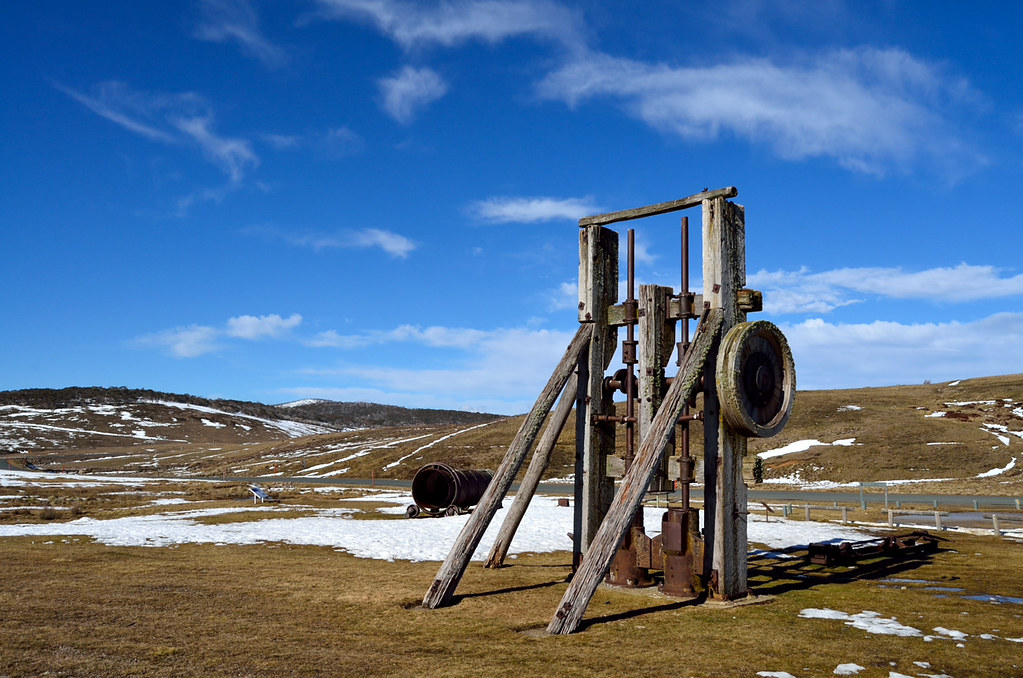
New Chum Hill Ruins

Remnants of Kiandra gold mine at New Chum Hill, #nsw #australia

May 04, 2009

Gadgets & Gizmos

Germans love technology. You will find the use of technology everywhere and there is a tendency to introduce more and more technologies without keeping in mind that too much of it can complicate things. One of our guests came out of a city toilet (which runs a cleaning program after each visit) in panic that there was a sign that the door can open automatically after a certain time. The time (20 minute) was enough but there was something in the thought that the door is mechanically controlled and can be opened without the visitor's consent.

I was watching a TV program which was showing that sophisticated gadgets like coffee machine, car navigation units and ticket dispensers at Rail stations have become so complicated that almost everybody struggles to use them properly. The fully automatic coffee machine had a function called milk island, which the user could not find from the manual. The touch screen ticket dispensers had complicated code input systems and one user mentioned why don't you make it like the dispensers in Singapore. Every station has a button. You press it, insert money and voila! Your ticket is printed. But in Germany you have to go through many complicated menus.

The navigator had a voice recognition system which was not responding to certain words.

The bottom line is that these technologies have been incorporated without keeping in mind that most of the users are not geeks and are not comfortable with complicated menus.
The machine does not isolate man from the great problems of nature but plunges him more deeply into them. - Antoine de Saint-Exupery

April 28, 2009

Panic is Spreading Faster Than Swine Flu

Pink markers are suspect - Purple markers are confirmed or probable - Deaths lack a dot in marker - Yellow markers are negative
Swine Flu threat spreads worldwide, the panic is spreading faster than that.

If you feel you have contracted swine flu please check "Do I have Swine Flu?".

Via niman. Check for updates at Swine Flu World Map

April 26, 2009

Coping With The Heat And Load Shedding In South Asia

Heatwaves during this time of year is not uncommon for countries in South Asia. But the recent dry weather has kept sufficient rain away from the region keeping the mercury rising. And load shedding (rolling electricity blackouts) due to power crisis in several countries have made the lives of millions of people unbearable.

Last Friday (April 24, 2009) was the hottest day of this summer (with 38.5 Celsius) for Dhaka, the capital of Bangladesh. The Eastern parts of India is choking as mercury rises above 45 degree Celsius. Several deaths have been reported. Zoo officials in Patna took special measures to protect the animals from heat. There have been reports of forest fire in Nepal, and droughts in the typical rain prone areas.

The netizens are reacting strongly to this situation. Sukanya M writes in the post “United We Sweat” about the heat and the constant power cuts:

Phew. It's been unbearable.

Temperatures ranging around 40, 41, 41.8, and if we are lucky (like today), 39 degrees. Plus Humidity - according to Yahoo it is 84% today (felt like 100%). And of course power cuts everywhere and in a bizarre turn of affairs, Kolkata - Dumdum to Behala had 6-10 hours of power cut on Sunday..[..]

Here are some Twitter messages catching up the mood of common people:

calamur: Melting in the heat . #mumbai is seriously hot .

vitrag: afternoon heat, and boarding the Mumbai trains… damn it fells like stepping in the oven.

Amit Varma at The India Uncut jeers:

It’s so hot in Bombay… … that when I heat food in my microwave, it comes out colder.

In Bangladesh people are suffering badly because of heat wave and frequent rolling blackouts. Most people do not have air-condition at home; they use electric fans, which are useless during power cuts. Those who can afford to use power inverters do not get enough electricity to recharge the units. Worse, there is not enough electricity to run the water pumps. The water crisis has grown acute and people are protesting against the water shortage.

From Twitter:

dkhall44: Load shedding now at ridiculous levels in Dhaka. Electricity supply is cut for one hour every other hour. And its *38* degrees.

shahreaz: Working from the evening sounds more realistic in Dhaka. 6 hours of load shedding during the working hours do not make sense.

The power authorities have put up schedules of power outages online. Bernie Allen at Life & work in Dhaka city writes about the cause of the power outages in Dhaka:

Typical demand is 2000MW and one day this week we were allocated 1200W, so the shortfall had to be managed.

In Nepal, the power crisis has become a bit better. From an average of 14-16 hour load shedding a day the duration has come down. From Twitter:

zickme: Country facing an Electricity crisis and to over come this Nepal Electricity Authority (NEA) has imposed a 12 hrs load shedding each day.

Geshan's blog posts the load shedding schedule of Kathmandu showing the plights of the people.

The residents of Karachi city in Pakistan are facing unannounced power outages of 8 to 10 hour everyday. Pakistan Daily Photo posts pictures of how people are tackling the unbearable heat which is increasing day by day.

South Asia has seen much worse heatwaves than this. But the power crisis has really crippled peoples ability to cope with it. Until the rains bring some respite people will continue to suffer.

From Dhaka, battered by the heat, Blogger Kowshik is sarcastic [bn]:

সরকারের এখন বিদ্যুৎ এর বদলে বৃষ্টি উৎপাদনের চেষ্টা করা উচিত

The government should try to produce rains instead of electricity.

Even if it sounds imprudent, in this situation the people of South Asia cannot ignore this idea.


This was first published in Global Voices Online

April 25, 2009

Leaning House At Cambridge

Displaying a friend's Brightkite feed:

Leaning living.

dsasaki @ Western Ave & Gilmore St, Cambridge, MA 02139, United States - about 21 hours ago - via iphone

April 22, 2009

World Digital Library

The World Digital Library has been officially inaugurated today:

(It) has started small, with about 1,200 documents and their explanations from scholars in Arabic, Chinese, English, French, Portuguese, Spanish and Russian. But it is designed to accommodate an unlimited number of such texts, charts and illustrations from as many countries and libraries as want to contribute.

There is not much on Bangladesh now. But the Bengali readers may be interested in this:


Memoirs of the Revolution in Bengal, anno Dom. 1757 by William Watts

This work by William Watts (active 1737-58) is an account of the Battle of Plassey, which took place on June 23, 1757, near the village of Pâlāshir, some 150 kilometers north of Calcutta (present-day Kolkata). In this decisive encounter, the forces of the British East India Company, under Robert Clive, defeated Siraj Ud Daulah, the last independent Nawab of Bengal. The British victory and the treaty with the Moghul Empire that ensued brought the province of Bengal and its great wealth under the control of the company, thereby establishing the basis for the expansion of British control in the rest of India. The French East India Company (La Compagnie des Indes Orientales) supported the nawab, and his defeat hastened the elimination of French influence in India. The “Meer Jaffeir” referred to in the title is Mir Jafar, one of Siraj-ud-Daulah's military commanders, who betrayed his leader and helped to cause the defeat. The British East India Company later selected Mir Jafar as its puppet ruler in Bengal.

You can read the 161 page pamphlet (published in 1760) online.

April 17, 2009

Let us get the record straight

From the Daily Star:
Foreign Minister Dipu Moni today said Bangladesh is not a moderate Muslim country as dubbed by foreigners but a secular country with a majority population of Muslims.

"We achieved our independence through an armed revolution with a dream to establish a non-communal country," Dipu Moni added.

The minister said many countries were termed with different labels but it is not necessary to take other's indication when it contradicts the fundamental values, she said.

"So the concept of moderate Muslim democratic country is not applicable here,"

Kudos to FM for telling the truth with guts. We have seen that the politicians like to use religious labels as a strategical ploy. But at last somebody had the guts to spell out the spirit of our liberation war - to be free from communalism.

Bijli strikes Bangladesh!

Image courtesy Earth Snapshot

According to the previous prediction weather system "Bijli" gained strength to be a Tropical cyclonic storm is and rushing into Bangladesh's Southern shores, packing winds up to 90 kph. Warning signals have been raised by the authorities (more in BD News24).

People in Bangladesh has been complaining about extreme heat. The warm sea temperature is a bit to bother. Remember cyclone Nargis which striked Myanmar last year? It gained its energy due to warm ocean temperature:
Cyclones thrive on warm layers of ocean water that are at least 26 degrees Celsius (79 degrees Fahrenheit). As they traverse the ocean, they typically draw deep, cold water up to the ocean surface, a process that limits their ability to strengthen, and even weakens them as they evolve.

The satellite pictures are showing that it will make a landfall in the Chitatgong and Cox's Bazar region onto Myanmar:

Image courtesy NOAA


Update: TV channels are reporting that people are being evacuated as heavy rain and gusty winds increased in coastal lines. The landfall is expected during early morning of Saturday. BRAC blog reports:
Cyclone Bijli has hit land in Bangladesh as a category 1 storm. BRAC is currently monitoring Cyclone Bijli and all teams are prepared to respond. We have been coordinating closely with the Bangladeshi government and will continue to track the progress of the Cyclone.


Update II: Latest pictures of Bijli from Joint Typhoon Warning Center:


Update III: Thanks God Bijli did not do significant damage. According to BDNews24.com:

* At least five people, including two children, were killed (mostly due to lightening and tree fall)
* Reports were received of over 600 houses and about 650 hectares of cropland being damaged
* Thousands of mud-and-thatch homes were destroyed.
* Cyclone Bijli turned into a land depression early Saturday morning after striking the Chittagong-Cox's Bazar coastline overnight with winds of up to 100 kph.
* Chittagong seaport was up and running again from morning.Chittagong airport, which had also been closed the previous night, was operating again from 8am.


Live Twitter messages: